Four of Swords and Five of Pentacles Tarot as Feelings
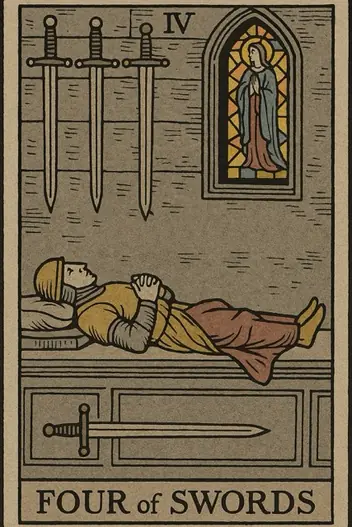
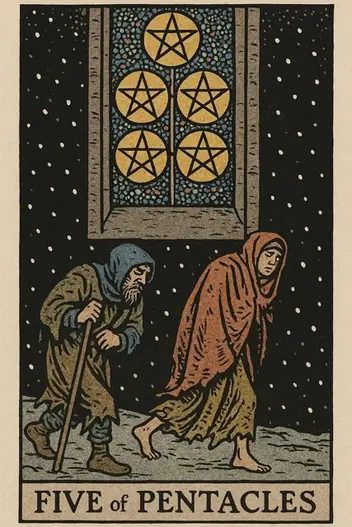
- Arcana
- Four of Swords — Minor Arcana, Swords; Five of Pentacles — Minor Arcana, Pentacles
- Elements
- Four of Swords — Air; Five of Pentacles — Earth
- Elemental interaction
- Opposing elements — energies create tension
- Numerology
- 4 + 5 = 9
When the Four of Swords—a card of mental rest, isolation, and recuperation—collides with the Five of Pentacles—a card of material lack, social exclusion, and spiritual poverty—we witness a powerful psychological paradox. On the surface, this pairing appears to signal a double blow: you are both mentally exhausted and materially strained. However, from a Jungian perspective, this combination represents a critical threshold moment. The psyche is forcing a pause precisely when external circumstances feel most precarious.
The strategic intersection here is not about panic, but about controlled hibernation. The Five of Pentacles warns of a real or perceived scarcity in resources—money, support, or belonging. The Four of Swords offers the only viable response: stop struggling, conserve energy, and analyze the situation from a detached, almost clinical distance. This is not giving up; it is strategic disengagement to prevent further loss. The core challenge is to differentiate between a necessary retreat to heal and a self-imposed exile born from shame or fear.
Core Dynamics & Interpretation
The psychological state created by this merging is one of defensive withdrawal under duress. You are likely experiencing a high degree of cognitive dissonance: your mind (Four of Swords) knows you need rest, but your ego (reacting to the Five of Pentacles) screams that you cannot afford to stop. This internal conflict generates anxiety, insomnia, or a feeling of being "stuck" between a rock and a hard place. The key insight is that your survival instinct is misdirected. The Five of Pentacles triggers a fight-or-flight response to a perceived lack, but the Four of Swords insists that the only path to survival is stillness.
In real-world terms, this often manifests as a person who has overworked themselves into burnout, only to face a financial setback or a loss of social standing. The mind wants to collapse, but the environment demands output. The correct interpretation is to treat this as a triage situation. You must prioritize your mental and physical health (Four of Swords) as the foundational resource. Without it, you cannot solve the material problems (Five of Pentacles). This pair suggests that your most valuable asset right now is your ability to think clearly, not your ability to hustle harder. The pragmatic advice is to create a strict, temporary isolation period to rebuild your cognitive reserves, even if it means accepting a short-term reduction in income or social activity.
Love and Relationships
If you are single:
This combination suggests you are evaluating potential partners from a place of emotional exhaustion. You may be projecting your own feelings of lack (loneliness, financial insecurity) onto others, seeing them as either a savior or a threat. Pause before committing to any new connection. Your judgment is clouded.
If you are in a relationship:
The dynamic likely involves one partner feeling drained and needing space (Four of Swords) while the other feels abandoned or neglected (Five of Pentacles). This is a classic cycle of emotional withdrawal and protest. Avoid blaming each other for the lack of connection.
The relationship interpretation here is less about romance and more about survival dynamics. The Five of Pentacles can represent a shared sense of hardship—financial trouble, social isolation, or feeling "out in the cold" together. The Four of Swords warns that you cannot fix the relationship from a place of depletion. Bold key relationship advice: Do not try to "solve" your partner's problems or your own loneliness through more emotional labor. Instead, establish a temporary truce: agree on a specific period of quiet, low-demand coexistence. Use this time to rest individually, not to repair the bond. The psychological danger is emotional co-dependency, where one person's exhaustion fuels the other's insecurity. The pragmatic step is to set a clear boundary: "I need 48 hours of minimal interaction to reset. We will talk about the budget/household issues after that." This respects both the need for rest and the reality of the material situation.
Your pair is already on the table. Ask your question and draw the clarifying card
or simply focus on it
Career and Finances
Strategic Opportunities:
Use this period to audit your expenses and income streams. The Five of Pentacles often reveals hidden leaks or unnecessary costs. This is a prime time for budget restructuring.
Strategic Opportunities:
Focus on high-value, low-energy tasks. Delegate, automate, or postpone everything else. Your energy is your most limited currency right now.
Calculated Risks:
Avoid making major career changes or investment decisions. The combination of mental fatigue and perceived scarcity is a recipe for poor judgment. Do not quit your job out of desperation.
This pairing is a powerful signal for professional triage. In a career context, the Five of Pentacles might indicate a pay cut, a missed promotion, or being overlooked. The Four of Swords advises you to not react immediately. Do not send that angry email, do not accept a counteroffer out of fear, and do not burn bridges. Instead, view this as a strategic timeout. Bold important financial warning: The biggest risk is "scarcity thinking"—making decisions from a place of fear that actually create more lack. For example, taking a high-interest loan to cover a shortfall, or accepting a demeaning role because you feel you have no options. The pragmatic action is to create a 30-day "observation period" where you only monitor your finances and mental state without making any binding moves. Use this time to update your resume, network quietly, or learn a new skill, but do not execute until your mind is clear.
Uncover hidden insights
Let our advanced Tarot system interpret these archetypes specifically for your personal path.
Reversed Positions: What Changes?
Four of Swords Reversed:
This indicates restless rest or resistance to healing. You are ignoring the signals from your body and psyche that call for a pause. Instead of recovery, you are expending your last reserves on "activity for activity's sake." Advice: force yourself to stop. Even 24 hours of complete disconnection from work and social media will shift your perspective.
Five of Pentacles Reversed:
This is a paradoxical improvement. The fear of loss fades, but may be replaced by apathy or a refusal to fight. You stop worrying about money, but risk sliding into inaction. Warning: do not confuse humility with surrender. This is a chance to begin recovery without panic.
BOTH reversed:
Complete imbalance. You are simultaneously unable to rest and unable to see a way out of the crisis. This is a state of "freeze" — the most dangerous scenario. Corrective measure: external support. You critically need a coach, psychologist, or mentor to break you out of this cycle. It is nearly impossible to escape this loop on your own.
Four of Swords and Five of Pentacles: Warning Signs
The shadow side of this combination is self-sabotaging isolation. The seeker may use the need for rest (Four of Swords) as an excuse to avoid confronting the painful reality of their situation (Five of Pentacles). This leads to learned helplessness—a cognitive bias where you believe you are incapable of changing your circumstances, so you stop trying. Alternatively, the shadow can manifest as martyrdom complex: you may unconsciously enjoy the narrative of being the "poor, exhausted victim" because it absolves you of responsibility. Another pitfall is paralysis by analysis: you rest so long, thinking and planning, that you never take the necessary action to leave the cold. The psychological trap is confusing "rest" with "retreat." Rest is regenerative; retreat is defensive. If you find yourself feeling shame or guilt during this period, or if you are using the cards to justify inaction, you have slipped into the shadow. The key is to set a strict timeline for your withdrawal. For example: "I will rest for exactly three days. On day four, I will take one small action to address my material lack."
What Is the Overall Message of Four of Swords and Five of Pentacles?
Constructive use of this combination requires disciplined acceptance of reality. The energy of the Four of Swords should be directed not toward escaping the world, but toward conscious restoration. The Five of Pentacles is not a verdict, but a signal that your previous resource-acquisition strategy has failed. Acknowledge this without self-flagellation.
Deep strategic advice:
Divide your life into two parallel trajectories. The first is a "survival mode" for the next 30 days: minimize expenses, sleep 8 hours, decline all non-essential commitments. The second is a "new start strategy": begin learning one new skill or seeking one new income channel that does not require significant energy expenditure. The balance between rest and micro-actions is the only way to break the cycle of scarcity.
Remember: The Four of Swords grants you permission to rest, but not to surrender. The Five of Pentacles demands a reassessment of what "enough" means to you. The answer lies not in money, but in restoring a sense of self-worth that does not depend on external circumstances.
Where to Go From Here
The core message of the Four of Swords and Five of Pentacles is this: You are not broken; you are depleted. The feeling of lack is real, but it is a temporary signal, not a permanent identity. Your primary task is to protect your mental clarity as your most vital resource. Once you have rested, you will see that the door is not locked—you just need the energy to open it. This is not a time for grand gestures, but for small, precise, and deliberate steps.
While this analysis provides a deep understanding of the archetypes, the true power of Tarot lies in its application to your specific life. Your unique question, your personal history, and the other cards in your spread change everything. Do not settle for generic advice. Download the Fortune Cards app on the web or your device to get a personalized, AI-driven interpretation of this exact combination for your question right now. Discover the specific path out of the cold that is tailored only for you.
Interpretation by the Fortune Cards editorial team, based on the Rider–Waite tradition and Jungian archetypes. About our methodology · Updated: 2026-08-26
Other Combinations with Four of Swords
Other Combinations with Five of Pentacles
Explore Individual Card Meanings
Ready to find answers to your questions?
Start your first reading now and look at your situation with fresh clarity. The cards are ready to reveal deeper meaning.