Love Tarot: Four of Wands and Seven of Cups
- Arcana
- Four of Wands — Minor Arcana, Wands; Seven of Cups — Minor Arcana, Cups
- Elements
- Four of Wands — Fire; Seven of Cups — Water
- Elemental interaction
- Opposing elements — energies create tension
- Numerology
- 4 + 7 = 11 → 2
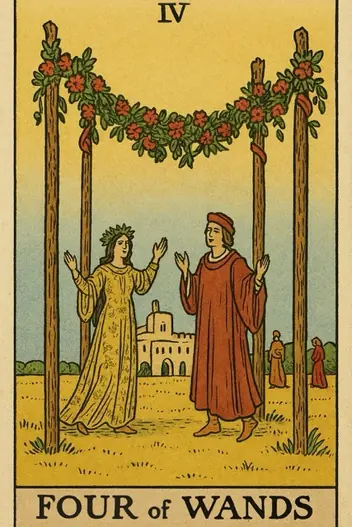
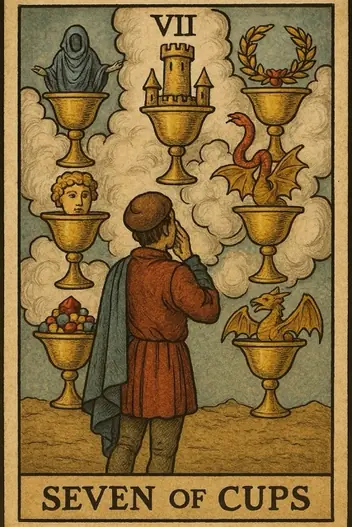
The intersection of the Four of Wands and Seven of Cups presents a fascinating psychological tension. The Four of Wands represents concrete stability, celebration, and a secure foundation—a home built, a milestone reached, or a relationship solidified. In contrast, the Seven of Cups embodies the realm of illusions, multiple possibilities, and wishful thinking—the mind flooded with fantasies, temptations, and choices that may not be grounded in reality.
When these two archetypes collide, you are standing at a crossroads where established security meets seductive possibility. The question is not whether you can have more, but whether you can distinguish between what is real and what is merely a projection of your desires. This combination demands pragmatic discernment: you must evaluate whether the new opportunities appearing before you will enhance your foundation or simply distract you from it. The psychological risk here is confusing emotional excitement with genuine progress.
Core Dynamics & Interpretation
The core dynamic of the Four of Wands and Seven of Cups is the conflict between substance and fantasy. The Four of Wands grounds you in tangible achievements—a stable home, a committed relationship, or a successful project. It represents the satisfaction of having built something real. The Seven of Cups, however, introduces a cascade of options, daydreams, and potential pitfalls. You may find yourself feeling restless despite having what you once wanted, or you may be tempted to abandon a solid situation for an alluring but unproven alternative.
Psychologically, this pairing activates the Jungian archetype of the Puer Aeternus (eternal child) —the part of us that avoids commitment in favor of endless possibility. You might experience a cognitive bias known as the "grass is greener" syndrome, where you overvalue what you don't have and undervalue what you do. The strategic response is to perform a reality check: list the tangible benefits of your current foundation, then objectively evaluate each new option's feasibility. Do not confuse novelty with improvement. The healthiest outcome requires you to integrate the stability of the Four with the vision of the Seven—use your imagination to enhance your foundation, not to escape it.
What Do Four of Wands and Seven of Cups Say About Love?
If you are single:
This combination warns against idealizing a potential partner before you have enough data. Emotionally, you may be projecting a fantasy onto someone who has not yet proven themselves reliable. Focus on actions, not promises.
If you are in a relationship:
You may be tempted to compare your partner to an imaginary ideal or to entertain the idea of another option. This is a test of your commitment to the real person in front of you.
In love, the Four of Wands and Seven of Cups together suggest a critical moment of decision. If you are in a relationship, the foundation is solid, but your mind may be wandering into dangerous territory. You might feel bored or undervalued, but the Seven of Cups often exaggerates the appeal of what you don't have. The key relationship advice here is to communicate your dissatisfaction directly rather than escaping into fantasy. Ask yourself: "Is the problem real, or am I romanticizing an alternative?" If you are single, resist the urge to build a castle in the air with someone you barely know. Take time to see if their actions match your ideal. Emotional intelligence means distinguishing between genuine compatibility and your own unmet needs projected onto a stranger.
Your pair is already on the table. Ask your question and draw the clarifying card
or simply focus on it
Career Meaning of Four of Wands and Seven of Cups
Strategic Opportunities:
Use your current career stability as a launchpad for calculated experimentation. Your foundation allows you to explore side projects or new skills without risking everything.
Strategic Opportunities:
Leverage your network and reputation (Four of Wands) to vet the credibility of new offers or partnerships. Trusted colleagues can help you separate real opportunities from distractions.
Calculated Risks:
Avoid making a major financial commitment based on a "get-rich-quick" scheme or an unverified promise. The Seven of Cups is notorious for indicating scams, overhyped ventures, or unrealistic projections.
From a career perspective, this combination signals a time of tempting options but high risk of misallocation of resources. You may be presented with multiple job offers, investment opportunities, or entrepreneurial ideas. The wise financial strategy is to apply the "test before trust" principle: gather concrete data, run small experiments, and do not invest significant capital or time until you have proof of concept. Beware of shiny object syndrome—the Seven of Cups can make a mediocre opportunity look irresistible. Your strongest move is to double down on your current strengths while cautiously exploring one new avenue at a time. Do not spread yourself thin across five fantasies; focus on the one that aligns with your core values and existing resources.
Your unique Tarot reading
See how these cards interact with your destiny. Start a free personal reading now.
Reversed Four of Wands and Seven of Cups Explained
The Reversed Four of Wands indicates blocked potential or a crisis within an already achieved stability. You may feel that the "home" (relationship, business) is crumbling, but you don't understand the reasons. Paired with the Seven of Cups, this creates a toxic pattern of "escapism into illusions" — instead of repairing the foundation, you start dreaming of moving to a "castle in the clouds." Advice: acknowledge that the base is cracking at the seams, and focus on repairing it, rather than searching for a new platform.
The Reversed Seven of Cups represents internal resistance and a fear of choice. You see the options, but are paralyzed by the fear of making a mistake. Combined with the upright Four of Wands, this creates a "gilded cage" syndrome: you have everything you need for happiness, but you are afraid to take a step toward realizing it. Advice: use the "minimum test" method. Choose one of the options and try it for two weeks without any commitment. This will relieve anxiety and provide real data for analysis.
If BOTH cards are reversed, a complete imbalance of dynamics arises. You have simultaneously lost stability (Four of Wands) and the capacity for conscious choice (Seven of Cups). This is a state of "cognitive collapse": everything seems meaningless, and the future feels foggy. A logical way to correct this: reduce the number of variables to one. Give up all side projects and social obligations for a month. Focus on basic needs (sleep, food, one key project). Restore the foundation before looking at the "showcase of possibilities" again.
Four of Wands and Seven of Cups: Warning Signs
The shadow side of this pairing is self-sabotage through indecision and escapism. You may have built something genuinely good—a stable career, a loving home, a reliable routine—yet the Seven of Cups whispers that you are missing out. This can trigger a cognitive bias known as the "hedonic treadmill," where you constantly seek more because you fail to appreciate what you have. The result is chronic dissatisfaction, procrastination on important commitments, or even abandoning a solid foundation for a mirage.
Alternatively, the shadow can manifest as paralysis by analysis. With so many options, you may freeze, unable to choose any path. This is often a defense mechanism against the fear of making the wrong decision. The pitfall is that you end up with nothing, while your foundation crumbles from neglect. Poor judgment here often stems from conflating "possibility" with "probability." Just because something is possible does not mean it is likely or wise. The most dangerous move is to leave a sure thing for a fantasy without a risk-mitigation plan.
Four of Wands and Seven of Cups Combined Message
The key to working with this combination is discipline of focus. The Four of Wands provides you with a resource (time, money, status), but the Seven of Cups tries to dissipate that resource. Your task is to build a "mental filter" that will screen out 90% of options as noise.
Strategic algorithm of action:
First, conduct an audit of your "anchors." What in your life is truly stable and brings you satisfaction? Write it down. Second, from the 7 illusory desires of the Seven of Cups, choose one that does not destroy your anchors. For example, if you have a stable job (Four of Wands), do not quit for a startup, but launch it as a side project. Third, introduce the 72-hour rule: if 3 days after an idea arises you still consider it valuable, create a plan for its implementation. Otherwise, discard it.
For decision-making, use the "Cost of Error" framework. Ask: "What will I lose if this option turns out to be a failure?" If the price is the destruction of your current stability (Four of Wands), reject it. If the price is only your time and a small amount of money, test it. Deep strategic advice: do not try to "catch all the hares." It is better to scale one successful project by 200% than to launch three ill-conceived ones. In this context, the Four of Wands is not a cage, but a platform for a leap. But the leap must be calculated, not impulsive.
Applying This to Your Situation
The core message of the Four of Wands and Seven of Cups is this: Your foundation is real, but your fantasies are not. Use your imagination to enhance, not replace, what you have built. The path forward requires discipline, reality-testing, and the courage to say "no" to shiny distractions. You have the stability to explore—but only if you keep one foot firmly planted on solid ground.
While this article provides a general archetypal analysis, the true power of Tarot comes from applying it to your unique life. To get a deep, personalized interpretation of this exact combination for your specific question, use the Fortune Cards app. Whether you access it on the web or download it, the app will guide you through a tailored reading that considers your current context, emotional state, and strategic needs. Don't settle for generic advice—get the clarity you need to make your next move with confidence.
Interpretation by the Fortune Cards editorial team, based on the Rider–Waite tradition and Jungian archetypes. About our methodology · Updated: 2026-08-26
Other Combinations with Four of Wands
Other Combinations with Seven of Cups
Explore Individual Card Meanings
Table of Contents
- Core Dynamics & Interpretation
- What Do Four of Wands and Seven of Cups Say About Love?
- Career Meaning of Four of Wands and Seven of Cups
- Reversed Four of Wands and Seven of Cups Explained
- Four of Wands and Seven of Cups: Warning Signs
- Four of Wands and Seven of Cups Combined Message
- Applying This to Your Situation
Ready to find answers to your questions?
Start your first reading now and look at your situation with fresh clarity. The cards are ready to reveal deeper meaning.