Love Tarot: Seven of Cups and Ten of Swords
- Arcana
- Seven of Cups — Minor Arcana, Cups; Ten of Swords — Minor Arcana, Swords
- Elements
- Seven of Cups — Water; Ten of Swords — Air
- Elemental interaction
- Neutral elements — energies coexist without conflict
- Numerology
- 7 + 10 = 17 → 8
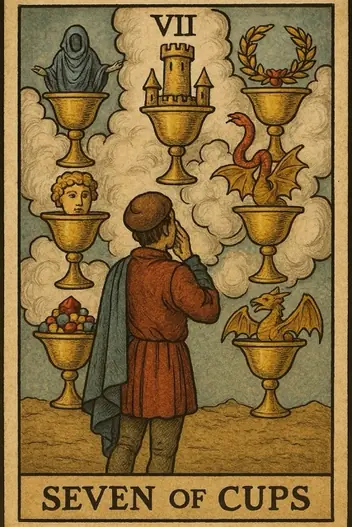
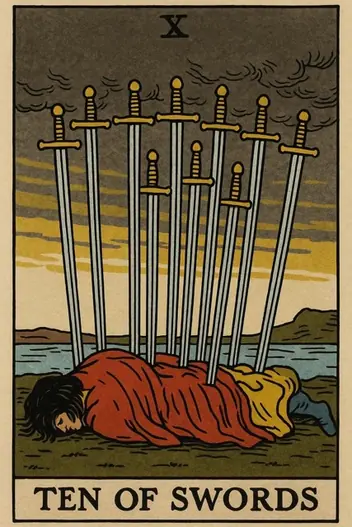
The Seven of Cups represents a state of unbounded imagination, wishful thinking, and the allure of multiple possibilities. It is the card of the inflated ego, where desires are projected outward without a grounded reality check. The Ten of Swords, in stark contrast, signifies the climax of a painful mental pattern—a definitive end, a betrayal, or a crisis that forces a brutal awakening. When these two cards appear together, the message is clear: the castles you’ve built in the air are about to collapse under the weight of reality.
This combination is not a warning of external disaster but an internal psychological audit. It describes a moment when the mind’s ability to fantasize (Seven of Cups) has led to a self-inflicted crisis (Ten of Swords). The seeker may have been ignoring red flags, over-idealizing a person or situation, or chasing a mirage. The Ten of Swords delivers the painful but necessary truth: this fantasy cannot survive. The only way forward is to accept the ending and learn to distinguish between a genuine opportunity and a seductive illusion.
Core Dynamics & Interpretation
The core dynamic here is a collision between desire and consequence. The Seven of Cups represents the shadow of the Puer Aeternus—the eternal child who avoids commitment and reality by chasing novelty. The Ten of Swords represents the crash of that avoidance. Psychologically, the seeker is experiencing cognitive dissonance: they held onto a fantasy so strongly that the inevitable failure feels like a betrayal from the universe. In truth, it is a betrayal of their own judgment.
This pair forces the seeker to confront the cost of indecision. The Seven of Cups offers many paths, but when combined with the Ten of Swords, it reveals that choosing nothing is itself a choice—and it often leads to a painful, unavoidable end. The key insight is that this ending is not random; it is the direct result of refusing to ground one’s desires in practical action. The Ten of Swords is not a punishment but a diagnosis: your fantasies have become a liability. To move forward, you must kill the illusion, not yourself.
The pragmatic takeaway is that recovery requires ruthless self-honesty. The seeker must identify which of their desires were realistic and which were escapist. The Ten of Swords offers a clean break—a chance to reset. But only if the seeker stops mourning the fantasy and starts analyzing the pattern that led to this collapse. This is a moment for cold, clear thinking, not more dreaming.
What Do Seven of Cups and Ten of Swords Say About Love?
If you are single:
This combination warns against projecting a fantasy onto a new person. You may be attracted to someone who represents an ideal, not a reality. The relationship will end abruptly if you ignore the red flags. Focus on observing actions, not potential.
If you are in a relationship:
This pair signals a toxic cycle of idealization and disappointment. One partner may be living in a fantasy about the relationship, while the other is preparing to end it. Honest, difficult conversations are non-negotiable.
In relationships, the Seven of Cups and Ten of Swords often describe a power imbalance rooted in delusion. One partner may be over-invested in a fantasy of who the other person could be, ignoring who they are. The Ten of Swords then arrives as the inevitable betrayal or breakup that shatters this illusion. The key relationship advice here is to stop rescuing or fixing. If you are the one holding onto a fantasy, recognize that your partner’s flaws are not a puzzle to solve but a reality to accept. If you are the one being idealized, set clear boundaries to prevent the other from projecting their unmet needs onto you.
This card pair also warns against staying in a relationship out of fear of being alone. The Seven of Cups can represent the fantasy of “someday” happiness, while the Ten of Swords represents the painful reality of staying too long. The healthiest move is to end the charade now, rather than waiting for a dramatic collapse. In either case, emotional intelligence requires you to see the situation as it is, not as you wish it were.
Your pair is already on the table. Ask your question and draw the clarifying card
or simply focus on it
Career and Finances
Strategic Opportunities:
Reassess your professional goals. The Seven of Cups suggests you may be chasing too many ideas. The Ten of Swords demands you cut the weakest ones to focus on what is viable.
Strategic Opportunities:
Use this crisis as a catalyst. The ending of a project, job, or financial plan is a chance to rebuild with a clearer vision. Document what worked and what didn’t.
Calculated Risks:
Avoid any new investment or partnership that promises “too good to be true” returns. The risk of scams or over-leverage is high. If it feels like a fantasy, it is.
Professionally, this combination signals a reckoning with over-optimism. The Seven of Cups represents the entrepreneurial trap of chasing every shiny idea without a solid business plan. The Ten of Swords represents the inevitable failure that follows. The strategic move is to stop brainstorming and start auditing. Review your financials, your contracts, and your time allocation. Bold financial warning: If you are considering a risky venture that relies on luck or a “miracle,” the Ten of Swords suggests you will face a sharp loss. Cut your losses now.
For those in a corporate role, this pair warns against office politics based on wishful thinking. You may believe a colleague is an ally when they are not, or that a promotion is guaranteed when it is not. Objectivity is your best tool. Ask for concrete data, not promises. The Ten of Swords also suggests a necessary ending—perhaps leaving a toxic job or abandoning a dead-end project. The pragmatic action is to create an exit strategy, not to cling to the fantasy that things will improve on their own.
Get a personalized interpretation
Unlock the combined meaning of your cards in the context of your unique question — for free.
Reversed Seven of Cups and Ten of Swords Explained
When cards appear in a reversed position, the dynamic becomes less fatal, but no less complex.
The Seven of Cups Reversed:
Illusions have already dissipated, but the person stubbornly clings to their remnants. This is a state of denial and internal resistance. Instead of acknowledging the collapse, the person seeks someone to blame or tries to "resuscitate" a dead project. Advice: stop the self-sabotage. Acknowledge that you were wrong — this is not weakness, but the first step toward liberation.
The Ten of Swords Reversed:
The blow has been struck, but it was not fatal. This is a state of chronic trauma or a protracted crisis. The person lies "pinned to the ground," but cannot find the strength to get up. This points to a deep inner weakness and an unwillingness to take responsibility for recovery. Warning: prolonging the healing process turns a crisis into chronic suffering.
BOTH Reversed:
Complete imbalance. The illusions (Seven of Cups) were not consciously lived through, and the crisis (Ten of Swords) did not lead to purification. This is a state of stagnation and disorientation. The person can neither dream nor act. Method for correction: harsh external feedback (coach, psychologist, mentor) is necessary to "activate" reality and initiate the process of conscious choice.
Seven of Cups and Ten of Swords: Warning Signs
The shadow of this combination is self-deception leading to self-destruction. The Seven of Cups, when ungrounded, manifests as grandiosity—the belief that you are special, exempt from consequences, or destined for a miracle. The Ten of Swords then becomes the punishing crash that the ego interprets as victimhood. The pitfall is to blame external circumstances rather than recognizing your own role in the fantasy. Cognitive bias alert: This is the sunk cost fallacy in action—you stay with a bad decision because you’ve invested so much, even when the evidence screams to stop.
Another shadow aspect is paralysis by analysis. The Seven of Cups offers so many options that the seeker freezes, allowing the Ten of Swords to arrive as a chosen defeat. This is passive self-sabotage: you avoid making a decision, so the decision is made for you in the worst possible way. The shadow is not the fantasy itself, but the refusal to act. Furthermore, this pair can indicate addictive patterns—chasing a high (Seven of Cups) until the crash (Ten of Swords) becomes predictable. The psychological work here is to break the cycle by introducing reality checks: ask a trusted friend for their honest opinion, or write down the worst-case scenario and plan for it.
What Is the Overall Message of Seven of Cups and Ten of Swords?
Constructive use of this combination's energy requires radical honesty with oneself. The first step is to acknowledge that your "inner narrative" about the situation has been false. The Seven of Cups tempted you with a story where you were the hero, while the Ten of Swords revealed that you were merely an extra in your own drama. Stop searching for deep meaning in the catastrophe. Ask yourself: "What specific action or inaction brought me to this point?"
The exit strategy is discipline over fantasy. You need to replace impulsive desires (Seven of Cups) with rigid procedures and rituals. If you once dreamed of great success, now focus on small, sustainable results. The Ten of Swords in its constructive aspect is not an ending, but a surgical removal of a tumor. It cuts away everything superfluous, leaving only what truly matters. Use this period as an opportunity for a "digital detox" from emotions and a return to facts.
The deep strategic advice: do not try to "replay" the past. Any attempt to return to an old illusion will end in repeating the cycle. Your task is to create a new reality, grounded in the experience of this collapse. Allow yourself to dwell in the emptiness left behind by the Ten of Swords. It is precisely this emptiness that is the fertile ground for new, but now conscious and realistic, goals. Remember: only by passing through the complete destruction of illusions can you build something authentic.
Your Next Step: Personal Context Matters
The core message of Seven of Cups and Ten of Swords is that fantasy without action leads to ruin. You are being called to end a chapter of wishful thinking and embrace the painful but liberating truth. The ending you face is not the end of your story—it is the end of a lie you told yourself. Your next step is to apply this wisdom to your specific life context, because these cards are not a verdict; they are a mirror. The way out is through ruthless self-honesty and a commitment to grounded, realistic action.
This article provides the general archetype, but the true power of Tarot lies in its application to your unique situation. Don’t guess—get clarity. The Fortune Cards app allows you to input your specific question and receive a deep, personalized interpretation of this exact combination, tailored to your career, relationship, or personal dilemma. Use the app on the web or download it now to move from abstract insight to actionable guidance for your life.
Interpretation by the Fortune Cards editorial team, based on the Rider–Waite tradition and Jungian archetypes. About our methodology · Updated: 2026-09-24
Other Combinations with Seven of Cups
Other Combinations with Ten of Swords
Explore Individual Card Meanings
Table of Contents
- Core Dynamics & Interpretation
- What Do Seven of Cups and Ten of Swords Say About Love?
- Career and Finances
- Reversed Seven of Cups and Ten of Swords Explained
- Seven of Cups and Ten of Swords: Warning Signs
- What Is the Overall Message of Seven of Cups and Ten of Swords?
- Your Next Step: Personal Context Matters
Ready to find answers to your questions?
Start your first reading now and look at your situation with fresh clarity. The cards are ready to reveal deeper meaning.