The Hanged Man and Six of Wands Meaning in Tarot
- Arcana
- The Hanged Man — Major Arcana; Six of Wands — Minor Arcana, Wands
- Elements
- The Hanged Man — Water; Six of Wands — Fire
- Elemental interaction
- Opposing elements — energies create tension
- Numerology
- 12 + 6 = 18 → 9
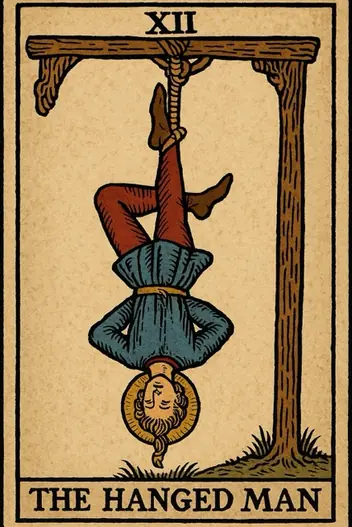
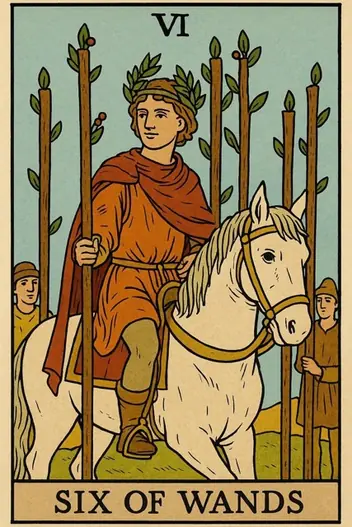
What happens when the archetype of voluntary sacrifice meets the archetype of public victory? This combination suggests a paradoxical path: you must pause, reflect, or surrender a previous goal to achieve a meaningful win. The Hanged Man represents a state of cognitive restructuring—seeing from a new perspective—while the Six of Wands signals social recognition and validated effort. Together, they indicate that true success requires a deliberate pause to reassess your strategy, values, or motivations.
In practical terms, this pairing warns against chasing quick wins without first resolving internal conflicts. The Hanged Man’s suspension is not punishment but a strategic retreat; the Six of Wands’ victory is not hollow but earned through patience. For the seeker, the key question becomes: What am I willing to suspend or sacrifice to achieve lasting acclaim?
The Hanged Man and Six of Wands Card Meaning Explained
The psychological interplay here is one of delayed gratification versus immediate reward. The Hanged Man asks you to step back from your ego’s need for applause and examine the deeper motives behind your actions. This is Jungian active imagination in action—you must integrate the shadow of impatience or pride before stepping into the spotlight. The Six of Wands, in turn, rewards this introspection with authentic recognition, not fleeting praise.
This combination often appears when you are on the verge of a breakthrough but feel stuck. The Hanged Man’s energy suggests that the “stuckness” is actually a necessary incubation period. Your brain is reorganizing information, challenging assumptions, and forming a new mental model. Once this internal work is complete, the Six of Wands’ energy propels you forward with clarity and momentum. Avoid forcing results—instead, trust the process of strategic stillness.
A key takeaway: Victory without reflection is fragile. The Hanged Man ensures your success is built on solid psychological ground, while the Six of Wands confirms that your efforts will be seen. However, beware of the temptation to skip the introspection phase. Rushing to claim the Six of Wands’ laurels without the Hanged Man’s perspective can lead to hollow victories that crumble under scrutiny.
Your pair is already on the table. Ask your question and draw the clarifying card
or simply focus on it
The Hanged Man and Six of Wands for Career and Money
Strategic Opportunities:
Take a sabbatical or pause a major project to reassess your career trajectory. This pause can reveal a more authentic path to recognition.
Strategic Opportunities:
Accept a behind-the-scenes role temporarily. Your contributions will be noticed and appreciated later.
Calculated Risks:
Avoid publicizing a win too early. Premature celebration can attract jealousy or scrutiny that undermines your long-term goals.
Professionally, this combination signals that a temporary sacrifice of visibility can lead to greater authority. If you are seeking a promotion, the Hanged Man suggests you may need to volunteer for a less glamorous task that builds essential skills. The Six of Wands promises that your competence will be recognized, but only after you prove your dedication through quiet, consistent effort.
Financially, be cautious of impulsive spending to appear successful. The Hanged Man warns against using money to buy status. Instead, invest in education or restructuring your finances (e.g., refinancing debt, reorganizing investments). The Six of Wands rewards this patience with steady, sustainable growth. A key warning: Do not loan money to impress others—this combination often appears when someone is tempted to play the “rescuer” role, which leads to resentment.
Ask your specific question
Don't rely on generic meanings. Get a customized reading tailored specifically to your energies.
The Hanged Man and Six of Wands in Love and Relationships
If you are single:
This pairing suggests that a potential partner may seem “unavailable” or distant, but this pause is actually a test of your patience and authenticity. Focus on understanding your own needs before pursuing them.
If you are in a relationship:
A period of emotional withdrawal or role reversal may be necessary to reset power dynamics. This is not rejection but a chance to see your partner from a new angle.
In relationships, the Hanged Man and Six of Wands often indicate a necessary sacrifice for mutual growth. One partner may need to temporarily step back from leading or seeking validation to allow the other to shine. This is not about martyrdom but about strategic ego management. For example, if you feel unappreciated, the Hanged Man asks you to stop seeking external approval and instead examine your own self-worth. The Six of Wands then rewards this inner shift with renewed admiration from your partner.
Key relationship advice: Avoid competing for the spotlight. Instead, practice “suspending” your need to be right or to be praised. This creates space for genuine connection. If conflict arises, use the Hanged Man’s perspective to reframe the argument as an opportunity to understand each other’s core values. The Six of Wands’ victory here is not about winning an argument but about building a stronger foundation.
Negative Meaning of The Hanged Man and Six of Wands
The shadow of this pairing manifests as martyrdom without purpose or victory without integrity. You may become stuck in the Hanged Man’s suspension, using “reflection” as an excuse for procrastination or avoidance of responsibility. This leads to missed opportunities and a sense of being overlooked. Alternatively, the Six of Wands’ energy can become narcissistic triumph—you achieve recognition but at the cost of betraying your values or relationships.
Cognitive biases to watch for:
The sunk cost fallacy (staying in a bad situation because you’ve already invested time) and the spotlight effect (overestimating how much others notice your struggles). The Hanged Man can also trigger learned helplessness if you believe sacrifice is the only path to reward. The antidote is active decision-making—choose your suspension consciously, not out of fear.
The Hanged Man and Six of Wands Reversed: How to Read It
Reversed cards shift the paradox into conflict.
The Hanged Man Reversed:
The sacrifice was either futile or unconscious. You are either refusing to let go of a situation, or you have already given up but gained no insights. This is a state of "stagnation" without development. Instead of triumph, there is disappointment. Advice: Urgently stop doing what yields no results and acknowledge the strategic error.
The Six of Wands Reversed:
You have received recognition, but have not undergone an inner transformation. The "success" has slid into ego and hubris. You are boasting about a result you did not earn, or you do not appreciate the path that led to it. Risk: Rapid loss of reputation. Advice: Return to the stage of the Hanged Man and honestly assess the cost of this victory.
BOTH Reversed:
Complete imbalance. The person is simultaneously sacrificing themselves incorrectly and receiving no recognition. This is the scenario of "the forgotten hero." The logical way to correct this is a complete halt. Stop seeking external approval and cease self-flagellation. Start from scratch, with a new strategy.
Overall Meaning of The Hanged Man and Six of Wands
Constructive use of the Hanged Man and the Six of Wands energy requires a conscious choice of the moment to pause and the moment to act. You cannot remain perpetually in the victim position, just as you cannot endlessly celebrate victory. Your task is to learn to discern when a pause is a strategic necessity, not procrastination.
Strategic advice: use the "bifurcation point" method. When you feel stuck (the Hanged Man), ask yourself: "Is this helplessness or a reset?" If it is a reset, set clear time frames (e.g., one month) and exit criteria. As soon as you have formulated a new understanding—act immediately, like the Six of Wands: declare yourself, present the result, demand recognition.
This union teaches that true power lies not in never falling, but in being able to turn a pause into a springboard. You are neither a victim of circumstances nor a lone hero. You are a strategist who understands that sometimes you must "die" to the old in order to be reborn in a new, more successful capacity. Only in this way can sustainable, rather than illusory, success be achieved.
Where to Go From Here
The Hanged Man and Six of Wands together teach that true recognition follows intentional stillness. Your next step is to identify one area where you are rushing toward a goal without pausing to ask why. Is this about genuine achievement, or is it about validation? By suspending your ego’s demands, you create space for a victory that aligns with your deeper values.
For a personalized interpretation of how this combination applies to your unique question—whether in love, career, or personal growth—use the Fortune Cards app. This article provides the general archetype, but the app’s AI-driven analysis tailors the meaning to your specific situation, offering actionable steps and psychological insights. Available on the web or for download, Fortune Cards turns this theoretical knowledge into a practical tool for your life right now.
Interpretation by the Fortune Cards editorial team, based on the Rider–Waite tradition and Jungian archetypes. About our methodology · Updated: 2026-08-26
Other Combinations with The Hanged Man
Other Combinations with Six of Wands
Explore Individual Card Meanings
Table of Contents
- The Hanged Man and Six of Wands Card Meaning Explained
- The Hanged Man and Six of Wands for Career and Money
- The Hanged Man and Six of Wands in Love and Relationships
- Negative Meaning of The Hanged Man and Six of Wands
- The Hanged Man and Six of Wands Reversed: How to Read It
- Overall Meaning of The Hanged Man and Six of Wands
- Where to Go From Here
Ready to find answers to your questions?
Start your first reading now and look at your situation with fresh clarity. The cards are ready to reveal deeper meaning.