Justice and Page of Cups Reversed in Tarot
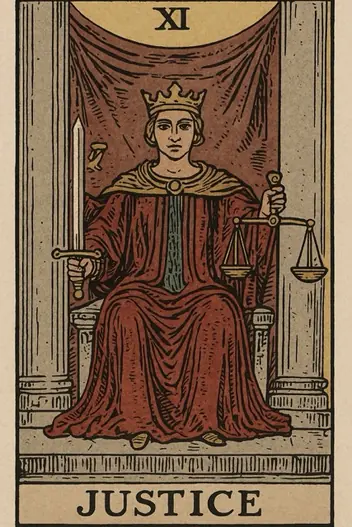

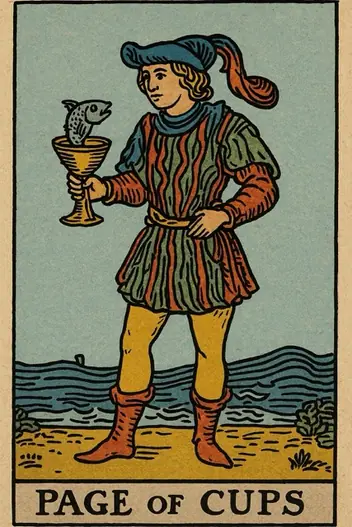
- Arcana
- Justice — Major Arcana; Page of Cups — Minor Arcana, Cups
- Elements
- Justice — Air; Page of Cups — Water
- Elemental interaction
- Neutral elements — energies coexist without conflict
- Numerology
- 11 + 11 = 22 → 4
When the scales of Justice meet the open cup of the Page of Cups, we encounter a powerful psychological intersection: the demand for objective fairness colliding with the tender, often irrational, realm of emotional intuition. This is not a card pair that offers easy comfort. Instead, it presents a strategic challenge: how do you make a rational decision when your heart is offering you a new, fragile feeling?
In real-world terms, this combination signals a moment where you must evaluate a creative idea, a relationship offer, or a personal truth with both rigorous logic and compassionate curiosity. The Page brings a "first draft" of emotional data—a crush, a hunch, a budding talent—while Justice asks, "Is this real? Is this fair? What are the consequences of acting on this feeling?" The key is to avoid dismissing the feeling as "illogical" while also refusing to let it override your objective judgment. This is about integrating the heart's truth with the mind's structure.
Justice and Page of Cups Together: Meaning
The psychological state created by Justice and Page of Cups is one of emotional accountability. You are being asked to take responsibility for your feelings, not just your actions. The Page of Cups represents the Anima/Animus archetype—the internal image of the beloved or the muse—while Justice represents the Superego—the internalized law of fairness and consequence. When these collide, you may feel a tension between what you want to feel and what you should do.
This dynamic is particularly potent for creative professionals and those in early-stage negotiations. The Page suggests a new offer, a fledgling project, or a vulnerable emotional disclosure. Justice demands that you audit the terms. Is this opportunity built on a fair exchange? Are you being asked to give more of your emotional labor than you receive in return? The core insight here is that true emotional intelligence requires a judicial review of your own desires. You must ask: "Is this feeling a genuine signal from my authentic self, or a projection of a need for validation?"
The strategic action is to create a structured process for evaluating this new emotional data. Write down the facts of the situation (Justice) and then, separately, write down the raw feeling (Page). Look for points of alignment and conflict. This is not about suppressing the feeling but about giving it a fair trial. The most sophisticated outcome is a balanced decision that honors both the truth of the situation and the truth of your heart.
Your pair is already on the table. Ask your question and draw the clarifying card
or simply focus on it
Justice and Page of Cups for Career and Money
Strategic Opportunities:
Launch a new creative project that has a clear ethical foundation. This is an excellent time to pitch an idea that aligns with your values and offers a fair exchange of value (e.g., a freelance proposal, a new product line, a grant application).
Strategic Opportunities:
Mentor a junior colleague or intern. The Page of Cups energy is about learning, and Justice suggests you have the wisdom to guide someone fairly. This builds long-term professional goodwill.
Calculated Risks:
Avoid signing a contract that feels emotionally "off," even if the terms look good on paper. The Page of Cups is warning you to trust your gut feeling about the people involved. If a client or partner makes you feel subtly manipulated, the Justice card says the fine print may not protect you.
From a career perspective, this combination is a powerful signal for ethical innovation. You are being asked to bring a new, emotionally resonant idea to the table, but you must do so with a strict adherence to fairness and transparency. In financial matters, do not make a speculative investment based on a "hunch" (Page) without a thorough audit of the risks and rewards (Justice). The most pragmatic move is to prototype your idea on a small scale first. Test the emotional waters (Page) while keeping your financial risk low (Justice). A major financial warning: be wary of "too-good-to-be-true" offers that appeal to your desire for creative fulfillment. The Page of Cups can be naive, and Justice is here to provide the necessary skepticism.
Deepen your understanding
Find out exactly what this reading means for your current life situation with our oracle.
Justice and Page of Cups as Feelings
If you are single:
This pair suggests you are evaluating a new romantic interest through a lens of fairness, perhaps after a past injustice. Do not let the fear of being hurt (Justice's shadow) cause you to prematurely close your heart (Page's shadow). Look for someone who honors both your need for clarity and your emotional vulnerability.
If you are in a relationship:
You and your partner may be navigating a new emotional disclosure or a decision that affects the balance of power. This could be about dividing household responsibilities, discussing a major life change, or healing from a past betrayal.
In relationships, Justice and Page of Cups calls for radical emotional honesty paired with structured communication. The Page brings up a new, tender subject—perhaps a desire for more affection, a creative project, or a feeling of being undervalued. Justice demands that this subject be discussed without blame or defensiveness. The key relationship advice is to create a "safe container" for these conversations. Use "I feel" statements (Page) and ask for mutual agreement on the facts (Justice). For example: "I feel a pull toward a new hobby, and I need to know if we can fairly share the time and resources for it." Avoid letting the Page's sensitivity turn into passive-aggression, and avoid letting Justice's need for fairness become a cold, legalistic argument. The goal is a verdict of mutual understanding, not a winner and a loser.
Negative Meaning of Justice and Page of Cups
The shadow of Justice and Page of Cups manifests as emotional legalism or sentimental self-deception. On one hand, you may use the Justice card's logic to intellectualize and dismiss a genuine emotional need. You might tell yourself, "It's not logical to feel this way," or "I don't deserve this opportunity," thereby blocking the Page's vulnerable gift. This leads to emotional constipation and missed opportunities for growth.
On the other hand, the Page of Cups' shadow can cause you to romanticize a situation and ignore the warning signs. You might believe that "love conquers all" or that "this creative idea is destined to succeed," skipping the necessary due diligence that Justice demands. This is a classic cognitive bias known as the "halo effect" —letting one positive feeling (the Page's excitement) cloud your judgment of the entire situation (Justice's need for balance). The ultimate pitfall is making a decision based on a fantasy of fairness, rather than the reality of it. You may sign a bad contract because you want to believe the other person is fair, or you may stay in an imbalanced relationship because you hope it will become equal.
Justice and Page of Cups Reversed: What Changes?
If Justice is Reversed:
You risk becoming a reckless idealist. Emotions (Page of Cups) completely take control, while logic is ignored. You might sign an unfavorable contract out of pity or get involved in an adventure where you are being used. Advice: Return to the facts. Make a list of pros and cons without emotion.
If the Page of Cups is Reversed:
This indicates internal resistance to expressing feelings or emotional rigidity. You become too rigid, dry, and suspicious. Justice turns into cold formalism, and sincerity is seen as weakness. Advice: Allow yourself a small act of trust. Start with a safe gesture of empathy.
If BOTH are Reversed:
Complete imbalance. Externally — chaos and injustice; internally — apathy and disbelief that honest dialogue is possible. This is a scenario of emotional judgment, where you are either blaming others or feeling like a victim. How to fix it: Stop. Cease all negotiations for a week. Focus on basic self-restoration — sleep, food, physical activity — before attempting to restore justice.
Justice and Page of Cups: The Combined Message
Constructive use of this energy requires a clear division of roles. Justice is your strategic compass, and the Page of Cups is your empathic radar. Do not attempt to use them simultaneously for the same task. First, employ the Page to understand the emotional landscape: "What are the participants feeling?", "What is their true motivation?". Then, activate Justice to design a solution: "What rule or contract will protect everyone?".
This approach is particularly effective in situations of uncertainty where no ready-made templates exist. You are creating a new ethical code for a specific situation, grounded in facts (Justice) and humanity (Page of Cups). A deep strategic piece of advice: do not try to be fair at the expense of your empathy, and do not try to be kind at the expense of your integrity. Find the point where these two qualities amplify each other.
Remember: Justice without empathy is cruelty. Empathy without justice is codependence. Your task is to become an integrator, a person who can say: "I see your pain (Page), and I will make sure this is fair for both of us (Justice)." This is mature, responsible leadership.
Applying This to Your Situation
The core message of Justice and Page of Cups is that your most vulnerable feelings deserve a fair hearing, but they do not automatically dictate the final verdict. You are being asked to integrate your heart's intuition with your mind's structure. The path forward requires both the courage to feel something new and the discipline to evaluate it honestly. Your next step is to create a "fair trial" for your feelings.
While this analysis provides the general archetype, the true power of Tarot lies in its application to your specific life. The same cards mean something different for a negotiation, a breakup, or a creative block. To get a deep, personalized interpretation of this exact combination for your unique question, use the Fortune Cards app. You can access it on the web or download it to receive a custom reading that integrates your personal context, giving you the strategic insight you need to act with clarity and emotional intelligence.
Interpretation by the Fortune Cards editorial team, based on the Rider–Waite tradition and Jungian archetypes. About our methodology · Updated: 2026-08-26
Other Combinations with Justice
Other Combinations with Page of Cups
Explore Individual Card Meanings
Table of Contents
Ready to find answers to your questions?
Start your first reading now and look at your situation with fresh clarity. The cards are ready to reveal deeper meaning.