Knight of Swords and Four of Pentacles Meaning in Tarot
- Arcana
- Knight of Swords — Minor Arcana, Swords; Four of Pentacles — Minor Arcana, Pentacles
- Elements
- Knight of Swords — Air; Four of Pentacles — Earth
- Elemental interaction
- Opposing elements — energies create tension
- Numerology
- 12 + 4 = 16 → 7
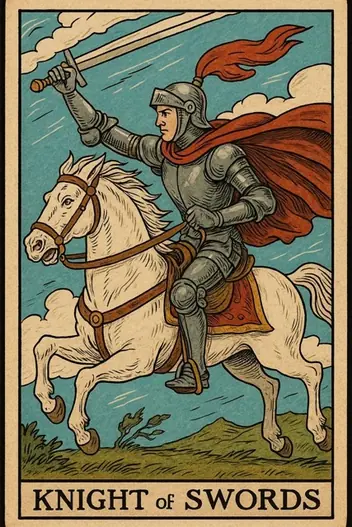
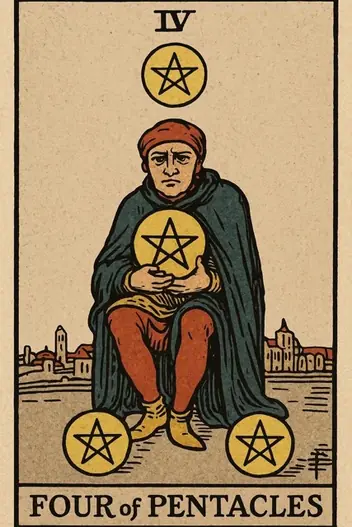
The collision between the Knight of Swords and the Four of Pentacles creates a tense psychological battlefield. The Knight embodies pure cognitive velocity—a mind that charges forward with razor-sharp logic, cutting through ambiguity to seize a truth. The Four of Pentacles, in contrast, represents a rigid defensive posture: a tight grip on resources, routines, and emotional security. When these two archetypes meet, you are dealing with a person who is intellectually aggressive yet emotionally guarded, or a situation where swift action is being stifled by an obsessive need for control.
In real-world terms, this combination often manifests as a high-stakes negotiation, a sudden career pivot, or a relationship where one partner is pushing for change while the other digs in their heels. The core conflict is between speed and stability, between the desire to conquer new territory and the fear of losing what you already have. The key psychological insight here is that the Knight’s clarity can be weaponized to justify the Four’s hoarding, or the Four’s fear can paralyze the Knight’s necessary forward momentum. Understanding this dynamic is critical for making strategic decisions that honor both your need for progress and your need for security.
Knight of Swords and Four of Pentacles: How These Energies Interact
This pairing creates a cognitive dissonance between action and preservation. The Knight of Swords brings a sharp, analytical mind that seeks to dissect problems and cut through red tape. The Four of Pentacles, however, introduces a deep-seated anxiety about loss—of money, status, relationships, or identity. The psychological state here is one of defensive aggression: you may appear confident and decisive on the surface, but underneath, you are reacting from a place of scarcity and fear.
The most important insight is that this combination often leads to premature escalation. The Knight’s impulsiveness can cause you to make a bold move—like quitting a job or confronting a partner—without fully assessing the resources you are about to risk. Conversely, the Four’s grip can cause you to hoard information or opportunities, using the Knight’s sharp tongue to justify why you can’t share or let go. In practice, this means you must consciously slow down your thinking. Before you act, ask yourself: Am I charging into a battle I haven’t scouted, or am I holding onto a position that is no longer defensible? The balance lies in using the Knight’s clarity to audit your attachments, not to attack them impulsively.
Your pair is already on the table. Ask your question and draw the clarifying card
or simply focus on it
Knight of Swords and Four of Pentacles: Career and Money
Strategic Opportunities:
Use the Knight’s analytical speed to audit your current financial holdings or career strategy. This is an excellent time to identify redundant expenses or outdated skills that need upgrading.
Strategic Opportunities:
Leverage your sharp communication skills to negotiate a raise or a contract. The Four’s energy helps you know your worth, while the Knight helps you articulate it persuasively.
Calculated Risks:
Avoid making impulsive job changes or large investments based on a single insight. The Knight can see a clear path, but the Four reminds you that the foundation must be secure before you jump.
In a professional context, this combination is a double-edged sword. On one hand, you have the mental firepower to outmaneuver competitors, solve complex problems, and drive projects forward with precision. On the other hand, the Four of Pentacles introduces a scarcity mindset that can lead to micromanagement, territorial disputes, or an inability to delegate. Important financial warning: Do not confuse a defensive posture with prudent risk management. If you are holding onto a failing strategy or a toxic job just because it feels safe, the Knight’s clarity will eventually force a crisis. The strategic tip here is to use the Knight’s energy to plan, not to attack. Spend 80% of your mental energy on scouting and strategy, and only 20% on execution. This prevents the burnout and conflict that comes from charging into a situation without a solid resource base.
Your unique Tarot reading
See how these cards interact with your destiny. Start a free personal reading now.
Knight of Swords and Four of Pentacles as Feelings
If you are single:
This combination warns against intellectualizing potential partners. You may be overly critical or defensive, using sharp questions to keep people at a distance. Focus on vulnerability over victory in early conversations.
If you are in a relationship:
Expect power struggles over money, time, or decision-making. One partner may be pushing for a major change while the other clings to routine. The conflict is rarely about the surface issue—it’s about control.
In relationships, the Knight of Swords and Four of Pentacles often signals a cold war dynamic. The Knight partner may express frustration through cutting remarks or logical arguments that leave the other feeling dismissed. The Four partner may respond by withdrawing affection, withholding resources, or rigidly enforcing boundaries. This is a recipe for emotional gridlock. The key relationship advice here is to separate the content from the context. When you feel the urge to make a sharp point or defend your territory, pause and ask: Am I trying to solve a problem, or am I trying to win an argument? To break the impasse, each partner must be willing to loosen their grip—the Knight must slow down and listen, and the Four must share their fears openly rather than guarding them.
Knight of Swords and Four of Pentacles Reversed: What Changes?
When cards appear in a reversed position, the dynamic becomes distorted, but does not disappear. This points to hidden, suppressed, or destructive forms of the same archetypes.
If the Knight of Swords is reversed:
This is blocked anger or passive aggression. You want to act, but fear the consequences. Instead of honest conflict, you sabotage processes, show up late, or "forget" important tasks. Advice: Release the aggression through physical activity or written analysis before speaking with people.
If the Four of Pentacles is reversed:
This is inner weakness and loss of control. You are not holding onto resources, but squandering them. This could be impulsive spending or emotional incontinence. Warning: You risk being left empty-handed if you do not establish firm boundaries.
If BOTH are reversed:
Complete imbalance. You are simultaneously angry at the whole world and feel helpless. This is a state of paralysis of the will. You can neither attack nor defend. Method for correction: Start small. Regain control over one micro-resource (e.g., tidying your desk) and perform one micro-action (e.g., one difficult phone call). This will restart the cycle.
The Shadow Side of Knight of Swords and Four of Pentacles
When the Knight of Swords and Four of Pentacles operate in their shadow forms, the result is paranoid overthinking and self-sabotage. The Knight’s cognitive speed becomes a weapon of rationalization: you can construct elaborate justifications for why you must hold onto something (a relationship, a job, a belief) that is no longer serving you. The Four’s grip amplifies this by creating confirmation bias—you only seek out information that supports your defensive position, ignoring any data that suggests you should let go or change course.
The most dangerous cognitive bias here is the sunk cost fallacy. You may feel that because you have invested so much time, money, or emotion into a particular path, you cannot afford to abandon it. The Knight’s sharp logic can then be used to attack anyone who suggests a different approach, turning a rational discussion into a personal battle. This shadow dynamic also manifests as intellectual arrogance. You may believe that your analysis is so precise that you cannot possibly be wrong, leading to rigid thinking and broken relationships. To counteract this, you must practice intellectual humility—actively seek out opposing viewpoints and treat your own conclusions as hypotheses, not truths.
Knight of Swords and Four of Pentacles: The Combined Message
How to constructively utilize the energy of this pair? The answer lies in a paradoxical strategy: "Defense through Offense." You must not choose between aggression and stability. Instead, use the intellectual power of the Knight of Swords to strengthen and restructure the system of the Four of Pentacles. Your task is not to attack people, but to attack the problems that threaten your stability.
Imagine you are a general fortifying a stronghold. The Knight of Swords is your reconnaissance and vanguard, sending out patrols and eliminating threats on the distant approaches. The Four of Pentacles is the quartermaster corps, counting ammunition and distributing provisions. Without reconnaissance, you go blind; without the quartermaster, you starve. A deep strategic counsel: establish a weekly "war council" ritual. Set aside 30 minutes to analyze your resources (money, time, connections) and identify one primary threat. Then channel all your aggression into eliminating precisely that threat.
This approach transforms internal conflict into a source of strength. You no longer vacillate between the urge to blow everything up and the fear of losing it all. You act purposefully and economically. Remember: the core value of the Knight of Swords is clarity of thought, and of the Four of Pentacles, it is stability. Combine them, and you will have an impenetrable strategy.
Your Next Step: Personal Context Matters
The core message of the Knight of Swords and Four of Pentacles is that you must balance your need for speed with your need for security. The goal is not to choose one over the other, but to integrate them: use your sharp mind to protect what matters, and use your resources to fuel your forward momentum. This combination asks you to examine where you are holding on too tightly and where you are moving too fast. The answer is always in the middle path.
While this article provides a deep exploration of the archetypes, the true power of Tarot lies in how these cards speak to your unique situation. Your specific question, your personal history, and the other cards in your spread all shift the meaning. To get a personalized interpretation of this exact combination for your love life, career, or personal growth, use the Fortune Cards app. You can access it on the web or download it now to receive a deep, tailored reading that applies these insights directly to your life. Your next step is just one click away.
Interpretation by the Fortune Cards editorial team, based on the Rider–Waite tradition and Jungian archetypes. About our methodology · Updated: 2026-08-26
Other Combinations with Knight of Swords
Other Combinations with Four of Pentacles
Explore Individual Card Meanings
Table of Contents
- Knight of Swords and Four of Pentacles: How These Energies Interact
- Knight of Swords and Four of Pentacles: Career and Money
- Knight of Swords and Four of Pentacles as Feelings
- Knight of Swords and Four of Pentacles Reversed: What Changes?
- The Shadow Side of Knight of Swords and Four of Pentacles
- Knight of Swords and Four of Pentacles: The Combined Message
- Your Next Step: Personal Context Matters
Ready to find answers to your questions?
Start your first reading now and look at your situation with fresh clarity. The cards are ready to reveal deeper meaning.