Love Tarot: The Moon and Two of Cups
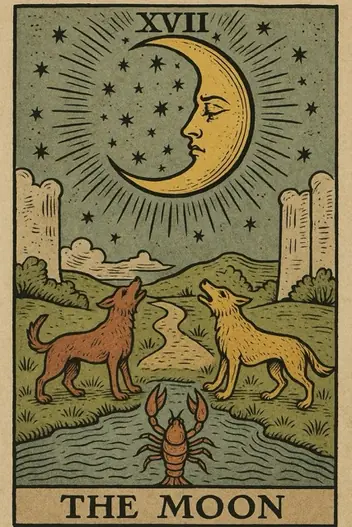
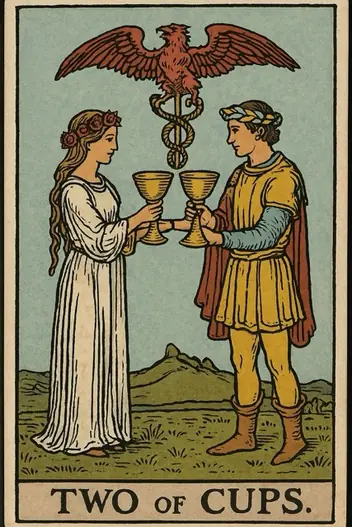
- Arcana
- The Moon — Major Arcana; Two of Cups — Minor Arcana, Cups
- Elements
- The Moon — Water; Two of Cups — Water
- Elemental interaction
- Same element — energies intensify each other
- Numerology
- 18 + 2 = 20 → 2
When The Moon—the card of illusion, fear, and the unconscious—intersects with The Two of Cups—the card of mutual attraction, partnership, and emotional exchange—you face a profound psychological tension. The Moon introduces ambiguity, hidden motives, and subconscious patterns, while the Two of Cups demands clarity, reciprocity, and conscious bonding. This combination suggests that what appears to be a genuine connection may be clouded by unspoken fears, projections, or unresolved past experiences. The practical challenge is to distinguish authentic intimacy from emotional fantasy without letting anxiety sabotage a promising bond.
This pairing often emerges when a seeker is drawn to someone who feels both magnetic and mysterious. The Moon’s influence can amplify idealization or suspicion, while the Two of Cups calls for vulnerability and mutual choice. In real-world terms, this means you may need to slow down, gather objective data, and test the relationship’s foundation before fully committing. The archetypal lesson here is integration: bringing the shadow into the light of conscious partnership.
Core Dynamics & Interpretation
The core dynamic of The Moon and Two of Cups is the clash between emotional depth and psychological clarity. The Moon represents the unknown territory of the psyche—fears, dreams, repressed memories, and intuitive hunches that lack logical proof. The Two of Cups represents the conscious act of choosing a partner, exchanging emotions, and building trust. When combined, these cards create a state where the seeker feels a strong emotional pull but cannot yet trust its source.
This psychological state often manifests as ambivalence in early-stage relationships. You may feel a deep connection with someone, yet also sense something is “off” or hidden. The Moon warns that your own projections—not the other person’s behavior—may be the primary obstacle. For example, past betrayals can cause you to interpret neutral actions as threats. The strategic action is to separate your internal fears from external reality by observing the other person’s consistent behavior over time, rather than reacting to your own anxious narratives.
The key insight here is that this combination does not necessarily indicate deception from the other party. Instead, it highlights your own need to integrate unconscious material—such as unexpressed needs or fears of abandonment—before you can engage in a truly balanced partnership. The Moon’s shadow is self-deception, so honest journaling or therapy is more valuable than interrogation of your partner.
What Do The Moon and Two of Cups Indicate for Your Career?
Strategic Opportunities:
Explore partnerships with people who have complementary skills but different perspectives. The Moon’s intuition can help you identify hidden market needs, while the Two of Cups ensures mutual benefit.
Strategic Opportunities:
Use this period to network in informal settings—coffee meetings, industry events—where genuine rapport can develop. Trust your gut about who is reliable, but verify with references or track records.
Calculated Risks:
Avoid signing long-term contracts or making major financial commitments with a new partner until you have observed them through a full business cycle (e.g., 3-6 months). The Moon warns of hidden liabilities or unspoken agendas.
Professionally, this combination warns against rushing into a joint venture based solely on chemistry. The Two of Cups indicates strong potential for collaboration, but The Moon cautions that one party may be concealing financial instability, legal issues, or conflicting motives. Bold important financial warning: Do not merge resources without a written agreement that includes exit clauses. The Moon’s shadow in career contexts often involves wishful thinking about a partner’s reliability—so conduct due diligence even if the connection feels “fated.” For entrepreneurs, this pair suggests that your next strategic alliance will require both intuitive alignment and concrete risk management. Trust your instincts, but verify with data.
Your pair is already on the table. Ask your question and draw the clarifying card
or simply focus on it
Love and Relationships
If you are single:
This pair suggests you are drawn to someone who evokes strong feelings but remains unclear. Prioritize getting to know them in varied social contexts before labeling the connection. Watch for inconsistent words versus actions.
If you are in a relationship:
The relationship may be entering a phase where old insecurities or secrets surface. Both partners must commit to transparent communication rather than assuming the worst. This is a time for healing, not accusation.
In existing partnerships, The Moon and Two of Cups often signal a period of emotional testing. One partner may feel the other is withdrawing, while the other may feel overwhelmed by unspoken expectations. The psychological trap is to interpret silence as rejection when it may simply be a need for space. Bold key relationship advice: Schedule regular check-ins where both partners share what they are feeling but not yet acting on. This prevents the Moon’s fear-based fantasies from corrupting the Two of Cups’ genuine bond. If secrets are present, this combination urges compassionate disclosure rather than hidden resentment. The goal is to transform anxiety into intimacy by naming the fears together.
Shadow Side & Pitfalls
When The Moon and Two of Cups manifest in their shadow form, the seeker may fall into emotional codependency or paranoid avoidance. The Moon’s fear of the unknown can turn the Two of Cups’ desire for union into clinging or controlling behavior. For example, you might constantly check your partner’s phone or demand reassurance, driven by an unconscious fear of betrayal. Conversely, the shadow can also appear as idealization—projecting a perfect partner onto someone who is actually unavailable or unsuitable.
Cognitive biases to watch for:
Confirmation bias (interpreting ambiguous actions as proof of your fears) and the halo effect (assuming a charismatic person is trustworthy). Self-sabotage may occur if you pull away just as intimacy deepens, repeating old patterns of abandonment. The practical antidote is grounding rituals: write down objective facts about the situation, separate them from your feelings, and ask a trusted friend for an outside perspective. The Moon’s shadow thrives in isolation; bring the relationship into the daylight of social reality.
Uncover hidden insights
Let our advanced Tarot system interpret these archetypes specifically for your personal path.
What If The Moon or Two of Cups Appears Reversed?
When cards appear in a reversed position, the dynamic becomes distorted, but does not disappear.
If The Moon is reversed:
This signals that illusions are beginning to dissipate, but the process is painful. You may suddenly see a truth you have long denied. Fear recedes, but is replaced by anxiety from losing your familiar worldview. Advice: do not try to fix everything immediately. Give yourself time to adapt to the new reality before making decisions in relationships or career. This is a chance for healing, not a catastrophe.
If the Two of Cups is reversed:
This points to internal resistance to union or an imbalance in the relationship. One partner (or you) is not ready for an equal partnership. This can manifest as passive aggression, emotional coldness, or hidden competition. Warning: do not try to "pull" your partner to your side by force. If you feel you are giving more than you receive, this is not a union, but emotional slavery. Your task is to honestly reassess the terms of the "contract."
If BOTH are reversed:
Complete imbalance. You are in a state of paranoid isolation (reversed Moon) and simultaneously desperately need connection but are incapable of building it (reversed Two of Cups). This is a vicious cycle: fear makes you push people away, while loneliness amplifies the fear. The logical way to correct this: start with yourself. Before seeking a partner or business ally, you need to confront your shadow side. Consult a psychologist or begin keeping a journal of your dreams and fears. Only by clarifying your inner landscape can you build healthy external connections.
What Is the Overall Message of The Moon and Two of Cups?
How to constructively use the energy of the Moon to balance the Two of Cups? The strategy lies in transforming fear into a tool for exploration. Instead of fearing the "dark side" of your partner or situation, acknowledge its existence. Tell yourself: "Yes, there is uncertainty here. Yes, I could be wrong. And that is precisely why I will act consciously and slowly."
Your primary strategic asset in this combination is emotional honesty with yourself. The Moon demands that you acknowledge your own fears and projections before you can build a genuine connection (Two of Cups). A practical algorithm: every time you feel a strong attachment or trust toward someone, ask yourself three questions: "What am I afraid of in this situation?", "What am I unwilling to notice?", "What is my benefit in remaining ignorant?"
A deep strategic piece of advice: use the Two of Cups as a compass and the Moon as a map. The Two of Cups will point you in the direction—toward which person or project you are drawn. The Moon, however, will show you the road with all its dangers and detours. Do not ignore either one. Move toward your goal, but with your eyes wide open. This is not about paranoia; it is about mature awareness. It is precisely this that transforms a fragile union based on illusions into a solid partnership founded on the acceptance of reality.
Where to Go From Here
The Moon and Two of Cups together deliver a clear message: Your deepest connections require you to confront your own shadows. The path forward is not to avoid the uncertainty, but to engage with it consciously—using communication, patience, and self-awareness to transform fear into trust. This combination is neither a warning nor a blessing; it is an invitation to integrate your emotional intelligence with your psychological insight.
To truly understand what this means for your specific situation, context is everything. The same cards can signal a breakthrough in a long-term relationship or a red flag in a new business partnership, depending on your unique question and life stage. For a deep, personalized interpretation tailored to your exact circumstances, use the Fortune Cards app. Whether on the web or downloaded, it provides analytical, context-aware readings that apply the archetypes to your real-world choices—helping you move from uncertainty to actionable clarity right now.
Interpretation by the Fortune Cards editorial team, based on the Rider–Waite tradition and Jungian archetypes. About our methodology · Updated: 2026-08-26
Other Combinations with The Moon
Other Combinations with Two of Cups
Explore Individual Card Meanings
Ready to find answers to your questions?
Start your first reading now and look at your situation with fresh clarity. The cards are ready to reveal deeper meaning.