Love Tarot: Two of Cups and Five of Swords
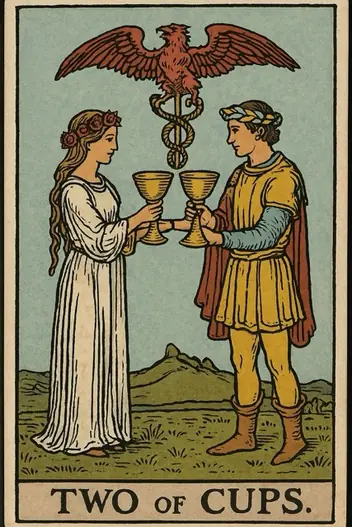

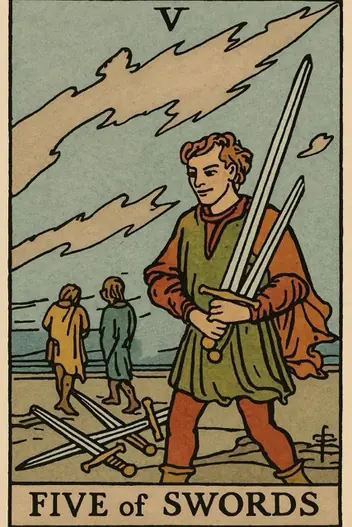
- Arcana
- Two of Cups — Minor Arcana, Cups; Five of Swords — Minor Arcana, Swords
- Elements
- Two of Cups — Water; Five of Swords — Air
- Elemental interaction
- Neutral elements — energies coexist without conflict
- Numerology
- 2 + 5 = 7
When the Two of Cups—the card of mutual attraction, emotional bonding, and equal partnership—collides with the Five of Swords—the card of Pyrrhic victory, bitter defeat, and psychological warfare—you get a dynamic that is both deeply human and intensely challenging. This pairing represents the moment when a sincere connection is tested by a clash of egos, unresolved resentment, or a win-lose mentality. It asks: Can you preserve the bond without losing yourself in the fight?
In real life, this combination often appears when a relationship—romantic, professional, or social—is at a crossroads. One party may feel they have "won" an argument, but the victory feels hollow because the emotional connection has been damaged. Alternatively, it signals a situation where two people are drawn to each other despite a history of conflict, creating a fragile truce that requires careful management. The core tension here is between genuine rapport and the need to dominate.
Core Dynamics & Interpretation
The psychological state created by the Two of Cups and Five of Swords is one of ambivalent attachment. You may feel a strong pull toward someone—a sense of chemistry, shared values, or even love—yet simultaneously sense that this person is not safe to trust completely. This is not a simple "good vs. bad" pairing; rather, it reflects a complex dynamic where vulnerability is both desired and feared. The Two of Cups wants to merge, while the Five of Swords wants to protect its territory.
This combination often emerges when a seeker is trying to reconcile a past betrayal with a current desire for connection. The Five of Swords represents a prior battle—perhaps a breakup, a professional rivalry, or a family feud—that left emotional scars. The Two of Cups then represents a tentative attempt to rebuild, but the shadow of the past conflict looms large. The key insight here is that this union cannot thrive without a conscious reckoning with the power struggle. Ignoring the Five of Swords energy will only lead to a repeat of the conflict.
From a Jungian perspective, this pairing activates the Shadow of the Lover archetype. The seeker may idealize the connection (Two of Cups) while denying their own competitive or aggressive impulses (Five of Swords). The result is a relationship where one person feels they are "giving" while the other is "taking," or where passive-aggressive behavior masks deeper resentment. The path forward requires integrating both the desire for harmony and the capacity for honest confrontation.
Your pair is already on the table. Ask your question and draw the clarifying card
or simply focus on it
Career Meaning of Two of Cups and Five of Swords
Strategic Opportunities:
This pairing can indicate a high-stakes negotiation where you can build a powerful alliance—but only if you are willing to compromise on a specific point of pride. Look for joint ventures that require a clear, written agreement.
Strategic Opportunities:
It also suggests a mentorship or partnership where one person has more experience (and possibly more ego). If you can manage the power dynamic without resentment, this could be a major career accelerator.
Calculated Risks:
Avoid any "winner takes all" deals or legal battles. The short-term victory will come at a long-term cost to your reputation or network. Also, be wary of office politics where you are asked to take sides in a conflict that isn't yours.
In a career reading, the Two of Cups and Five of Swords combination is a red flag for toxic partnerships. You may be offered a collaboration with a former rival, or you may be considering merging your resources with someone who has a history of underhanded tactics. The pragmatic advice is to structure any agreement with ironclad terms. Do not rely on goodwill or past chemistry alone. This is a time to be strategically trusting—give enough rope to build a bridge, but keep the safety net of clear boundaries and exit clauses.
Financially, this pair warns against investing in a venture that is fueled by ego rather than data. A classic example is buying a business from a friend or family member without proper due diligence because "we have a great relationship." The Five of Swords energy will surface later as disputes over valuation, control, or decision-making. The smartest financial move here is to separate the relationship from the transaction. Hire a neutral third party to handle negotiations, and keep your personal and professional accounts strictly separate.
Get a personalized interpretation
Unlock the combined meaning of your cards in the context of your unique question — for free.
Two of Cups and Five of Swords in Love Tarot
If you are single:
This pairing warns against rushing into a connection that feels electric but carries signs of unresolved drama. Ask yourself if you are being drawn to a "fixer-upper" partner rather than a healthy match.
If you are in a relationship:
You are likely in a cycle of "make-up and break-up." The initial attraction is real, but the conflict patterns are toxic. Focus on breaking the loop by addressing the root cause of the power struggle.
In a relationship context, the Two of Cups and Five of Swords together describe a love-hate dynamic that is both passionate and draining. On one hand, there is genuine affection, shared history, and a sense of destiny. On the other hand, there is a persistent undercurrent of competition, where arguments become about "winning" rather than understanding. The most critical relationship advice here is to stop keeping score. If you or your partner are tracking who apologized last or who "gave in" more, you are operating from the Five of Swords mindset, which will eventually corrode the Two of Cups bond.
This combination also points to the danger of triangulation—a third party (ex-partner, friend, or family member) being used as a weapon in the relationship. The Five of Swords often involves a crowd or witnesses to the conflict. To heal, you must create a private, closed-loop communication system where only the two of you have a say in your relationship's outcome. Avoid airing grievances publicly or seeking allies against your partner. The goal is to transform the battlefield into a sanctuary.
Reversed Two of Cups and Five of Swords Explained
When the Two of Cups is reversed, the potential for harmony is blocked. You may be experiencing unfulfilled attraction, disappointment in a partner, or an inability to form an emotional connection. In combination with the upright Five of Swords, this points to a conflict arising from unmet expectations. Advice: stop trying to "fix" a relationship that was dysfunctional from the start.
If the Five of Swords is reversed, the energy of conflict turns inward. Instead of open confrontation, you face feelings of guilt, shame, or fear of asserting your own interests. The Two of Cups in this situation can become a trap: you continue the relationship out of pity or habit, even though you have already lost internally. Warning: do not confuse self-sacrifice with love—they are different things.
When BOTH cards are reversed, a complete imbalance arises: you can neither build harmony nor end the conflict. This is a state of emotional paralysis, where every action worsens the situation. A logical way to resolve this: seek a neutral third party (therapist, mediator), as it is nearly impossible to break out of this cycle on your own.
Two of Cups and Five of Swords: Warning Signs
The shadow manifestation of this combination is the Martyr Complex. The seeker may believe they are the "loving one" (Two of Cups) who is constantly being victimized by the "aggressive one" (Five of Swords). This is often a cognitive bias where one denies their own role in perpetuating the conflict. The shadow question is: In what ways are you also fighting for control, even as you claim to seek peace? Another common pitfall is avoidance through romanticism—using the beautiful feelings of the Two of Cups to paper over the ugly realities of the Five of Swords. This leads to a cycle of reconciliation followed by a blow-up, with no real learning.
From a psychological perspective, the biggest risk is splitting—seeing yourself as all good and the other as all bad. This defense mechanism prevents you from seeing the complex truth: that both connection and conflict can coexist, and that the path forward requires holding both realities without collapsing into one or the other. Self-sabotage can also occur when the seeker, fearing the intensity of the bond, unconsciously picks a fight (Five of Swords) to create distance. If you recognize this pattern, the most courageous act is to sit with the discomfort of intimacy without needing to destroy it.
Two of Cups and Five of Swords Combined Message
Constructive use of this combination requires the ability to discern where to fight and where to retreat. The Two of Cups gives you the emotional intelligence to understand the other party's motives, while the Five of Swords provides the strength to make unpopular decisions. Your task is not to let emotions cloud strategic thinking.
A practical algorithm for action: first use the Two of Cups for diagnosis — assess how ready your partner is for dialogue and compromise. If you see that your interests are being systematically ignored, activate the Five of Swords to defend your boundaries. But do this not from aggression, but from conscious choice: "I value this relationship, but I also value myself. If we cannot find a mutually beneficial solution, I am forced to protect my own interests."
Key strategic advice: establish the "rules of war" before the conflict begins. Discuss with your partner or colleague how you will resolve disagreements when they arise. This will allow you to preserve the Two of Cups (respect and trust) even amidst the Five of Swords (asserting your position). Remember: your goal is not to destroy the opponent, but to find a solution that allows you to move forward — together or separately.
Your Next Step: Personal Context Matters
The core message of the Two of Cups and Five of Swords is that love and conflict are not mutually exclusive, but they cannot thrive in the same space without conscious management. You are being asked to examine whether your desire for connection is truly about union, or if it is a cover for an unresolved power struggle. The path forward requires radical honesty about your own motives and the courage to set boundaries that protect the relationship from your own ego.
This article provides the general archetype, but the true magic happens when Tarot is applied to your unique situation. Your specific question, your personal history, and the positions of these cards in your spread all change the meaning. To get a deep, personalized interpretation of this exact combination for your specific question right now, use the Fortune Cards app. Available on the web and for download, it offers a tailored reading that respects the complexity of your life. Don't settle for a generic answer—let the cards speak directly to you.
Interpretation by the Fortune Cards editorial team, based on the Rider–Waite tradition and Jungian archetypes. About our methodology · Updated: 2026-08-26
Other Combinations with Two of Cups
Other Combinations with Five of Swords
Explore Individual Card Meanings
Table of Contents
- Core Dynamics & Interpretation
- Career Meaning of Two of Cups and Five of Swords
- Two of Cups and Five of Swords in Love Tarot
- Reversed Two of Cups and Five of Swords Explained
- Two of Cups and Five of Swords: Warning Signs
- Two of Cups and Five of Swords Combined Message
- Your Next Step: Personal Context Matters
Ready to find answers to your questions?
Start your first reading now and look at your situation with fresh clarity. The cards are ready to reveal deeper meaning.