Seven of Cups and Eight of Cups Meaning in Tarot

- Arcana
- Seven of Cups — Minor Arcana, Cups; Eight of Cups — Minor Arcana, Cups
- Elements
- Seven of Cups — Water; Eight of Cups — Water
- Elemental interaction
- Same element — energies intensify each other
- Numerology
- 7 + 8 = 15 → 6
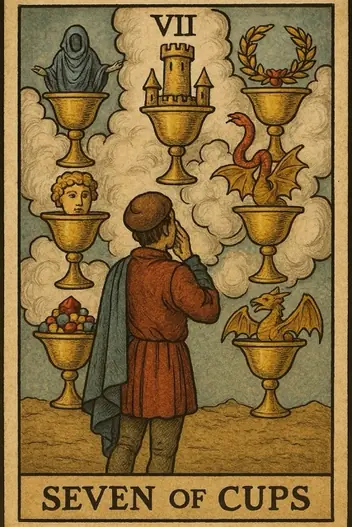
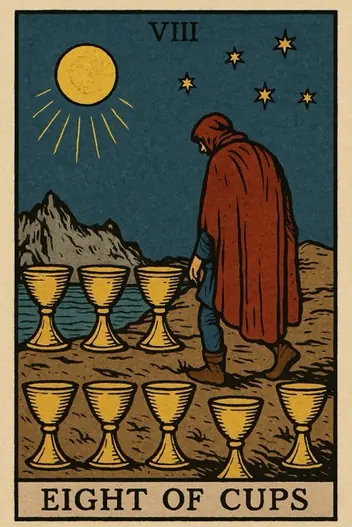
When the Seven of Cups—a card of fantasy, temptation, and scattered desires—meets the Eight of Cups—a card of emotional withdrawal, deliberate departure, and walking away from the unfulfilling—a powerful psychological tension emerges. This pairing represents the moment you realize that your fantasies are not delivering the fulfillment you sought. The mind’s endless menu of possibilities (Seven of Cups) collides with the soul’s quiet demand for substance and closure (Eight of Cups).
In practical terms, this combination signals a critical decision point: you must stop chasing illusions and start leaving behind what no longer serves you. It’s not about choosing the “best” option from a list of fantasies; it’s about recognizing that none of those options are truly satisfying. The Eight of Cups forces a strategic retreat from the chaos of desire, pushing you toward emotional honesty and a disciplined exit from dead-end scenarios.
Seven of Cups and Eight of Cups: How These Energies Interact
The psychological core of this pairing is cognitive dissonance between desire and reality. The Seven of Cups represents the pleasure principle—the ego’s tendency to imagine endless gratifications without consequences. The Eight of Cups represents the reality principle—the mature recognition that some pursuits drain more energy than they provide. When these two cards combine, the seeker is caught between the allure of new possibilities and the growing weight of dissatisfaction.
The key insight here is that the Eight of Cups does not solve the fantasy problem—it simply walks away from it. This is not a card of transformation or resolution; it is a card of strategic abandonment. The seeker must first acknowledge that their current fantasies (Seven of Cups) are leading them in circles. Then, they must have the courage to leave the table entirely, rather than trying to “fix” a broken game. The psychological challenge is to distinguish between healthy ambition (pursuing a genuine goal) and escapist fantasy (chasing a mirage to avoid reality).
In real-world terms, this combination often appears when someone is juggling multiple projects, relationships, or career paths without progress. The Eight of Cups advises cutting losses—not because the options are bad, but because the emotional cost of indecision outweighs any potential gain. The pragmatic action is to conduct a cost-benefit analysis of each fantasy: Which one, if any, actually moves you toward your core values? If none do, the Eight of Cups says leave them all behind.
Your pair is already on the table. Ask your question and draw the clarifying card
or simply focus on it
Seven of Cups and Eight of Cups as Feelings
If you are single:
This pairing warns against romanticizing unavailable or inconsistent partners. Instead of fantasizing about potential, focus on observable actions and consistency.
If you are in a relationship:
One or both partners may be emotionally withdrawing due to unmet expectations. Honest communication about needs is critical to avoid silent resentment.
In relationships, the Seven of Cups and Eight of Cups combination often signals a disconnect between fantasy and reality. One partner may be projecting idealized qualities onto the other (Seven of Cups), while the other feels unseen and begins to emotionally withdraw (Eight of Cups). This creates a painful cycle: the more one person fantasizes, the more distant the other becomes. The solution is not to double down on the fantasy, but to face the real person in front of you.
For singles, this card pair suggests you are likely attracted to people who represent a “project” or a “what if” scenario rather than a genuine partner. You may be drawn to charisma, mystery, or drama instead of stability and mutual respect. The Eight of Cups advises you to walk away from these emotional roller coasters. Stop investing energy in people who are not investing in you.
For committed relationships, this combination points to a power imbalance in emotional labor. One partner may be constantly trying to “fix” the relationship by imagining better scenarios (Seven of Cups), while the other is quietly checking out (Eight of Cups). The pragmatic advice is to schedule a direct, non-accusatory conversation about what each person truly wants. If one partner has already left emotionally, no amount of fantasy can bring them back. Know when to let go with dignity rather than cling to a ghost.
Seven of Cups and Eight of Cups: Career and Money
Strategic Opportunities:
Use this time to conduct an audit of your current projects—identify which ones are aligned with your long-term goals and which are distractions.
Strategic Opportunities:
The Eight of Cups energy favors leaving a toxic work environment or ending a partnership that consistently underperforms. This is a calculated exit, not a rash decision.
Calculated Risks:
Avoid investing in multiple ventures simultaneously without a clear priority. Spreading yourself too thin is the primary risk here.
Professionally, this combination is a red flag for decision fatigue and resource misallocation. The Seven of Cups can manifest as a startup founder chasing every trend or a manager approving every project without strategic focus. The Eight of Cups then appears as the inevitable burnout or quiet quitting that follows. The financial warning is clear: do not confuse activity with productivity.
The strategic move is to apply the “80/20 rule”—identify the 20% of your efforts that produce 80% of your results, and systematically eliminate the rest. This may mean turning down a lucrative but distracting side project, or resigning from a committee that consumes time without impact. The Eight of Cups rewards precision, not volume.
For financial planning, this card pair warns against speculative investments or get-rich-quick schemes. The Seven of Cups represents the allure of a “sure thing” that is actually a mirage. Instead, focus on debt reduction and building an emergency fund—the Eight of Cups energy supports leaving behind financial risk for stability. If you are considering a career change, use the Eight of Cups to leave a role that drains you, but only after securing a concrete offer (Seven of Cups can be daydreams without execution).
Ask your specific question
Don't rely on generic meanings. Get a customized reading tailored specifically to your energies.
Negative Meaning of Seven of Cups and Eight of Cups
The shadow of this combination is self-deception through avoidance. The Seven of Cups can manifest as chronic daydreaming—using fantasy as a defense mechanism against the pain of reality. The Eight of Cups, in its shadow form, becomes emotional escapism—walking away not from a bad situation, but from any situation that requires effort. Together, they create a cycle of starting new projects or relationships with high hopes, then abandoning them when they get hard.
Cognitive biases at play include the “sunk cost fallacy”—staying in a dead-end situation because you’ve already invested time or money (Seven of Cups refuses to let go), and the “grass is greener” bias—believing that leaving will automatically solve your problems (Eight of Cups as false hope). The most dangerous pitfall is mistaking emotional withdrawal for wisdom. The Eight of Cups is only healthy when it leaves something that is truly toxic; it is destructive when it leaves a situation that is merely uncomfortable.
Practical self-sabotage includes:
quitting a job without a backup plan, ghosting a partner instead of having a difficult conversation, or abandoning a creative project because it’s not perfect. The shadow side requires you to ask: Am I leaving to grow, or am I leaving to avoid growing?
Seven of Cups and Eight of Cups Reversed: What Changes?
Reversed cards shift the dynamic from active to passive, but they do not negate the conflict.
If the Seven of Cups is reversed:
The potential for choice is blocked by fear or laziness. You cannot see the options, even though they exist. Instead of moving away from illusions (the Eight), you sink into apathy. Advice: seek an external mentor or coach who can point out the existing opportunities you are ignoring.
If the Eight of Cups is reversed:
This indicates internal resistance and weakness of will. You understand that you need to leave, but you do not do it. You return to old, destructive patterns. Warning: this is a direct path to neurosis. Your psyche is wasting resources on suppressing an obvious solution.
If BOTH are reversed:
Complete imbalance. Illusions have become obsessive ideas, and the desire to leave has become paralyzing melancholy. You are stuck between "I want to, but I can't see how" and "I need to leave, but I have no strength." Method for correction: radically simplify your life. Remove from your field of vision everything that triggers fantasies (social media, advertising, toxic people). Create a vacuum so you can hear your own true voice.
Overall Meaning of Seven of Cups and Eight of Cups
How to constructively use the energy of this pair? The Eight of Cups is a tool for clearing space, and the Seven of Cups is a tool for generating ideas. Don't let them work against you. Use them sequentially.
Your strategy is the "counterbalance" method. First, give yourself time for the "Seven": hold a "no-commitment brainstorming session". Write down 10-20 versions of your future, even the craziest ones. Then, activate the "Eight": apply a harsh filter of reality. Ask yourself: "Which items on this list am I ready to start doing tomorrow, even if it's scary and difficult?" Leave 1-2 points.
A deep strategic advice: do not walk away "into nothingness." The Eight of Cups in its pure form is a retreat into the desert. You need a beacon. Before burning bridges (Eight), make sure you have a map (Seven). Use the energy of disappointment not for depression, but for fuel. Disappointment is a signal that your current values no longer work. Find new ones. Only then will your departure become not an escape, but a conscious transition to a new level of development.
Your Next Step: Personal Context Matters
The Seven of Cups and Eight of Cups combination ultimately asks you to stop chasing illusions and start making hard decisions. The core message is that fantasy without action is a trap, and departure without direction is aimless. You must first clarify what you genuinely value (not just what you desire), then have the courage to leave behind everything that doesn’t align with that value. This is not a time for more options—it’s a time for ruthless prioritization and deliberate endings.
But Tarot is not a one-size-fits-all system. The meaning of this combination shifts dramatically based on your specific situation—whether you’re deciding between two lovers, leaving a career, or recovering from a loss. General archetypes can guide you, but true insight comes from personalized context.
That’s why I recommend using the Fortune Cards app—available on the web or as a download. You can input your exact question (e.g., “Should I leave my current relationship?” or “Which career path should I pursue?”) and receive a deep, personalized interpretation of this exact card combination for your unique circumstances. The app applies Jungian psychology and strategic analysis to your specific life situation, giving you actionable clarity rather than vague predictions. Stop guessing—get the tailored answers you need right now.
Interpretation by the Fortune Cards editorial team, based on the Rider–Waite tradition and Jungian archetypes. About our methodology · Updated: 2026-08-26
Other Combinations with Seven of Cups
Other Combinations with Eight of Cups
Explore Individual Card Meanings
Table of Contents
- Seven of Cups and Eight of Cups: How These Energies Interact
- Seven of Cups and Eight of Cups as Feelings
- Seven of Cups and Eight of Cups: Career and Money
- Negative Meaning of Seven of Cups and Eight of Cups
- Seven of Cups and Eight of Cups Reversed: What Changes?
- Overall Meaning of Seven of Cups and Eight of Cups
- Your Next Step: Personal Context Matters
Ready to find answers to your questions?
Start your first reading now and look at your situation with fresh clarity. The cards are ready to reveal deeper meaning.