Love Tarot: Seven of Cups and Seven of Swords
- Arcana
- Seven of Cups — Minor Arcana, Cups; Seven of Swords — Minor Arcana, Swords
- Elements
- Seven of Cups — Water; Seven of Swords — Air
- Elemental interaction
- Neutral elements — energies coexist without conflict
- Numerology
- 7 + 7 = 14 → 5
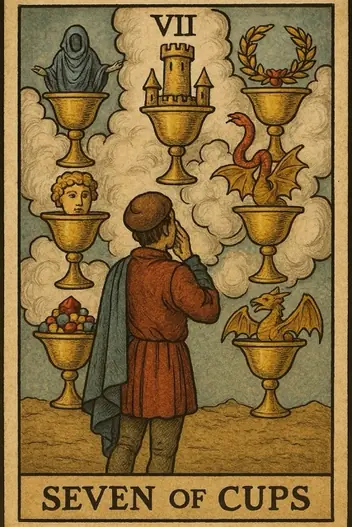
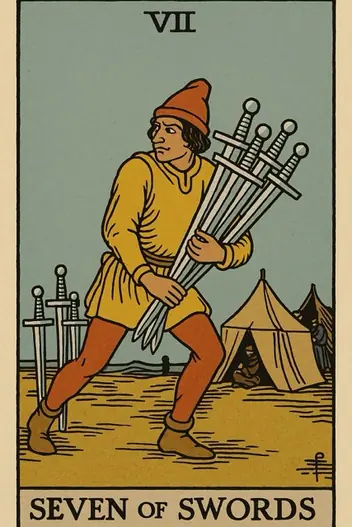
The Seven of Cups represents a mind flooded with desires, fantasies, and possibilities—a psychological state of unbounded imagination and wishful thinking. The Seven of Swords, in contrast, is the archetype of stealth, deception, and strategic withdrawal. When these cards combine, you are not simply daydreaming; you are actively manipulating reality to fit a fantasy. This pairing signals a critical moment where your desires may be blinding you to the ethical and practical costs of your actions.
This combination often appears when a person is tempted to take a shortcut, hide the truth, or pursue an illusion at the expense of integrity. The core dynamic is a clash between the idealized self (Cups) and the survival-oriented strategist (Swords). The question becomes: Are you being clever, or are you being fooled by your own cleverness?
Seven of Cups and Seven of Swords Combination Meaning
The psychological tension here is palpable. The Seven of Cups activates the Jungian archetype of the Puer Aeternus—the eternal child who refuses to commit to one path, preferring the thrill of infinite possibility. When paired with the Seven of Swords, the shadow side emerges: this child becomes a trickster, using cognitive dissonance to justify questionable actions. You might convince yourself that a lie is "strategic" or that a risky gamble is "creative."
In practical terms, this combination suggests a high-stakes situation where the truth is being obscured—either by you or by someone else. The Seven of Swords warns of hidden agendas, theft of ideas, or passive-aggressive behavior. The Seven of Cups warns that your own wishful thinking is making you vulnerable to these deceptions. The key insight is that the biggest threat is not external manipulation, but your own refusal to see reality as it is.
This energy is particularly dangerous in negotiations, partnerships, or creative projects where multiple options are on the table. The risk is that you will choose the option that feels most exciting, rather than the one that is most sustainable. The Seven of Swords demands that you check your facts, verify sources, and trust actions over words.
What Do Seven of Cups and Seven of Swords Say About Love?
If you are single:
This pairing suggests you are either idealizing a potential partner who is not what they seem, or you are withholding your true self to appear more desirable. Pause and gather objective evidence before investing emotionally.
If you are in a relationship:
A power dynamic of secrecy or manipulation is at play. One partner may be avoiding a difficult conversation by charming or distracting the other. The relationship is built on a shaky foundation of unspoken truths.
In relationships, the core dynamic is a battle between fantasy and authenticity. The Seven of Cups can manifest as unrealistic expectations—believing your partner will change, or that a "perfect" relationship exists without work. The Seven of Swords suggests that one or both partners are hiding their true feelings, needs, or actions to avoid conflict. This is a recipe for slow-burning resentment.
The bold truth here is that avoidance is not protection. If you are in a relationship, direct, honest communication is non-negotiable. If you are single, ask yourself: Am I attracted to the person, or to the story I am telling myself about them? The Seven of Swords encourages you to investigate quietly before making any commitments. Trust is earned through transparency, not seduction.
Your pair is already on the table. Ask your question and draw the clarifying card
or simply focus on it
What Do Seven of Cups and Seven of Swords Indicate for Your Career?
Strategic Opportunities:
Use this energy to brainstorm creative solutions without committing to any single one yet. The Seven of Cups can be a powerful tool for ideation if you keep your feet on the ground.
Strategic Opportunities:
Network discreetly to gather information about a potential job or deal. The Seven of Swords favors research and reconnaissance over public declarations.
Calculated Risks:
Do not sign contracts or make large financial commitments while this energy is active. Beware of "too good to be true" offers that appeal to your ego or greed.
In the professional realm, this combination is a clear warning against over-promising and under-delivering. The Seven of Cups can lead to scope creep—taking on too many projects because they all seem exciting. The Seven of Swords warns that colleagues or competitors may be working against you behind the scenes. Do not assume good intentions without data.
Financially, the risk is of "magical thinking"—believing that a risky investment or quick scheme will pay off without due diligence. The bold advice is to create a decision-making checklist that forces you to verify every assumption. If a deal requires secrecy or speed to close, treat it with extreme skepticism. This is a time for conservative cash management and ethical transparency. Your reputation is your most valuable asset; do not trade it for a short-term gain.
What If Seven of Cups or Seven of Swords Appears Reversed?
When cards appear in a reversed position, the dynamic shifts from active conflict to internal inhibition or, conversely, to a sudden breakthrough.
If the Seven of Cups is reversed:
Illusions dissipate, but motivation goes with them. You are no longer building castles in the air, but fall into cynicism and apathy. The risk is accepting reality too harshly and abandoning any ambitions, even useful ones. Advice: do not confuse realism with depression. Allow yourself at least one "little dream" to restore your energy.
If the Seven of Swords is reversed:
This signals a failed strategy or internal resistance. You can no longer play tricks; the truth comes out, or you yourself are tired of the deception. This is a painful but cleansing moment. Advice: admit your mistake or weakness. An honest confession will give you more control than continuing a game that no longer works.
If BOTH are reversed:
Complete imbalance. Fantasies are blocked, and the tools of manipulation are broken. This is a state of total disorientation and powerlessness. You don't know what you want and can't take any action. The logical way to correct this is a complete stop. Do not try to act. Use this period as a "mental detox": rest, observe the world without attempting to change it. Clarity will return in a week or two.
Deepen your understanding
Find out exactly what this reading means for your current life situation with our oracle.
Shadow Side & Pitfalls
The shadow of this combination is self-deception elevated to an art form. The Seven of Cups can lead to compulsive fantasizing—escaping into daydreams to avoid the anxiety of real decision-making. The Seven of Swords then enables dishonest behavior to maintain the fantasy. Cognitive biases like the optimism bias ("it will work out") and confirmation bias ("I only see evidence that supports my plan") are rampant.
Common pitfalls include:
gaslighting yourself into believing a bad situation is good; lying to protect someone's feelings (which is actually a form of control); stealing credit or ideas because you feel entitled to success; or engaging in passive-aggressive behavior instead of setting a direct boundary. The most dangerous pitfall is the belief that you are "too smart" to get caught. The Seven of Swords is about stealth, but it is also about eventual exposure. The truth always surfaces, and when it does, the cost is higher than the short-term gain.
Synthesis: Strategic Conclusion
The Seven of Cups and the Seven of Swords are not a verdict, but a diagnosis of your current thinking style. They indicate that you are using your intellect not for creation, but for protection from disappointment. Your mind has become a servant of your fears, not your goals. To break out of this cycle, you must reintegrate these energies: use the imagination of the Cups to create a clear, realistic image of the future, and the sharpness of the Swords to develop a direct, rather than circuitous, path toward it.
The constructive strategy lies in narrowing your focus. Take one of your fantasies (the one that evokes the strongest emotional response) and ask yourself: "What is the simplest and most honest thing I can do right now to move closer to this?" The answer of the Seven of Swords will tempt you with cunning, but your task is to choose a direct action. For example, instead of writing a complicated letter full of hints, tell the person the truth to their face. Instead of searching for the "perfect moment," start acting in an imperfect one.
A deep strategic counsel:
imagine you are a detective investigating your own self-sabotage. Write down on paper: "What am I truly afraid of?" (Seven of Swords) and "What fantasy is keeping me trapped in this fear?" (Seven of Cups). Then, tear up the sheet with the fantasy and keep the sheet with the fear. A fear that is seen and named loses its power. Once you acknowledge that you are afraid of failure or rejection, the energy of the Swords stops being spent on concealment and begins working for you. You will be able to act consciously, accepting risk as part of the process, not as a threat.
Applying This to Your Situation
The Seven of Cups and Seven of Swords together are a mirror reflecting your relationship with desire and deception. The core message is: Clarify your intentions, and then act with integrity. You have the imagination to dream big, but you also have the cunning to navigate obstacles. The key is to use your strategic mind to build something real, not to maintain an illusion.
To truly integrate this insight, you need to apply it to your specific situation. General archetypes provide a map, but the real transformation happens when you see how these patterns play out in your own life. The Fortune Cards app allows you to input your exact question—about love, career, or a personal dilemma—and receive a deep, personalized interpretation of the Seven of Cups and Seven of Swords that speaks directly to your circumstances. Stop guessing. Get clarity. Use the app on the web or download it now to unlock the full meaning of your reading.
Interpretation by the Fortune Cards editorial team, based on the Rider–Waite tradition and Jungian archetypes. About our methodology · Updated: 2026-08-26
Other Combinations with Seven of Cups
Other Combinations with Seven of Swords
Explore Individual Card Meanings
Table of Contents
- Seven of Cups and Seven of Swords Combination Meaning
- What Do Seven of Cups and Seven of Swords Say About Love?
- What Do Seven of Cups and Seven of Swords Indicate for Your Career?
- What If Seven of Cups or Seven of Swords Appears Reversed?
- Shadow Side & Pitfalls
- Synthesis: Strategic Conclusion
- Applying This to Your Situation
Ready to find answers to your questions?
Start your first reading now and look at your situation with fresh clarity. The cards are ready to reveal deeper meaning.