Seven of Swords and Six of Pentacles Meaning in Tarot

- Arcana
- Seven of Swords — Minor Arcana, Swords; Six of Pentacles — Minor Arcana, Pentacles
- Elements
- Seven of Swords — Air; Six of Pentacles — Earth
- Elemental interaction
- Opposing elements — energies create tension
- Numerology
- 7 + 6 = 13 → 4
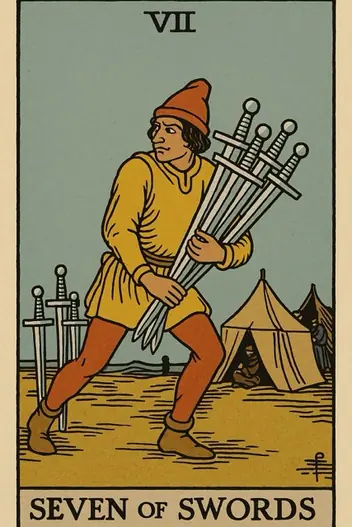
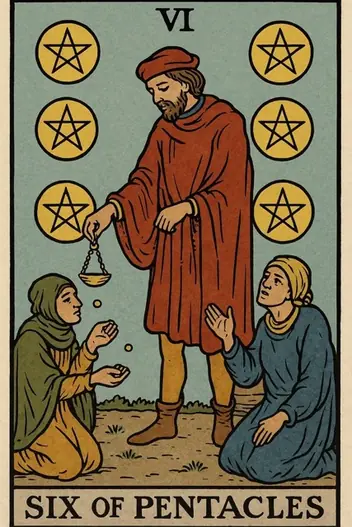
When the Seven of Swords—the card of cunning, strategic withdrawal, and unspoken agendas—meets the Six of Pentacles—the archetype of generosity, resource distribution, and power dynamics—we encounter a complex psychological landscape. This pairing often appears when someone is weighing what to give against what to keep, or when a seemingly generous act conceals a hidden calculation. The core tension here is between open-handed giving and covert self-interest, creating a dynamic where trust and strategy must be carefully balanced.
In practical terms, this combination suggests a situation where resources, information, or emotional energy are being exchanged with an unacknowledged agenda. The Six of Pentacles represents the visible transaction—the gift, the loan, the mentorship—while the Seven of Swords reveals the silent strategy behind it. The key question becomes: Is this a sophisticated form of negotiation, or is someone being played for a fool?
Seven of Swords and Six of Pentacles Card Meaning Explained
The psychological state created by this pairing is one of calculated generosity. The seeker may feel compelled to give—time, money, emotional support—but harbors private reservations or a hidden exit strategy. This is not necessarily malicious; it can reflect a protective mindset developed through past disappointments. The Seven of Swords brings a sharp, analytical edge to the Six of Pentacles' natural inclination toward sharing. The result is a person who gives, but watches closely how their gifts are received and used.
This combination often appears when someone is testing the waters—offering just enough to gauge another's intentions or loyalty. In business, this might manifest as a trial project or a modest investment to see if a partner is trustworthy. In relationships, it could be a small act of kindness designed to elicit a reciprocal response. The underlying dynamic is one of strategic risk management, where every exchange serves as data for a larger decision.
The real-world implication is that transparency is optional here. The seeker may feel justified in withholding full information, believing that partial disclosure protects their interests. However, this approach risks creating a cycle of mutual suspicion if the other party senses the hidden agenda. The psychological challenge is to recognize when strategic caution crosses into manipulative withholding, and whether the potential reward justifies the ethical compromise.
Seven of Swords and Six of Pentacles in Love and Relationships
If you are single:
This combination suggests you may be evaluating a new connection through a lens of scarcity. You might hold back your true feelings to test how much effort the other person will invest first.
If you are in a relationship:
The dynamic points to an imbalance in giving and receiving, where one partner may be over-functioning while the other quietly withholds emotional or material resources.
In relationships, the Seven of Swords and Six of Pentacles often reveal a power struggle masked as generosity. One partner might offer gifts or favors while secretly keeping score, expecting a specific return on their emotional investment. This creates a transactional atmosphere that undermines genuine intimacy. The key relationship advice is to examine your motives before giving: Are you offering freely, or is there an unspoken price tag attached?
If you are on the receiving end, this combination warns you to pay attention to strings attached. A partner who seems overly generous may be building a debt they intend to call in later. The psychological insight here is that true generosity requires no repayment. When the Seven of Swords energy is active, it's crucial to communicate openly about expectations before accepting significant gifts or favors. This prevents the relationship from becoming a quietly competitive negotiation rather than a partnership.
Your pair is already on the table. Ask your question and draw the clarifying card
or simply focus on it
Seven of Swords and Six of Pentacles: Career and Money
Strategic Opportunities:
Use this energy to negotiate from a position of hidden strength. If you have information or skills others don't, consider offering a small sample to demonstrate value before committing fully.
Strategic Opportunities:
This is an ideal time to restructure debts or payment plans. The Six of Pentacles favors fair exchange, while the Seven of Swords helps you find creative loopholes or alternative arrangements.
Calculated Risks:
Beware of offering too much too soon to untested partners. The Seven of Swords warns that your generosity may be exploited if you haven't verified the other party's integrity.
In the professional realm, this pairing suggests a delicate balance between transparency and strategy. You may be in a position where sharing resources—time, knowledge, budget—could accelerate a project, but doing so exposes you to potential exploitation. The strategic move is to give conditionally: offer access to resources with clear milestones, not open-ended support. This protects your position while still demonstrating goodwill.
Financially, the Six of Pentacles encourages generosity, but the Seven of Swords advises keeping an emergency reserve. If you're considering a loan or investment, structure it with clear terms and exit clauses. The combination also warns against impressive but hollow offers—someone may promise more than they can deliver. Bold financial warning: Do not confuse a generous gesture with a secure commitment. Verify the source of any promised resources before adjusting your own budget.
Uncover hidden insights
Let our advanced Tarot system interpret these archetypes specifically for your personal path.
Seven of Swords and Six of Pentacles Reversed: How to Read It
Seven of Swords Reversed:
Blocked potential for cunning. You lose your ability to maneuver, becoming vulnerable to deception. Advice: Return to basic principles — honesty is safer now than risky schemes.
Six of Pentacles Reversed:
Internal resistance to help. You cannot accept resources, even when offered, out of pride or fear. Warning: This is a path to isolation, where the Seven of Swords turns into paranoia.
BOTH Reversed:
Complete imbalance — chaos in strategy and resources. You act impulsively, losing control over consequences. Logical way to correct: Full stop and revision of all commitments. Temporarily decline new projects.
When Seven of Swords and Six of Pentacles Signal Trouble
When the energy of this combination is blocked or misdirected, it manifests as manipulative generosity or paranoid withholding. The shadow side of the Seven of Swords is deception—here, the seeker might use the Six of Pentacles' virtue of giving as a cover for selfish motives. This could look like making a public donation while privately expecting favors in return, or offering help only to create a sense of obligation.
Conversely, the shadow can manifest as extreme suspicion that prevents genuine connection. The seeker might interpret every act of generosity as having a hidden agenda, leading to isolation and missed opportunities. The cognitive bias at play is projection: assuming others operate with the same strategic cunning you possess. This creates a self-fulfilling prophecy where guarded behavior invites the very manipulation you fear.
Another pitfall is poor judgment in resource allocation. The Six of Pentacles asks for discernment about who deserves support, but the Seven of Swords can distort this into unfair favoritism or secret deals. In a workplace, this might mean promoting a friend over a more qualified candidate, justifying it as "loyalty." The psychological trap is mistaking strategic alliance-building for ethical decision-making.
Seven of Swords and Six of Pentacles: Tarot Advice
The constructive use of this combination is applying intellect to create sustainable systems of exchange. The Seven of Swords gives you the ability to see where resources are being distributed inefficiently. The Six of Pentacles is the tool for redistributing them. Your task is not to steal a piece of the pie, but to propose a new, more equitable model for dividing it.
Deep strategic advice:
Instead of concealing your intentions (Seven of Swords), use your insight to anticipate objections and prepare your arguments in advance. The Six of Pentacles then becomes not a tool of charity, but a mechanism for partnership.
In practice, this means: when you see an injustice, do not try to circumvent the system in secret. Instead, publicly propose a solution that benefits everyone. This requires courage, but it is precisely this approach that transforms "cunning" into "strategic leadership."
Where to Go From Here
The Seven of Swords and Six of Pentacles together reveal a situation where strategy and generosity must be carefully calibrated. Your core task is to distinguish between protective wisdom and manipulative withholding. The answer depends entirely on your specific circumstances—your role, your history with the people involved, and your genuine intentions.
To get a deep, personalized interpretation of this exact combination for your unique question, use the Fortune Cards app. While this article provides the general archetype, the true power of Tarot lies in applying it to your life. The app's AI analyzes your specific context—whether you're asking about a relationship, a career move, or a financial decision—and delivers a tailored reading that respects your situation. Try it now on the web or download it to discover what this powerful pairing means for you today.
Interpretation by the Fortune Cards editorial team, based on the Rider–Waite tradition and Jungian archetypes. About our methodology · Updated: 2026-10-01
Other Combinations with Seven of Swords
Other Combinations with Six of Pentacles
Explore Individual Card Meanings
Table of Contents
- Seven of Swords and Six of Pentacles Card Meaning Explained
- Seven of Swords and Six of Pentacles in Love and Relationships
- Seven of Swords and Six of Pentacles: Career and Money
- Seven of Swords and Six of Pentacles Reversed: How to Read It
- When Seven of Swords and Six of Pentacles Signal Trouble
- Seven of Swords and Six of Pentacles: Tarot Advice
- Where to Go From Here
Ready to find answers to your questions?
Start your first reading now and look at your situation with fresh clarity. The cards are ready to reveal deeper meaning.