Love Tarot: Six of Swords and King of Swords

- Arcana
- Six of Swords — Minor Arcana, Swords; King of Swords — Minor Arcana, Swords
- Elements
- Six of Swords — Air; King of Swords — Air
- Elemental interaction
- Same element — energies intensify each other
- Numerology
- 6 + 14 = 20 → 2
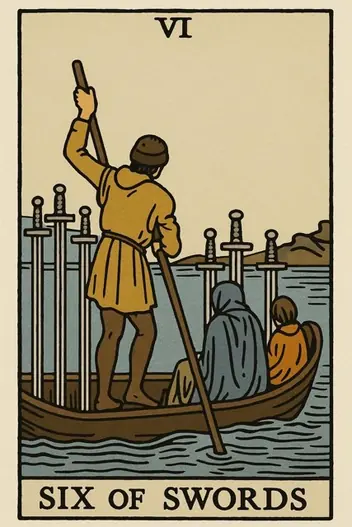
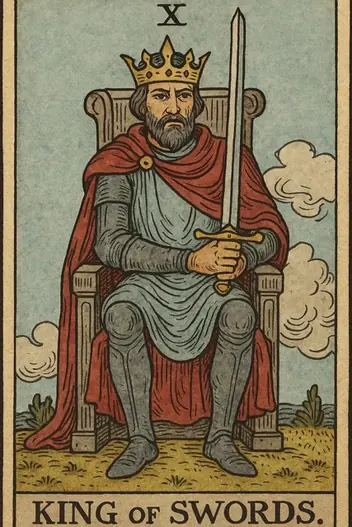
When the Six of Swords meets the King of Swords, we witness a psychological shift from passive endurance to active mastery. The Six of Swords represents a necessary journey away from troubled waters—a period of emotional detoxification and quiet departure from what no longer serves you. The King of Swords, by contrast, is the archetype of intellectual sovereignty—the cold, clear gaze of truth that cuts through illusion. Together, they form a powerful directive: leave the past behind, but do so with surgical precision and ruthless clarity.
This combination signals a transition that is not merely emotional but strategic. The seeker is moving from a state of reactive suffering (Six of Swords) into a position of calculated authority (King of Swords). The key question is: Are you navigating this transition with the wisdom of a seasoned general, or are you merely drifting toward an unknown shore? The answer determines whether this journey leads to genuine liberation or just another cycle of avoidance.
Six of Swords and King of Swords Combination Meaning
The psychological state created by this pairing is one of controlled detachment. The Six of Swords brings the emotional weight of grief, loss, or necessary release. Yet the King of Swords refuses to wallow. Instead, it imposes intellectual order on the chaos. This is not a denial of pain but a disciplined examination of it. The seeker is asked to observe their own emotional patterns with the dispassion of a scientist studying a specimen. The goal is not to feel less, but to think more clearly through the feeling.
In practical terms, this combination demands a strategic retreat. The Six of Swords suggests you are moving away from a situation that has become toxic, stagnant, or unproductive. The King of Swords insists you do so with a clear plan and a logical rationale. You cannot afford to leave on impulse; you must leave because the data supports it. This is a time for auditing your commitments, evaluating which battles are worth fighting, and which relationships or projects have outlived their usefulness. The mind must lead the heart across the water.
The real-world implication is a shift in personal authority. The seeker is stepping into a more mature, executive role in their own life. You are no longer a passenger on the boat; you are the captain reading the charts. This card pair often appears when someone is ready to make a difficult decision that others may not understand or support. The King of Swords provides the courage to be misunderstood as long as the logic is sound. The Six of Swords provides the permission to move on without guilt.
Your pair is already on the table. Ask your question and draw the clarifying card
or simply focus on it
What Do Six of Swords and King of Swords Indicate for Your Career?
Strategic Opportunities:
Exit gracefully from a toxic work environment or a failing business venture. Use the King of Swords to negotiate a severance, reference, or transition plan that protects your reputation and finances.
Strategic Opportunities:
Reorganize your professional priorities. This is an excellent time to outsource, delegate, or eliminate tasks that drain your energy without producing results. Focus on high-leverage activities that align with your long-term vision.
Calculated Risks:
Avoid making impulsive career changes based on emotional burnout alone. The Six of Swords can tempt you to flee, but the King of Swords insists you have a landing spot before you jump. Do not resign without a backup plan.
In the professional realm, this combination is a powerful signal for strategic disengagement. You may be in a role, industry, or partnership that has become a dead end. The Six of Swords encourages you to cut your losses and move toward a more promising horizon. The King of Swords provides the analytical tools to execute this transition cleanly. Bold financial warning: Do not burn bridges. The King of Swords is about calculated moves, not emotional exits. Ensure you have documented agreements, delivered on obligations, and maintained professional courtesy.
For entrepreneurs, this pair suggests a pivot in business strategy. The data is clear: your current approach is not working. The Six of Swords says it is time to leave the old model behind. The King of Swords says to build the new model on a foundation of market research, financial projections, and risk assessment. This is not a time for gut feelings; it is a time for spreadsheets, contracts, and contingency plans.
Get a personalized interpretation
Unlock the combined meaning of your cards in the context of your unique question — for free.
Six of Swords and King of Swords in Love Tarot
If you are single:
This combination suggests you are ready to leave behind a pattern of emotionally draining connections. You are now applying higher standards and logical filters to potential partners. Do not settle for someone who cannot match your intellectual depth or your need for honest communication.
If you are in a relationship:
This pair indicates a necessary conversation about the future. One or both partners may feel the relationship has run its course, or that a significant change in structure (e.g., moving, changing jobs, redefining boundaries) is required. Honesty, even if painful, is non-negotiable.
In relationships, this combination calls for emotional intelligence married to intellectual clarity. The Six of Swords warns against staying in a situation out of habit, comfort, or fear of being alone. The King of Swords demands that you articulate your needs with precision and listen to your partner’s logic without letting emotions hijack the dialogue. The key relationship advice here is to prioritize truth over harmony. A relationship that cannot withstand a difficult conversation is not a safe harbor—it is a leaky boat.
If you are the one initiating the departure, the King of Swords reminds you to be fair but firm. Do not soften the truth to spare feelings; that only prolongs the suffering. If you are the one being left, this card pair asks you to accept the logic of the situation and focus on your own journey of recovery. The Six of Swords offers the promise that the pain will subside once you reach the other shore.
Reversed Six of Swords and King of Swords Explained
When cards appear reversed, the constructive dynamic is disrupted, transforming into a destructive pattern.
If the Six of Swords is reversed:
Movement is blocked. You are stuck at a "way station." This can mean sabotaging your own departure — you know you need to leave, but you don't do it out of fear or false hope. Advice: acknowledge that your inaction is also a choice. Find the reason you are clinging to the old situation (fear of loneliness, financial instability) and work with it as a problem, not as fate.
If the King of Swords is reversed:
The inner critic becomes a tyrant. You are not making decisions; you are endlessly criticizing yourself. This is a state of "mental masochism," where the mind is used not for analysis but for self-destruction. Warning: you risk falling into paranoia or cynicism, rejecting any opportunity as "not good enough."
If BOTH are reversed:
Complete imbalance: "flight without a map." You are leaving a situation impulsively, without a plan, but simultaneously berating yourself for it. This is a combination of chaotic movement and harsh self-criticism. Way to correct it: stop. Before you move, you need to restore contact with reality. Take a 24-hour pause, turn off your emotions, and write down one single fact: "Where am I right now, and what do I objectively need to do in the next hour?"
Shadow Side & Pitfalls
The shadow of this combination emerges when intellect becomes a weapon of avoidance. The King of Swords, in its shadow form, can rationalize cruelty, detachment, or emotional abandonment. The seeker may use logic to justify leaving a relationship or job without addressing the underlying emotional damage. The Six of Swords, in its shadow, can become a perpetual state of flight—always moving away from problems but never truly resolving them. The cognitive bias to watch for is "rationalization"—convincing yourself that a necessary departure is a virtuous one, when in fact you are simply running from discomfort.
Another pitfall is over-intellectualizing grief. The seeker may try to "think their way out" of sadness, suppressing emotions that need to be felt in order to heal. This creates a disconnect between mind and heart that can lead to delayed emotional crashes or psychosomatic symptoms. Poor judgment manifests when the seeker treats all relationships and commitments as transactions, failing to account for the human cost of their decisions.
Finally, there is a risk of authoritarian rigidity. The King of Swords can become dogmatic, insisting on a single "correct" path and dismissing alternative perspectives. Combined with the Six of Swords' need for movement, this can lead to hasty, unilateral decisions that alienate partners, colleagues, or family members. The antidote is to temper logic with empathy—not to abandon your plan, but to communicate it with respect and allow others their own process of adjustment.
Synthesis: Strategic Conclusion
The combination of the Six of Swords and the King of Swords is not about fate, but about will and discipline. It demands that you become the captain of your own ship, one who knows not only the destination, but also the route, and knows how to read the charts. To constructively use this energy, you need to accept two paradoxical facts.
First: a rational plan does not negate the pain of transition. You can analytically understand that parting with a project, person, or place is necessary, but that will not make the process any less painful. Your task is not to avoid the pain, but to manage it. Use your intellect to minimize damage, not to deny feelings.
Second: the King of Swords needs the Six of Swords to avoid becoming a tyrant. Pure logic without movement is stagnation. Pure movement without logic is chaos. Your strategic conclusion should be this: "I know where I am going because I have analyzed the past. I am moving now because the analysis is complete." Do not wait for perfect certainty—wait for sufficient clarity. Once you see the shore on the horizon, row towards it without looking back. This combination grants you clarity, but demands the courage to use it immediately.
Applying This to Your Situation
The Six of Swords and King of Swords together deliver a clear message: leave the past behind, but do so with a strategy, not a whim. This is a time for calculated transitions—in love, career, and personal growth. The core challenge is to balance emotional honesty with intellectual discipline, ensuring that your departure is both necessary and executed with integrity. Remember, the boat is small, and you can only carry what is essential. Let the King of Swords be your compass, and the Six of Swords your vessel.
Ready to apply this insight to your exact situation? While this analysis covers the general archetype, the true power of Tarot lies in its personal relevance to your unique question. The Fortune Cards app allows you to input your specific context—whether it's a relationship dilemma, a career crossroads, or a personal struggle—and receive a deep, personalized interpretation of the Six of Swords and King of Swords combination. Stop guessing how these cards apply to your life. Use the app on the web or download it now to get the clear, strategic guidance you need to navigate your next step with confidence.
Interpretation by the Fortune Cards editorial team, based on the Rider–Waite tradition and Jungian archetypes. About our methodology · Updated: 2026-08-26
Other Combinations with Six of Swords
Other Combinations with King of Swords
Explore Individual Card Meanings
Table of Contents
- Six of Swords and King of Swords Combination Meaning
- What Do Six of Swords and King of Swords Indicate for Your Career?
- Six of Swords and King of Swords in Love Tarot
- Reversed Six of Swords and King of Swords Explained
- Shadow Side & Pitfalls
- Synthesis: Strategic Conclusion
- Applying This to Your Situation
Ready to find answers to your questions?
Start your first reading now and look at your situation with fresh clarity. The cards are ready to reveal deeper meaning.