Six of Wands and Four of Cups Reversed in Tarot


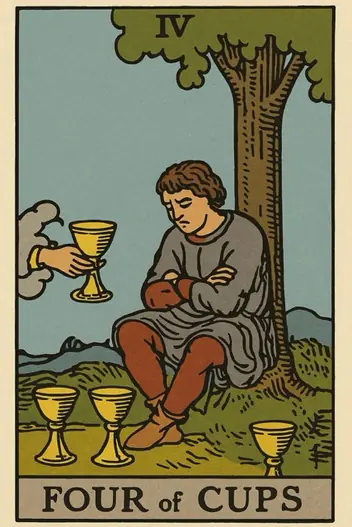
- Arcana
- Six of Wands — Minor Arcana, Wands; Four of Cups — Minor Arcana, Cups
- Elements
- Six of Wands — Fire; Four of Cups — Water
- Elemental interaction
- Opposing elements — energies create tension
- Numerology
- 6 + 4 = 10 → 1
The Six of Wands and Four of Cups present a fascinating psychological tension: external validation meets internal dissatisfaction. The Six of Wands represents triumph, recognition, and the ego’s need for applause. The Four of Cups embodies apathy, withdrawal, and a refusal to engage with present opportunities. When these archetypes collide, the seeker often finds themselves standing on a pedestal they no longer want to occupy.
This combination typically surfaces during a period of visible success that feels hollow. You may have achieved a goal, received a promotion, or earned public praise—yet something essential feels missing. The Four of Cups whispers that the victory itself isn’t the problem; it’s the disconnection from what genuinely matters that creates the emotional void. The challenge lies in distinguishing between legitimate burnout and a deeper misalignment of values.
Six of Wands and Four of Cups Together: Meaning
The core dynamic here is a motivational paradox: the external world rewards you, while your inner world feels indifferent. This isn’t necessarily a negative sign—it often indicates a necessary recalibration of priorities. The Six of Wands energy pushes you to accept recognition gracefully, even if it feels undeserved or unsatisfying. The Four of Cups energy urges you to pause and examine why the victory tastes like ash.
Psychologically, this combination activates the Jungian shadow of the “good soldier” —someone who performs for external approval while ignoring their own emotional reality. The key insight is that recognition doesn’t equal fulfillment. You may need to separate the achievement itself from the emotional weight you’re attaching to it. The Four of Cups invites you to ask: “Am I rejecting this success, or am I rejecting the person I’ve become to achieve it?”
Strategically, this pair advises deliberate disengagement from external validation for a defined period. Take the win, but don’t let it define your next move. Instead, use the recognition as leverage to create space for introspection. The danger lies in mistaking emotional numbness for genuine dissatisfaction—sometimes, the Four of Cups represents a temporary need for rest, not a permanent rejection of your path.
Your pair is already on the table. Ask your question and draw the clarifying card
or simply focus on it
Six of Wands and Four of Cups for Career and Money
Strategic Opportunities:
Leverage your current recognition to negotiate for better working conditions—you have more leverage than you realize. Use the Four of Cups energy to identify what truly motivates you, not just what looks good on a résumé.
Strategic Opportunities:
Delegate tasks that feel like empty victories to focus on projects with deeper meaning. The Six of Wands success can buy you the time needed to pivot toward more fulfilling work.
Calculated Risks:
Avoid making major financial decisions based on momentary dissatisfaction. The Four of Cups can create a false sense of urgency to “blow up” a stable situation. Don’t quit a job or make a large investment until you’ve sat with the feeling for at least two weeks.
Professionally, this combination signals a critical decision point disguised as a plateau. You may be receiving a promotion, award, or public acknowledgment, yet feel an inexplicable urge to walk away. The pragmatic advice is to separate the achievement from the environment. Ask yourself: “Do I dislike this role, or do I dislike how I’m being treated within it?” The Six of Wands warns against burning bridges while you’re still on a winning streak—use your positive reputation to open doors elsewhere rather than slamming them shut.
Financially, the Four of Cups cautions against rejecting steady income streams out of boredom. The grass may appear greener in a different industry or role, but this card pair suggests the problem is often internal, not external. Bold financial tip: Create a “satisfaction audit” —list what your current role provides (status, money, flexibility) versus what it lacks (meaning, autonomy, growth). If the deficits outweigh the benefits, plan a calculated exit over 3-6 months.
Six of Wands and Four of Cups in Love and Relationships
If you are single:
This combination suggests you may be receiving attention from someone genuinely interested, but you feel oddly disconnected. Evaluate whether your apathy stems from fear of vulnerability or a legitimate mismatch—don’t confuse emotional fatigue with lack of chemistry.
If you are in a relationship:
One partner may be thriving publicly while the other feels emotionally neglected. The success of one can unintentionally trigger withdrawal in the other, creating a cycle of praise and distance.
In relationships, this pairing often reveals a power imbalance in emotional investment. The Six of Wands partner may be receiving accolades at work or in social circles, while the Four of Cups partner feels increasingly invisible or resentful. The key relationship advice here is to schedule intentional, judgment-free conversations where both partners can express how the success dynamic affects them. The Six of Wands partner must resist the urge to dismiss their partner’s withdrawal as jealousy—it may be a legitimate cry for attention.
For singles, the Four of Cups warns against rejecting a potential partner simply because they don’t fit your ideal narrative. You may be so focused on past disappointments (or future fantasies) that you overlook someone who offers genuine stability. Bold action: Write down three specific qualities you’re ignoring in a current prospect, then ask yourself why.
Uncover hidden insights
Let our advanced Tarot system interpret these archetypes specifically for your personal path.
Six of Wands and Four of Cups Reversed: What Changes?
If the Six of Wands is Reversed:
External success is blocked or achieved at the cost of your reputation. You may feel like an "imposter" whose triumph goes unrecognized. Paired with the Four of Cups, this creates a toxic cocktail of envy and apathy. Advice: Stop chasing others' approval and focus on your internal standard of quality.
If the Four of Cups is Reversed:
Apathy gives way to active irritation and rebellion. You are not merely unhappy with success; you are actively sabotaging it. This is a state of "resentment toward the world" — you believe you deserve more but are not receiving it. Warning: Do not burn bridges in a fit of anger. Your dissatisfaction is energy for change, but it needs to be managed.
If BOTH are Reversed:
Complete imbalance. You are simultaneously unable to achieve success (Six reversed) and reject any new opportunities (Four reversed). This is a trap of chronic dissatisfaction. The logical way to correct this is to radically lower your expectations. Advice: Take a "minimum viable action" — a small but concrete step that requires no recognition and evokes no disgust.
When Six of Wands and Four of Cups Signal Trouble
The shadow side of this combination manifests as performative dissatisfaction—using apathy as a shield against vulnerability. You may reject success not because it’s wrong, but because you fear the responsibility it brings. This is a classic cognitive bias known as “affective forecasting error” : you predict that achieving the goal will make you happy, but when it does, you discount the achievement because it doesn’t match your inflated expectations.
Another pitfall is passive-aggressive withdrawal—punishing others (or yourself) by withholding enthusiasm. This can sabotage relationships and career opportunities. The Four of Cups can also mask imposter syndrome, where you feel undeserving of the Six of Wands recognition, leading you to push people away before they discover your perceived flaws. The risk is that you create a self-fulfilling prophecy: by rejecting the victory, you confirm your belief that you don’t belong.
Self-sabotage tip-off: If you find yourself saying “I don’t care” about something you clearly worked hard for, pause. This is often a sign of emotional exhaustion, not genuine indifference. The shadow solution is to acknowledge the discomfort without acting on it—let yourself feel the emptiness without making drastic changes.
Overall Meaning of Six of Wands and Four of Cups
Constructive use of the Six of Wands' energy to balance the Four of Cups requires a shift in focus from "having" to "being." You already possess the resource of recognition and status. The question is how you use it. Instead of seeking the next summit to conquer, use your current success as a platform for exploring your own depths. The Six of Wands grants you security and time—do not squander them chasing new trophies.
Strategic advice: practice "conscious inaction." This is not apathy, but a deliberate refusal of activity. Allow yourself to dwell in the state of the Four of Cups, not with a sense of boredom, but with curiosity. What do you feel when there is no need to prove anything? What desires surface when you are not trying to monetize them? Your task is not to get rid of the Four of Cups, but to transform it from apathy into receptivity.
The profound conclusion is this: true success is not the absence of emptiness, but the ability to fill it with what is personally valuable to you. The Six of Wands has given you a stage. Now decide what play you want to perform. The Four of Cups is not an enemy, but an inner critic demanding authentic, not merely ostentatious, fulfillment. Accept its challenge.
Your Next Step: Personal Context Matters
The Six of Wands and Four of Cups ultimately teach that external success cannot substitute for internal alignment. The core message is to accept recognition gracefully while giving yourself permission to feel conflicted. Your next step is to identify one area where you’re rejecting a genuine opportunity because it doesn’t match your ideal scenario—and decide whether to engage with it on your own terms.
For a truly personalized interpretation, context is everything. The meaning of this combination shifts dramatically depending on whether you’re the one receiving praise or the one feeling withdrawn. That’s why the Fortune Cards app exists. While this article provides the general archetype, the app applies these insights to your unique question, your specific situation, and the exact positions of these cards in your spread. You can use it on the web or download it to get a deep, personalized interpretation of this combination right now—because the real magic happens when Tarot meets your life.
Interpretation by the Fortune Cards editorial team, based on the Rider–Waite tradition and Jungian archetypes. About our methodology · Updated: 2026-08-26
Other Combinations with Six of Wands
Other Combinations with Four of Cups
Explore Individual Card Meanings
Table of Contents
- Six of Wands and Four of Cups Together: Meaning
- Six of Wands and Four of Cups for Career and Money
- Six of Wands and Four of Cups in Love and Relationships
- Six of Wands and Four of Cups Reversed: What Changes?
- When Six of Wands and Four of Cups Signal Trouble
- Overall Meaning of Six of Wands and Four of Cups
- Your Next Step: Personal Context Matters
Ready to find answers to your questions?
Start your first reading now and look at your situation with fresh clarity. The cards are ready to reveal deeper meaning.