Six of Wands and Ten of Wands Tarot as Feelings
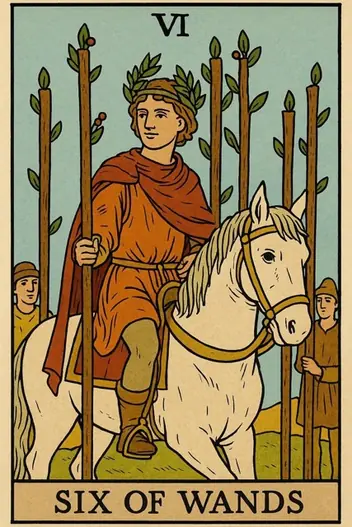

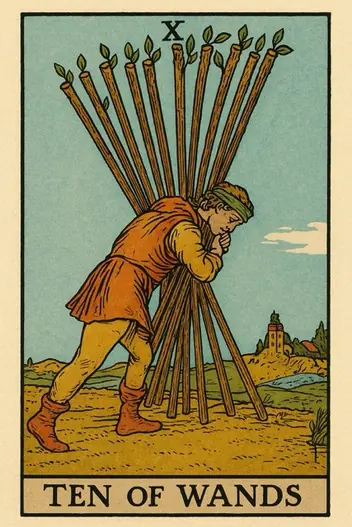
- Arcana
- Six of Wands — Minor Arcana, Wands; Ten of Wands — Minor Arcana, Wands
- Elements
- Six of Wands — Fire; Ten of Wands — Fire
- Elemental interaction
- Same element — energies intensify each other
- Numerology
- 6 + 10 = 16 → 7
This combination represents a critical psychological crossroads: the moment when public recognition and personal validation collide with the crushing burden of responsibility. The Six of Wands archetype embodies the ego’s need for external approval, victory, and social proof. The Ten of Wands archetype, in contrast, forces the confrontation with limits, burnout, and the weight of obligations. When these two energies merge in a reading, they reveal a person who has achieved something significant—but at a cost that may be unsustainable.
In real-world terms, this is the entrepreneur who wins industry awards while working 80-hour weeks, the manager promoted to a role they cannot handle alone, or the caregiver praised by family while secretly exhausted. The psychological tension here is between the hero’s triumph and the martyr’s fatigue. The key insight is that the recognition is real, but so is the price. The question becomes: how do you leverage success without sacrificing your well-being?
Six of Wands and Ten of Wands Combination Meaning
The psychological state created by the Six of Wands and Ten of Wands together is one of achievement-driven burnout. The seeker has likely received validation—a promotion, public praise, a relationship milestone—but the energy of the Ten of Wands reveals that this success comes with an unmanageable load. The Jungian shadow here is the "Hero Complex": the unconscious belief that one must suffer to be worthy of recognition. This leads to a dangerous cycle of overcommitting to maintain status.
The cognitive bias most relevant is the "sunk cost fallacy." The seeker may feel they have invested too much time, energy, or reputation to stop now, even if the burden is destroying their health or relationships. Pragmatically, this combination demands a strategic audit: identify which tasks, relationships, or obligations can be delegated, renegotiated, or shed without losing the core of what was achieved. The ego (Six of Wands) wants to keep the trophy; the body and psyche (Ten of Wands) are screaming for relief.
A key distinction: this is not a warning against ambition. It is a warning against unchecked ambition without boundaries. The most sophisticated response is to accept the accolade, then immediately restructure your life to prevent collapse. The archetype of the Wise King—who delegates, trusts others, and knows his limits—is the healthy outcome here. The archetype of the Overburdened Martyr is the shadow to avoid.
Career and Finances
Strategic Opportunities:
Leverage your recent success to negotiate for better resources, support staff, or a lighter workload. The recognition gives you leverage.
Strategic Opportunities:
Use this moment to delegate or outsource tasks that drain energy but do not require your unique skills.
Calculated Risks:
Avoid accepting new projects or promotions until you have offloaded existing burdens. Saying "yes" now may lead to a crash.
Professionally, this combination signals a critical inflection point. You have likely achieved a visible win—a promotion, a successful project, positive press. However, the Ten of Wands warns that the infrastructure supporting this success is fragile. Bold financial warning: do not increase spending or lifestyle inflation based on this recognition alone. The income may be temporary or come with hidden costs (e.g., longer hours, higher stress, health issues).
The most pragmatic action is to create a "burden audit." List every task, responsibility, and obligation you currently hold. Categorize them by: (1) essential to your core role, (2) important but delegable, (3) unnecessary or low-value. Then, use your newfound credibility to request a team, a budget, or a timeline extension. The key psychological shift is from "I must prove myself by doing everything" to "I prove myself by leading effectively." True leadership is about leverage, not labor.
Your pair is already on the table. Ask your question and draw the clarifying card
or simply focus on it
Six of Wands and Ten of Wands in Love Tarot
If you are single:
This pair suggests you may be attracting partners who admire your public persona but fail to see your private exhaustion. Focus on screening for emotional support, not just admiration.
If you are in a relationship:
You or your partner may be carrying an unequal load of responsibilities, while one person receives most of the credit or attention.
In relationships, this combination often reveals a power imbalance disguised as partnership. One person may be the "star" (Six of Wands)—the one praised by friends, family, or social media—while the other quietly manages the household, emotional labor, or financial stress (Ten of Wands). This dynamic breeds resentment. Bold key advice: schedule a candid conversation about workload distribution. Ask: "Are we both carrying this relationship equally, or is one person performing heroism while the other suffers?"
For couples, the psychological insight is that public validation can become a trap. If you are the one receiving praise, you may unconsciously pressure your partner to maintain the "perfect couple" image, ignoring their burnout. If you are the one carrying the load, you may feel invisible. The healthy resolution is mutual recognition and rebalancing. Acknowledge the achievement, then renegotiate the terms of partnership to ensure sustainability.
Uncover hidden insights
Let our advanced Tarot system interpret these archetypes specifically for your personal path.
Shadow Side & Pitfalls
The shadow of this combination manifests when the seeker refuses to acknowledge the weight of the Ten of Wands. The ego (Six of Wands) becomes inflated by praise, leading to hubris and overcommitment. The cognitive bias here is "optimism bias"—the belief that you can handle more than is humanly possible. This leads to a burnout spiral: you take on more to maintain the image of success, which degrades your performance, which forces you to work harder to regain the recognition.
Another shadow manifestation is martyrdom: the unconscious need to suffer for approval. The seeker may complain about their burden but secretly derive identity from being "the one who carries it all." This is a Jungian shadow complex where suffering becomes a currency for love and respect. The danger is that this pattern destroys relationships, health, and creativity. The antidote is ruthless self-honesty: ask yourself, "Would I still feel valuable if I stopped overworking? Would I still feel loved if I set boundaries?"
A third pitfall is resentment toward those who helped achieve the success. The Six of Wands can make the seeker feel solely responsible for the victory, ignoring the contributions of others. This leads to isolation and, ironically, a heavier burden (Ten of Wands) because you refuse to ask for help. The shadow demands you confront the ego's need for exclusive credit.
Reversed Six of Wands and Ten of Wands Explained
When cards appear in a reversed position, the dynamic is distorted, but not eliminated. If the Six of Wands is reversed and the Ten is upright — you are carrying an excessive burden, but receiving no recognition for it. This is the state of the "invisible hero," which leads to deep frustration and cynicism. Advice: stop waiting for external approval. Create a system of internal validation and publicly, without hesitation, document your achievements; otherwise, you risk becoming a "workhorse."
If the Ten of Wands is reversed and the Six is upright — you are shedding responsibility, but doing so chaotically, risking your reputation. This is an attempt to unburden yourself that looks like irresponsibility. Warning: do not abandon tasks halfway. If you are handing off a task, ensure the recipient has the resources to complete it. Otherwise, your triumph (the Six) will turn into a public failure.
If BOTH cards are reversed, we see a complete imbalance: you are overloaded, receiving no recognition, and actively sabotaging your own efforts. This is a state of learned helplessness. A logical way to correct it: take a pause. Let go of everything that is not critical. Lower your expectations to zero and start small — complete one simple task and publicly acknowledge it. Restore the "effort-result-recognition" cycle on a micro level.
What Is the Overall Message of Six of Wands and Ten of Wands?
Constructive use of this combination requires paradoxical thinking. You need to use the energy of triumph (Six) to shed the burden (Ten). This means that the moment of your greatest recognition is the ideal time to delegate authority. When you are at your peak, you have the leverage to negotiate better terms for yourself and your team. Do not wait for a crisis to start delegating; do it from a position of strength.
Strategically, your main goal is to transform the "burden" into "infrastructure." Instead of carrying 10 Wands, build a cart (a system) that allows you to transport 20 Wands with less effort. This requires investment—time, money, training others. But this is precisely what separates a successful executor from an effective leader. Deep advice: find one person to whom you can entrust 30% of your current tasks. Start with the most routine and energy-draining ones. Your payment to them is your patronage and training. This is not a loss of control, but the creation of leverage.
Remember: the Six of Wands is not a final destination, but an observation deck. From it, you must see not only the path you have traveled, but also how to make the next stage easier. Your task is not merely to carry the burden to the summit, but to build a base on that summit for further growth without self-destruction.
Your Next Step: Personal Context Matters
The core message of Six of Wands and Ten of Wands is clear: your success is real, but your current strategy is unsustainable. You must accept the recognition without accepting the martyrdom. The most intelligent response is to use your victory as leverage to restructure your life—delegate, set boundaries, and renegotiate obligations. Do not let the fear of losing approval keep you trapped in a cycle of burnout.
However, no article can capture the nuance of your specific situation. The true power of Tarot lies in applying these archetypes to your unique question, relationship, or career dilemma. That is why I recommend using the Fortune Cards app. Whether on the web or downloaded, it provides a deep, personalized interpretation of this exact combination for your exact question—right now. Stop guessing and get the clarity you need to act decisively.
Interpretation by the Fortune Cards editorial team, based on the Rider–Waite tradition and Jungian archetypes. About our methodology · Updated: 2026-09-24
Other Combinations with Six of Wands
Other Combinations with Ten of Wands
Explore Individual Card Meanings
Table of Contents
Ready to find answers to your questions?
Start your first reading now and look at your situation with fresh clarity. The cards are ready to reveal deeper meaning.