Three of Wands and Four of Cups Tarot Combination
- Arcana
- Three of Wands — Minor Arcana, Wands; Four of Cups — Minor Arcana, Cups
- Elements
- Three of Wands — Fire; Four of Cups — Water
- Elemental interaction
- Opposing elements — energies create tension
- Numerology
- 3 + 4 = 7
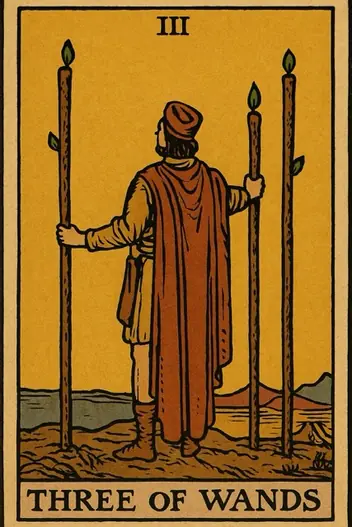
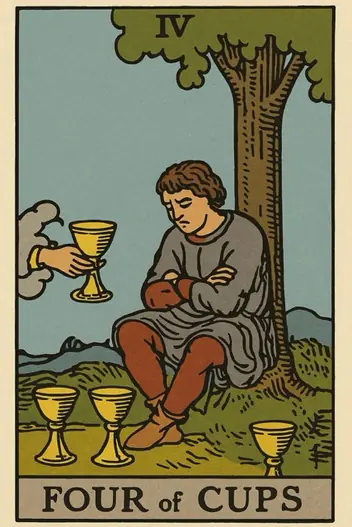
The collision of the Three of Wands and the Four of Cups creates a fascinating psychological paradox: you are standing at the edge of a major opportunity, yet you feel a profound sense of emotional disengagement. The Three of Wands represents forward momentum, strategic planning, and the thrill of expansion—the archetype of the Explorer who scans the horizon for the next conquest. The Four of Cups, however, embodies introspection, dissatisfaction, and the quiet refusal of an offered gift—the archetype of the Apathetic Observer who has seen it all before.
In practical terms, this combination suggests you have built a solid foundation for growth—perhaps a new business venture, a relocation, or a significant career move—but your inner world is whispering that something is missing. You are not rejecting the opportunity itself; you are rejecting the emotional payoff it promises. This is not laziness or lack of ambition; it is a signal that your current trajectory may be misaligned with your deeper values. The key insight here is that your apathy is a form of intelligence, not a weakness. It is asking you to pause and recalibrate before committing to a path that looks good on paper but feels hollow in practice.
Three of Wands and Four of Cups Card Meaning Explained
When the expansive energy of the Three of Wands meets the withdrawn energy of the Four of Cups, the resulting mindset is one of strategic dissatisfaction. You are not stuck; you are evaluating. The Three of Wands pushes you to act, to explore, to build bridges to the future. But the Four of Cups pulls you inward, urging you to question whether the bridge you are building leads to a destination you actually want to reach. This tension creates a psychological bottleneck: you have the resources and the plan, but you lack the emotional conviction to execute.
The core dynamic here is a conflict between external success metrics and internal fulfillment. The Three of Wands represents the tangible world—status, money, recognition, expansion. The Four of Cups represents the subjective world—meaning, satisfaction, emotional resonance. When these two cards appear together, they force you to ask: "Am I chasing what I truly want, or what I think I should want?" This is not a time for impulsive action; it is a time for conscious decision-making. You must separate the excitement of the plan from the reality of its emotional payoff. The most pragmatic interpretation is that you are being offered a choice, but your apathy is a protective mechanism—it is preventing you from wasting energy on a path that will leave you empty.
Three of Wands and Four of Cups: Career and Money
Strategic Opportunities:
Leverage your existing network and resources to explore new markets or roles, but only after a clear-eyed assessment of whether they align with your personal values. The Three of Wands gives you the ability to expand; use it to gather data, not to commit blindly.
Strategic Opportunities:
Use your dissatisfaction as a catalyst for innovation. The Four of Cups' apathy can be reframed as a sign that your current role or project is no longer challenging you. Consider pivoting to a niche that requires your unique expertise.
Calculated Risks:
Avoid accepting offers out of obligation or fear of missing out. The Four of Cups warns against taking a "gift" that feels hollow. If a promotion, partnership, or financial deal does not excite you, it is likely a trap disguised as progress. Do not mistake momentum for meaning.
In the professional realm, this combination often appears when you are being courted for a new opportunity—a job offer, a promotion, a business partnership—but you feel strangely unmoved. The Three of Wands represents the external validation: the prestige, the salary increase, the impressive title. The Four of Cups represents your internal response: "Is this really what I want?" The most pragmatic approach is to run a cost-benefit analysis on emotional energy, not just financial gain. Ask yourself: "If I take this path, will I feel more alive or more drained in six months?" This is also a warning against over-commitment to a plan that was made when you were in a different psychological state. If you planned a career move months ago but now feel apathetic, it is not a sign of weakness to pause and reassess. It is a sign of emotional intelligence. Financially, this combination advises against major investments or expansions until you resolve the inner conflict. The money will follow the meaning, not the other way around.
Your pair is already on the table. Ask your question and draw the clarifying card
or simply focus on it
Three of Wands and Four of Cups as Feelings
If you are single:
This combination suggests you may be attracting potential partners who seem promising on paper—stable, ambitious, available—but you feel oddly indifferent. Do not force chemistry. Your apathy is a valid signal that the connection lacks emotional depth, and pursuing it will likely lead to disappointment.
If you are in a relationship:
You or your partner may be withdrawing emotionally, even as the relationship itself appears stable. The issue is not a lack of love, but a lack of novelty or shared vision. One person is planning for the future while the other is disengaged, creating a dangerous power imbalance.
In the context of love, the Three of Wands and Four of Cups often point to a mismatch in relational investment. One partner is actively building a shared future—planning trips, discussing long-term goals, initiating conversations about commitment—while the other is sitting back, feeling uninspired or even resentful. This is not necessarily a sign of a failing relationship; it is a call to address the underlying emotional hunger. The partner embodying the Four of Cups may need to articulate what is missing, while the partner embodying the Three of Wands must resist the urge to over-function or compensate for the other's apathy. Key relationship advice: do not mistake stability for satisfaction. If you are the one feeling disengaged, ask yourself: "What am I really avoiding?" If you are the one pushing forward, ask: "Am I trying to fill a void with activity?" The healthiest path forward involves honest communication about unmet needs and a willingness to adjust the plan to include emotional nourishment, not just logistical progress.
The Shadow Side of Three of Wands and Four of Cups
The shadow manifestation of the Three of Wands and Four of Cups is a dangerous form of passive-aggressive stagnation. You may outwardly appear to be moving forward—sending emails, attending meetings, updating your resume—but inwardly you are sabotaging your own progress by withholding emotional investment. This is a cognitive bias known as "the sunk cost fallacy" : you continue to invest time and energy into a plan or relationship because you have already invested so much, even though you know it no longer serves you. Alternatively, you may fall into "analysis paralysis" , where you endlessly scan the horizon for better options (Three of Wands) while rejecting every current possibility (Four of Cups), leading to a state of chronic indecision.
Another pitfall is projecting your apathy onto others. You may blame your partner, boss, or circumstances for your lack of enthusiasm, when in reality the disconnection is internal. This can lead to resentment, passive aggression, or sudden, dramatic exits from situations that were actually salvageable. The shadow side of this combination also includes over-idealizing the future while devaluing the present. You may convince yourself that the "next big thing" will finally make you happy, only to find that same apathy waiting for you there. The most dangerous move is to force action without resolving the emotional disconnect. This leads to burnout, regret, and a cycle of starting over without ever feeling fulfilled.
Get a personalized interpretation
Unlock the combined meaning of your cards in the context of your unique question — for free.
Three of Wands and Four of Cups Reversed: What Changes?
When cards appear in a reversed position, the dynamic becomes more acute and less controllable.
If the Three of Wands is reversed:
This indicates blocked potential or recklessness. You are either setting unrealistic goals or, conversely, afraid to act, missing your window of opportunity. Warning: do not try to force events. Your plans may collapse due to a lack of preparation or excessive overconfidence. Take a step back and verify the facts.
If the Four of Cups is reversed:
This signals internal resistance or weakness. You are not merely passive; you are actively sabotaging your own opportunities. You may be rejecting help, overlooking obvious chances, or sinking into depression. Advice: start small. Take one action you have been putting off. This will break the cycle of apathy.
If BOTH are reversed:
This is a complete imbalance. You are in a state of paralysis of will and chaos of thoughts. Your plans are absurd, and your emotions are uncontrollable. The logical way to correct this: temporary isolation from making important decisions. Take a break for 1-2 weeks, engage in physical activity and routine tasks. Only after restoring your baseline energy level can you return to strategy.
Three of Wands and Four of Cups: The Combined Message
How can the energy of the Three of Wands be used constructively to activate the Four of Cups? The key lies in redefining "novelty." The Three of Wands strives for external expansion, but the Four of Cups does not respond to external stimuli. Therefore, you need to direct the energy inward. Instead of seeking new clients, partners, or projects, engage in a deep restructuring of your current assets. Perhaps you need to change not what you do, but how you do it.
The second strategic move is creating artificial scarcity. The Four of Cups suffers from satiety. To restore interest, you need to create conditions where something becomes unavailable. Temporarily limit yourself in resources (time, money, information) to re-experience their value. For example, set a strict deadline for yourself or give up one source of income for a month. This will force your mind to seek new, more creative paths.
A deep strategic piece of advice: do not try to "overcome" apathy with willpower. This will lead to exhaustion. Instead, use the inertia of the Four of Cups as fuel for the Three of Wands. Ask yourself: "What can I do less of to get more?" The answer often lies in abandoning ineffective actions, not in adding new ones. Your task is not to rekindle the fire, but to clear away the ashes that are smothering it.
Your Next Step: Personal Context Matters
The core message of the Three of Wands and Four of Cups is that you are at a crossroads where external opportunity meets internal dissatisfaction. The path forward is not about forcing enthusiasm or ignoring your apathy; it is about using that apathy as a compass to recalibrate your goals. You have the resources to expand—but only if you expand toward what truly matters to you. This is a moment for strategic patience, not impulsive action.
While this article provides a general archetype of this powerful combination, the true magic happens when Tarot is applied to your unique situation. Your specific question, your personal history, and the positions of these cards in a spread can reveal nuances that generic interpretations cannot touch. That is why I recommend using the Fortune Cards app. Whether you access it on the web or download it, you can get a deep, personalized interpretation of this exact combination for your specific question right now. Stop guessing and start understanding what your inner world is truly asking of you.
Interpretation by the Fortune Cards editorial team, based on the Rider–Waite tradition and Jungian archetypes. About our methodology · Updated: 2026-08-26
Other Combinations with Three of Wands
Other Combinations with Four of Cups
Explore Individual Card Meanings
Table of Contents
- Three of Wands and Four of Cups Card Meaning Explained
- Three of Wands and Four of Cups: Career and Money
- Three of Wands and Four of Cups as Feelings
- The Shadow Side of Three of Wands and Four of Cups
- Three of Wands and Four of Cups Reversed: What Changes?
- Three of Wands and Four of Cups: The Combined Message
- Your Next Step: Personal Context Matters
Ready to find answers to your questions?
Start your first reading now and look at your situation with fresh clarity. The cards are ready to reveal deeper meaning.