Love Tarot: Three of Wands and Page of Wands
- Arcana
- Three of Wands — Minor Arcana, Wands; Page of Wands — Minor Arcana, Wands
- Elements
- Three of Wands — Fire; Page of Wands — Fire
- Elemental interaction
- Same element — energies intensify each other
- Numerology
- 3 + 11 = 14 → 5
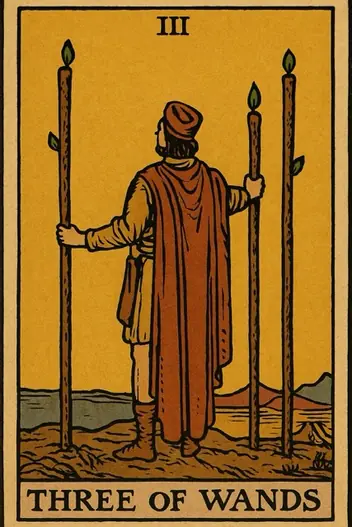
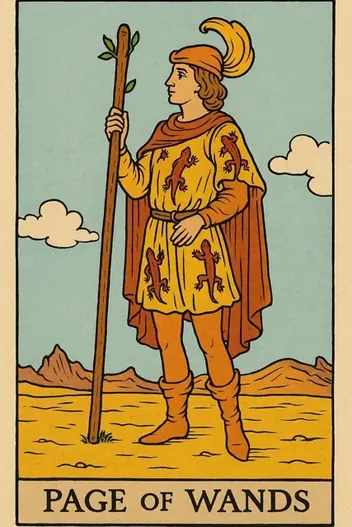
When the Three of Wands—a card of long-term planning, expansion, and calculated foresight—collides with the Page of Wands—an archetype of raw enthusiasm, curiosity, and untested action—you get a psychological cocktail that is both powerful and precarious. This pairing represents the tension between waiting for the right moment and the urge to leap before you look. It’s the strategist who suddenly gets an adrenaline rush, or the novice who accidentally stumbles into a breakthrough.
In Jungian terms, the Three of Wands embodies the conscious ego directing resources and setting goals, while the Page of Wands represents the puer aeternus—the eternal child—who brings novelty and risk, but also immaturity and impatience. The key to mastering this combination is integration: using the Page’s fire to fuel the Three’s vision, without letting the former burn the latter’s bridges.
What Do Three of Wands and Page of Wands Mean Together?
The core dynamic here is a strategic sprint: you have a clear destination (Three of Wands), but you’re tempted to take a shortcut or change the route on a whim (Page of Wands). Psychologically, this creates a state of productive restlessness. You are not stuck; you are actively scanning for new opportunities, but your execution may be scattered. The Page of Wands energy can manifest as a sudden idea, a new contact, or a flash of inspiration that feels urgent—but it demands critical evaluation before you act.
This pairing often appears when you are at a decision point in a project or life phase. The Three of Wands says, “Look at the horizon and commit to a path.” The Page of Wands says, “But what if I try this other, more exciting route?” The practical implication is that you must balance exploration with discipline. Bold: The risk is not in being too ambitious, but in being too impulsive with your ambition. If you act without vetting the Page’s ideas through the Three’s lens of long-term viability, you may waste resources on a distraction. Conversely, if you ignore the Page entirely, you may miss a genuine breakthrough.
In a reading, this combination suggests you have both the vision and the spark to make progress. The challenge is timing: you need to give the Page’s enthusiasm a structured outlet. Use the Three of Wands’ energy to set boundaries around your experiments. For example, allocate a specific time or budget to test a new idea, rather than abandoning your main plan. This creates a controlled risk environment where you can learn without catastrophic failure.
What Do Three of Wands and Page of Wands Indicate for Your Career?
Strategic Opportunities:
Leverage your existing network (Three of Wands) to test a new idea or side project (Page of Wands). This combination is excellent for entrepreneurial pilots or innovative marketing campaigns that don’t require a full resource commitment.
Strategic Opportunities:
Use the Page’s curiosity to research new markets or skills. Enroll in a short course, attend a networking event, or conduct a small-scale experiment. The Three of Wands ensures your efforts are aligned with a broader plan.
Calculated Risks:
Avoid over-committing to a new venture based on hype. The Page of Wands can make an opportunity look more promising than it is. Bold: Do not quit your job or drain your savings on an untested idea. Set a clear “stop-loss” point before you start.
In a career context, this pairing is a green light for exploration, but a yellow light for full investment. You may feel a strong urge to pivot careers, launch a startup, or propose a radical new project. The psychological strength here is your ability to spot potential where others see only risk. However, the shadow side is overconfidence in your own enthusiasm. Bold: The most pragmatic move is to treat the Page’s idea as a “side hustle” or a “proof of concept” while maintaining your current role or revenue stream.
Financially, this combination warns against speculative bets or “get-rich-quick” schemes. The Three of Wands is about calculated expansion, not gambling. If you are considering an investment, use the Page’s energy to research aggressively but the Three’s energy to demand data and timelines. Bold: A balanced approach would be to allocate no more than 10% of your capital to high-risk, high-reward experiments. This allows you to learn without jeopardizing your financial stability.
Your pair is already on the table. Ask your question and draw the clarifying card
or simply focus on it
Three of Wands and Page of Wands in Love Tarot
If you are single:
This pair suggests you are attracted to someone who is exciting and full of potential, but beware of projecting a fantasy onto them. The Page of Wands energy can make a new connection feel like a grand adventure, but the Three of Wands warns you to check if they share your long-term values or life direction.
If you are in a relationship:
You and your partner may be at a crossroads where one of you wants to shake things up (Page) while the other wants to solidify plans (Three). This is a classic tension between novelty and security. Bold: The key is to find a shared project or goal that channels the excitement into a constructive direction.
In relationships, this combination often points to a mismatch in pacing. One partner may feel the relationship is stagnating and wants to inject spontaneity (Page of Wands), while the other is focused on building a stable future (Three of Wands). This can lead to resentment if unaddressed. The psychological insight here is that both energies are valid: the relationship needs both the excitement of new experiences and the security of a shared plan. Bold: Avoid the trap of dismissing the Page’s impulses as childish or the Three’s caution as boring. Instead, negotiate a compromise: schedule regular “adventure dates” or jointly plan a future milestone that excites both of you.
If you are single, this combination warns against rushing into commitment based on chemistry alone. The Page of Wands can make you feel like you’ve found “the one” after one great conversation, but the Three of Wands asks you to step back and observe if this person aligns with your life trajectory. Use the Page’s energy to initiate contact and explore, but keep the Three’s perspective to assess compatibility over time. Bold: The healthiest outcome is a slow burn, not a wildfire.
Shadow Side & Pitfalls
The shadow of this combination manifests when impulsivity overrides strategy. The Page of Wands, unchecked, can lead to scattered efforts—starting five projects and finishing none. The Three of Wands, in its shadow, can become paralyzed by analysis—endlessly planning but never acting. Together, their unhealthy expression is a cycle of grand visions followed by hasty, poorly-executed actions.
Cognitive biases to watch for: the Dunning-Kruger effect (overestimating your competence due to the Page’s enthusiasm) and the sunk cost fallacy (refusing to abandon a flawed plan because you’ve already invested time, per the Three of Wands). You may also fall into confirmation bias, only seeking information that supports your exciting new idea while ignoring red flags.
Self-sabotage occurs when you use the Page’s energy to distract yourself from the hard work of implementation. Instead of executing your plan, you chase a new shiny object. The psychological root is often fear of failure—the Page’s novelty provides an excuse to avoid the Three’s accountability. Bold: The antidote is to commit to one path for a defined period, then review. If you find yourself constantly pivoting, ask: “Am I exploring, or am I avoiding?”
Your unique Tarot reading
See how these cards interact with your destiny. Start a free personal reading now.
What If Three of Wands or Page of Wands Appears Reversed?
When cards appear reversed, constructive tension turns into destructive imbalance.
If the Three of Wands is reversed:
Strategic vision is blocked. You are either postponing action due to fear of failure, or conversely, acting recklessly, ignoring obvious risks. Advice: return to basic planning. Write down 3 main goals and 3 main obstacles on paper. This will restore clarity.
If the Page of Wands is reversed:
Enthusiasm has waned. You feel inner resistance, apathy, or lack of confidence in your abilities. This is the state of a "burned-out startup." Advice: don't try to "force" yourself to act. Find one small, easy task that will bring you joy, and complete it.
If BOTH are reversed:
Complete imbalance. You are stuck between paralysis of will and meaningless bustle. This is a signal for a complete reset of the approach. You need to temporarily step away from strategy and stop trying to generate energy. The best action is a 24-48 hour pause, sleep, and a change of scenery.
Three of Wands and Page of Wands Combined Message
Constructive use of this combination requires shifting energy from reactive to proactive. Your task is not to wait for inspiration, but to create the conditions in which it will arise. Use the Three of Wands as the "observation post" card: identify 2-3 specific success indicators (KPIs) for your plan. Then use the Page of Wands as the "scout" card: take one small but concrete action that brings you closer to one of these indicators.
For example, if your goal is to start a business (Three), your Page action might not be writing a business plan, but one phone call to a potential supplier. This micro-step will shatter the illusion of complexity and provide real feedback. Strategic advice: apply the "5-second rule." As soon as you realize a step needs to be taken, you have 5 seconds to begin physical movement. This tricks the brain, which blocks action through fear, and unleashes the Page's energy under the control of the Three's strategy.
Applying This to Your Situation
The core message of Three of Wands and Page of Wands is that vision without action is a daydream, but action without vision is a nightmare. You have the tools to build something significant, but only if you marry your strategic foresight with disciplined experimentation. The combination asks you to be both the architect and the scout—planning the journey while staying open to detours that actually improve the route.
This article offers a general archetypal analysis, but your specific situation—your question, your timing, your other cards—changes the meaning dramatically. To get a deep, personalized interpretation of this exact combination for your unique question, use the Fortune Cards app. You can access it on the web or download it now. The app applies your context—your relationship status, career stage, and emotional state—to deliver a reading that is truly yours. Stop guessing. Start acting with clarity.
Interpretation by the Fortune Cards editorial team, based on the Rider–Waite tradition and Jungian archetypes. About our methodology · Updated: 2026-08-26
Other Combinations with Three of Wands
Other Combinations with Page of Wands
Explore Individual Card Meanings
Table of Contents
- What Do Three of Wands and Page of Wands Mean Together?
- What Do Three of Wands and Page of Wands Indicate for Your Career?
- Three of Wands and Page of Wands in Love Tarot
- Shadow Side & Pitfalls
- What If Three of Wands or Page of Wands Appears Reversed?
- Three of Wands and Page of Wands Combined Message
- Applying This to Your Situation
Ready to find answers to your questions?
Start your first reading now and look at your situation with fresh clarity. The cards are ready to reveal deeper meaning.