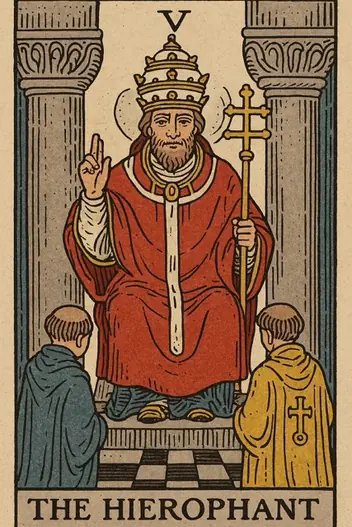
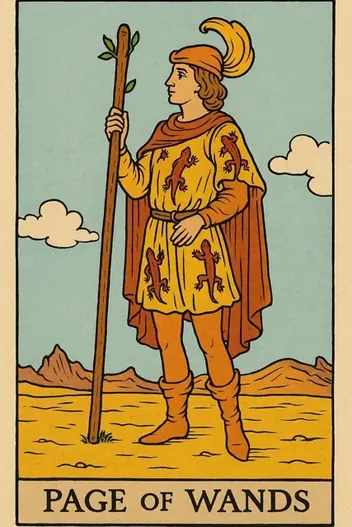
The Hierophant and Page of Wands Tarot as Feelings
- Arcana
- The Hierophant — Major Arcana; Page of Wands — Minor Arcana, Wands
- Elements
- The Hierophant — Earth; Page of Wands — Fire
- Elemental interaction
- Neutral elements — energies coexist without conflict
- Numerology
- 5 + 11 = 16 → 7
When The Hierophant—the archetype of institutional wisdom, structure, and established norms—collides with the Page of Wands—the youthful, curious, and often impulsive seeker of new experiences—you get a psychological tension that is both productive and destabilizing. This pairing represents the internal conflict between following the proven path and chasing an untested but exciting idea.
In real-world terms, this combination often appears when a person is standing at the threshold of a new venture, but they feel compelled to seek approval from a mentor, institution, or set of rules before proceeding. The key insight here is that the Page of Wands does not need permission to explore—but The Hierophant insists that structure is the only safe container for innovation. The resulting dynamic is a negotiation between freedom and discipline, between raw enthusiasm and seasoned restraint.
The Hierophant and Page of Wands Combination Meaning
At its psychological core, this pairing activates the tension between the Superego (the internalized rules and authority figures represented by The Hierophant) and the Ego’s desire for individuation (the Page of Wands’ drive to forge a unique identity). The seeker is likely experiencing a strong urge to break free from established systems—whether that’s a family tradition, a corporate ladder, or a spiritual dogma—yet simultaneously feels a deep-seated need for validation from those same systems.
The mindset here is one of cautious rebellion. You want to innovate, but you are not ready to burn bridges. This is not a revolutionary energy; it is a reformist one. The practical implication is that you should leverage existing structures to support your new ideas, rather than trying to dismantle them. For example, if you want to start a side business, The Hierophant suggests using your current professional network or formal education as a foundation, while the Page of Wands whispers to test the waters with small, low-risk experiments.
The strategic action this combination calls for is structured exploration. Create a plan with clear milestones, but allow room for improvisation. The danger lies in either becoming rigidly dogmatic (over-identifying with The Hierophant) or recklessly impulsive (over-identifying with the Page of Wands). The balanced path is to treat tradition as a tool, not a cage, and to treat your new ideas as hypotheses to be tested, not truths to be preached.
Your pair is already on the table. Ask your question and draw the clarifying card
or simply focus on it
The Hierophant and Page of Wands in Love Tarot
If you are single:
This pairing suggests you may be attracted to someone who embodies a mix of stability and spontaneity—perhaps an older, wiser figure with a playful edge. Be cautious of projecting a "teacher" role onto a potential partner; focus on mutual learning rather than hierarchy.
If you are in a relationship:
The dynamic likely involves one partner wanting to shake up the routine (Page of Wands) while the other insists on maintaining traditional roles or expectations (The Hierophant). The core issue is not the conflict itself, but whether both partners can negotiate a new set of shared rules.
In relationships, this combination often points to a power struggle between spontaneity and predictability. The Page of Wands partner may feel stifled by routines or family expectations, while the Hierophant partner may feel threatened by change. The psychological work here is to redefine what "commitment" means—is it about sticking to a script, or about being committed to the process of growth together? Bold relationship advice: Schedule a "tradition vs. innovation" conversation where both partners can propose one change to the relationship structure each month, and agree to test it for 30 days without judgment.
Career Meaning of The Hierophant and Page of Wands
Strategic Opportunities:
Seek a mentor who values experimentation. Look for a boss or colleague who has institutional knowledge but also supports pilot projects or "skunkworks" initiatives.
Strategic Opportunities:
Use formal training or certifications to legitimize your unconventional ideas. A degree, license, or industry credential can open doors for your creative projects.
Calculated Risks:
Avoid proposing radical changes to systems you do not yet fully understand. The Page of Wands can be naive about the reasons behind existing protocols—study the rules before you try to rewrite them.
From a career perspective, this combination is a signal to innovate within boundaries. You may have a brilliant idea for a new product, process, or service, but The Hierophant warns that you need to respect the chain of command or industry standards to get buy-in. Bold financial warning: Do not quit your day job yet. Use your current position as a "laboratory" to test your idea on a small scale. For example, if you work in marketing, propose a pilot campaign that uses a new channel but aligns with the brand guidelines. The Page of Wands gives you the energy to pitch; The Hierophant ensures you have the data to back it up.
Financially, this pairing advises against speculative investments or "get rich quick" schemes that require abandoning all conventional wisdom. Instead, allocate a small percentage of your portfolio (e.g., 5-10%) to higher-risk, high-potential ideas while keeping the majority in stable, proven assets. This mirrors the psychological strategy: satisfy the Page of Wands' need for novelty without jeopardizing the Hierophant's need for security.
Ask your specific question
Don't rely on generic meanings. Get a customized reading tailored specifically to your energies.
The Hierophant and Page of Wands: Warning Signs
The shadow manifestation of this combination is dogmatic rebellion—the seeker rejects tradition not because it is flawed, but because they want to feel special or unique. This is a cognitive bias known as reactance, where the urge to oppose a rule becomes more important than the goal itself. The Page of Wands, in its shadow, becomes a perpetual student who never graduates, always learning but never applying. The Hierophant, in its shadow, becomes a gatekeeper who uses rules to control rather than guide.
Self-sabotage occurs when you mistake novelty for progress. Just because an idea is new does not mean it is better. Conversely, just because something is traditional does not mean it is true. The pitfall is binary thinking—framing the choice as "follow the rules OR break free" when the real answer is "understand the rules, then choose which ones to keep." Poor judgment here looks like starting a new business without consulting a lawyer (ignoring The Hierophant) or staying in a dead-end job because "that's what my family does" (ignoring the Page of Wands).
Reversed Positions: What Changes?
When one or both cards are reversed, the dynamic becomes distorted, amplifying the shadow aspects.
If The Hierophant is reversed:
This indicates a blocking of the Page's potential due to rigid internal prohibitions or external pressure. You are afraid to step outside the lines, even though you passionately want to. Advice: start small—break one insignificant rule to test that the world won't collapse.
If the Page of Wands is reversed:
Enthusiasm turns into recklessness or passive aggression. You reject any tradition solely for the sake of rebellion, losing focus and resources. Warning: your "innovation" is simply infantile sabotage. Find a constructive channel for your energy.
If BOTH are reversed:
Complete imbalance—a crisis of the system and a loss of momentum. The person is stuck between the fear of change and the disgust for stability. Advice: take a pause. The only logical step is to consult an external advisor (therapist, coach) who can help restore the connection between your values and your actions.
What Is the Overall Message of The Hierophant and Page of Wands?
The constructive strategy is to use the Hierophant as a methodology and the Page of Wands as fuel. Do not try to choose between them. Instead, create a "structure for experiments" for yourself. For example, set aside one hour a day (Hierophant) for complete, rule-free creativity (Page). Or dedicate one month a year (Hierophant) to working on a "crazy" project that falls outside your usual activities (Page).
This approach allows you to channel impulsive energy into sustainable growth. You are not suppressing your enthusiasm, but giving it a safe framework in which to manifest. This is the path of a mature leader who is not afraid of novelty but respects experience. Your strength lies in your ability to be both reliable and inspiring.
A deep strategic counsel: Become an "architect of change." Instead of tearing down an old wall, design a door within it. Your task is not to destroy the system, but to make it more flexible and adaptive. Use your reputation and authority (Hierophant) to gain a mandate for experimentation (Page). This is the most effective way to change the world around you without losing yourself.
Where to Go From Here
The core message of The Hierophant and Page of Wands is this: You do not have to choose between respecting the past and embracing the future. The most sustainable path is to use the wisdom of tradition as a launchpad for your innovations. Respect the structure, but do not worship it. Ask yourself: "Which rules are serving my growth, and which ones are holding me back?" The answer will be different for every person and every situation.
Ready to apply this insight to your specific question? While this article provides the general archetype, the true magic happens when Tarot is tailored to your unique circumstances. Use the Fortune Cards app to get a deep, personalized interpretation of this exact combination for your specific relationship, career, or personal growth question. You can use it on the web or download it now—your next step is just a click away.
Interpretation by the Fortune Cards editorial team, based on the Rider–Waite tradition and Jungian archetypes. About our methodology · Updated: 2026-08-26
Other Combinations with The Hierophant
Other Combinations with Page of Wands
Explore Individual Card Meanings
Table of Contents
- The Hierophant and Page of Wands Combination Meaning
- The Hierophant and Page of Wands in Love Tarot
- Career Meaning of The Hierophant and Page of Wands
- The Hierophant and Page of Wands: Warning Signs
- Reversed Positions: What Changes?
- What Is the Overall Message of The Hierophant and Page of Wands?
- Where to Go From Here
Ready to find answers to your questions?
Start your first reading now and look at your situation with fresh clarity. The cards are ready to reveal deeper meaning.