Three of Wands and Seven of Wands Together in Tarot
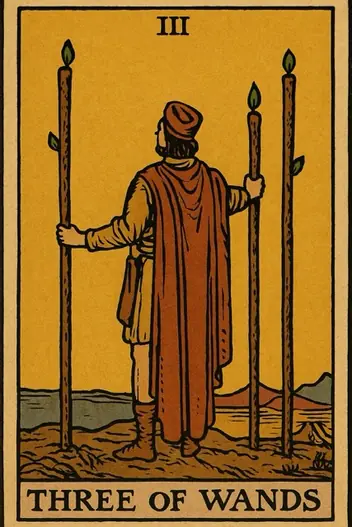

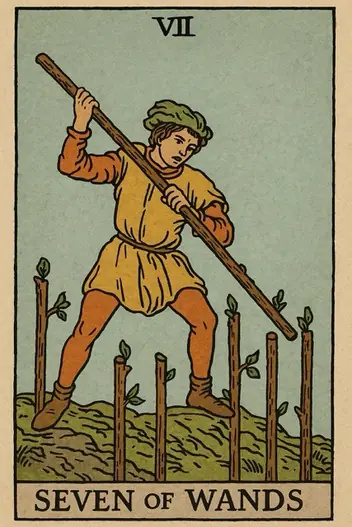
- Arcana
- Three of Wands — Minor Arcana, Wands; Seven of Wands — Minor Arcana, Wands
- Elements
- Three of Wands — Fire; Seven of Wands — Fire
- Elemental interaction
- Same element — energies intensify each other
- Numerology
- 3 + 7 = 10 → 1
When the Three of Wands—the card of expansion, foresight, and strategic planning—collides with the Seven of Wands—the card of defense, competition, and standing your ground—a unique psychological tension emerges. You are no longer simply dreaming of horizons; you are actively defending your position on the frontier. This combination represents the moment when a bold vision meets resistance, demanding that you not only see the future but fight for it.
Psychologically, this pairing activates the archetype of the Warrior-Explorer. You must balance the expansive, optimistic energy of scouting new territory with the gritty, defensive energy of protecting your gains. In real life, this often manifests as a promotion that invites office politics, a new relationship that triggers old insecurities, or a creative project that attracts critics. The key insight is that resistance is not a sign you are wrong—it is a sign you are making progress.
What Do Three of Wands and Seven of Wands Mean Together?
The core dynamic here is strategic defense. The Three of Wands provides the long-term vision and the map; the Seven of Wands provides the willpower and tactical reflexes to hold your ground. Together, they create a state of calculated perseverance. You are not fighting blindly; you are fighting from a position of conscious choice. This is the psychological state of the mature leader who understands that every expansion invites opposition, and every new height requires new defenses.
This combination forces a pragmatic shift from "What if?" to "How do I protect this?" The initial euphoria of the Three of Wands—the excitement of seeing your ship come in—is tempered by the Seven of Wands' sobering reality: others will try to board your ship or sink it. The healthy expression of this energy is assertive boundary-setting without paranoia. You are not being attacked because you are weak; you are being challenged because you are visible. Your task is to hold your position with confidence, not aggression.
A critical psychological insight here is the cognitive bias of "sunk cost" versus "strategic investment." The Three of Wands encourages you to look ahead, while the Seven of Wands can tempt you to defend a position out of stubbornness rather than wisdom. The highest integration of these cards occurs when you defend only what genuinely serves your long-term vision, and are willing to adjust the plan, not abandon it, when the resistance is valid.
Your pair is already on the table. Ask your question and draw the clarifying card
or simply focus on it
Career and Finances
Strategic Opportunities:
Leverage your existing network and reputation to open new doors. The Three of Wands suggests that your past groundwork is paying off; the Seven of Wands says you must actively promote and protect your contributions.
Strategic Opportunities:
Take a leadership role in a project that faces initial skepticism. Your ability to combine vision with resilience makes you uniquely suited to pioneer a new initiative or market.
Calculated Risks:
Avoid overextending your resources to defend a losing position. The Seven of Wands can make you fight for a project or strategy out of pride. The Three of Wands asks: "Is this hill worth dying on, or is it time to scout a better one?"
Professionally, this combination is a powerful indicator of entrepreneurial or intrapreneurial success, but only if you manage the defensive energy wisely. You may be facing competition for a promotion, a budget, or a client. The strategic advice is to focus on differentiation rather than direct confrontation. The Seven of Wands often suggests a "high ground" position—you are defending something you already have or have built. Do not get dragged into a mud fight; elevate the conversation to your vision and value.
A critical financial warning:
This pairing can indicate unexpected costs related to defending your position—legal fees, marketing battles, or resource drains from competitors. Bold the following: Before committing to a defensive action, run a cost-benefit analysis. Is the energy and money spent on defense better invested in a new growth opportunity? The Three of Wands' foresight should guide your defensive strategy, not the other way around.
Your unique Tarot reading
See how these cards interact with your destiny. Start a free personal reading now.
Love and Relationships
If you are single:
This pairing suggests you are attracted to someone who represents a new horizon (e.g., different culture, lifestyle, or values), but you must be prepared to defend your standards and boundaries early on. Do not compromise your core needs for the sake of the exciting "potential" of the connection.
If you are in a relationship:
You and your partner may be navigating external pressures (family, work, social circles) that test your unity. The core dynamic is about standing together against outside challenges, not against each other.
In relationships, the Three of Wands and Seven of Wands point to a power dynamic where one or both partners feel the need to "prove" the relationship's viability to the outside world. This can manifest as defending your partner to skeptical friends, managing long-distance challenges, or protecting your shared vision from unsolicited advice. The key psychological task is to differentiate between external threats and internal relationship issues. If you are constantly in "defense mode" together, ensure you are not neglecting the private, nurturing aspects of your bond.
Bold relationship advice:
Do not let the battle for the relationship become the relationship itself. The Seven of Wands energy can be addictive—it creates a sense of urgency and importance. However, the Three of Wands reminds you to maintain a long-term perspective on intimacy, trust, and shared growth. Ask yourselves: "Are we defending a future we both want, or are we just fighting to win an argument?" Healthy conflict resolution here involves validating each other's defensive instincts while refocusing on the shared horizon.
What If Three of Wands or Seven of Wands Appears Reversed?
When cards appear in a reversed position, constructive tension gives way to dysfunction.
If the Three of Wands is reversed:
This indicates blocked potential or recklessness. You are either abandoning plans because you got scared at the first difficulty (Seven), or conversely, you are rushing into an adventure without a map or compass. Warning: you fear your own success and sabotage expansion, hiding behind a false busyness of "defense."
If the Seven of Wands is reversed:
This is a sign of internal resistance and weakness. You are not ready to defend your boundaries. You surrender positions without a fight, allowing others to violate your personal or professional limits. Advice: you urgently need to develop assertiveness. Silence in response to aggression is now equivalent to defeat.
If BOTH are reversed:
Complete imbalance. This is a state of paralysis of will. There is neither a plan (Three) nor the strength to defend it (Seven). The person oscillates between the desire to flee and the inability to fight back. Logical way to correct it: stop. Take a step back. Stop reacting to external stimuli. You need a total audit of your life: give up everything that is not critically important, and start small—defend at least one of your boundaries and set one small but achievable goal.
Three of Wands and Seven of Wands: Warning Signs
The shadow of this combination is paranoid defensiveness or aggressive expansion without a sustainable plan. When the Seven of Wands energy overwhelms the Three of Wands, you may mistake every minor obstacle for a major attack, exhausting yourself fighting windmills. This is the cognitive bias of "hostile attribution" —seeing threat where there is only normal friction. Conversely, if the Three of Wands dominates, you may ignore real, present dangers in favor of a rosy future, leading to ambush.
A deeper shadow manifestation is the "lone warrior" complex. You may feel that you must fight alone, refusing help or collaboration because it feels like a sign of weakness. This isolates you and drains your resources. The psychological trap here is confusing independence with strength. True strength, as these cards suggest, involves knowing when to fortify your position and when to call for reinforcements. Self-sabotage occurs when you either fight every battle or avoid every conflict, missing the middle path of strategic engagement.
What Is the Overall Message of Three of Wands and Seven of Wands?
To constructively harness the energy of this pair, you must master the skill of "strategic retreat while fighting." Imagine you are the captain of a ship (Three) who spots a new island but must navigate through pirate-infested waters (Seven). Your task is not to destroy every pirate, but to guide the vessel to its goal with minimal losses. This means you must consciously choose with whom and when to engage in conflict.
The deep strategic advice: use the Seven of Wands as fuel for the Three. Transform resistance into a source of energy. Criticism from competitors? Use it to improve your product. A partner's misunderstanding? Make it a catalyst for clearer communication of your plans. When you stop perceiving defense as a burden and begin to see it as a necessary element of growth, your effectiveness soars. You are not merely fending off attacks—you are being tempered.
Your clarity comes from understanding a simple fact: ambition without defense is vulnerability, and defense without ambition is stagnation. Only their synthesis yields sustainable forward momentum. Allow yourself to be both a far-sighted strategist and a tough negotiator. This is not schizophrenia; it is the highest level of mastery in managing reality.
Your Next Step: Personal Context Matters
The core message of the Three of Wands and Seven of Wands is clear: your vision is worth fighting for, but not every fight is worth your vision. You are at a pivotal moment where foresight must guide your defenses, and your defenses must protect your future, not your ego. The challenge is to remain open to new information while steadfast in your core values.
To truly understand how this dynamic applies to your unique situation—your specific love life, career crossroads, or personal growth challenge—you need a reading that goes beyond general archetypes. Download the Fortune Cards app or use it on the web to get a deep, personalized interpretation of this exact combination for your specific question right now. The app analyzes your unique context, providing actionable insights that turn this powerful energy into a clear, strategic plan for your life.
Interpretation by the Fortune Cards editorial team, based on the Rider–Waite tradition and Jungian archetypes. About our methodology · Updated: 2026-08-26
Other Combinations with Three of Wands
Other Combinations with Seven of Wands
Explore Individual Card Meanings
Table of Contents
- What Do Three of Wands and Seven of Wands Mean Together?
- Career and Finances
- Love and Relationships
- What If Three of Wands or Seven of Wands Appears Reversed?
- Three of Wands and Seven of Wands: Warning Signs
- What Is the Overall Message of Three of Wands and Seven of Wands?
- Your Next Step: Personal Context Matters
Ready to find answers to your questions?
Start your first reading now and look at your situation with fresh clarity. The cards are ready to reveal deeper meaning.