Love Tarot: The Tower and King of Swords
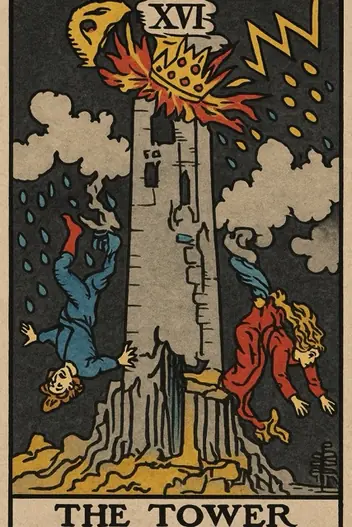
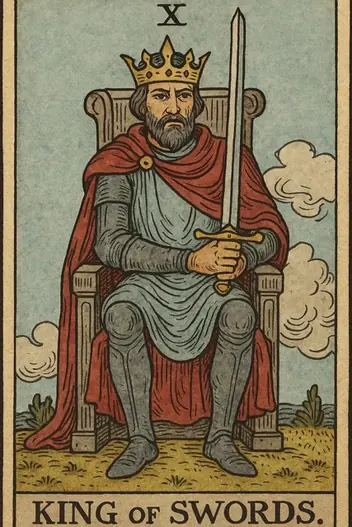
- Arcana
- The Tower — Major Arcana; King of Swords — Minor Arcana, Swords
- Elements
- The Tower — Fire; King of Swords — Air
- Elemental interaction
- Friendly elements — energies support each other
- Numerology
- 16 + 14 = 30 → 3
When the Tower’s sudden upheaval meets the King of Swords’ razor-sharp logic, you’re not just facing a crisis—you’re facing a truth that dismantles illusions. This combination signals a moment where emotional structures collapse under the weight of objective reality. The King of Swords doesn’t offer comfort; he offers clarity, often brutal and necessary. Together, these cards demand you cut through denial and rebuild with your mind, not your heart.
Psychologically, this pairing activates the archetype of the rational observer in the midst of chaos. The Tower represents the breakdown of a false self or unsustainable system—a job, relationship, or belief that no longer holds. The King of Swords steps in as the ego’s executive function, forcing you to analyze the wreckage without panic. This is not a time for emotional processing; it’s a time for strategic triage. You must ask: What can be saved? What must be discarded? The answer lies in cold, hard facts.
What Do The Tower and King of Swords Mean Together?
The core dynamic here is a collision between disruption and discipline. The Tower rips away the ground beneath your feet, while the King of Swords demands you stand up and survey the damage with a clear mind. This creates a high-stakes psychological state where cognitive rigidity is your greatest enemy. If you cling to old narratives or refuse to see the truth, the Tower’s destruction becomes even more painful. Conversely, if you embrace the King’s analytical detachment, you can transform chaos into a blueprint for renewal.
In practice, this combination often appears during sudden layoffs, painful breakups, or unexpected legal battles. The key is to suppress the urge for revenge or emotional outbursts—the King of Swords warns against impulsive reactions. Instead, use the Tower’s momentum to institutionalize new rules for your life. This is a time for contracts, boundaries, and clear communication. The psychological payoff is a strengthened ego that can withstand future shocks. Real-world implication: You’ll emerge more resilient, but only if you treat the crisis as a data point, not a tragedy.
Your pair is already on the table. Ask your question and draw the clarifying card
or simply focus on it
What Do The Tower and King of Swords Say About Love?
If you are single:
This combination warns against idealizing a new partner. The Tower suggests a sudden revelation—perhaps they’re not who they seemed. Use the King of Swords’ logic to evaluate compatibility based on actions, not words. Set clear criteria before getting emotionally invested.
If you are in a relationship:
Expect a truth bomb that shatters the status quo. This could be a confession, a boundary violation, or a realization that the relationship is unsustainable. The King of Swords demands honest, direct conversation—no sugarcoating.
In existing relationships, this pairing signals a power shift where intellectual honesty becomes non-negotiable. The Tower may expose a hidden dynamic—like one partner’s financial control or emotional manipulation. Key relationship advice in bold: Do not avoid the conflict; it will only grow more destructive. Instead, schedule a time to discuss the issue with clear rules of engagement (e.g., no interruptions, focus on facts). This is not about winning an argument; it’s about rebuilding trust on a foundation of truth. If the relationship survives, it will be stronger and more transparent. If it ends, the King of Swords ensures you learn the lesson quickly.
Career Meaning of The Tower and King of Swords
Strategic Opportunities:
Restructuring—the Tower’s chaos can be leveraged to renegotiate contracts, pivot to a new role, or launch a cost-cutting initiative. The King of Swords gives you the mental clarity to spot inefficiencies others miss.
Strategic Opportunities:
Legal or compliance issues—if you’ve been overlooking red tape, this is the moment to correct course. Use the King’s precision to document everything and protect yourself.
Calculated Risks:
Avoid impulsive resignations or lawsuits. The Tower’s destruction can tempt you to burn bridges, but the King of Swords warns: act with evidence, not emotion. Financial warning: Do not make major investments or loans without a thorough audit of the situation.
Professionally, this combination often appears during mergers, leadership changes, or industry disruptions. The strategic advice is to become the sober analyst in the room. While others panic, you should be compiling data, running scenarios, and presenting options. This is a time for ruthless prioritization: cut projects that don’t serve the core goal, renegotiate terms with vendors, or fire underperforming team members if necessary. Financial planning should focus on liquidity and risk management—the Tower can drain resources, so the King of Swords advises building a cash reserve and diversifying income streams. Key takeaway: Treat this as a stress test for your professional foundation.
Your unique Tarot reading
See how these cards interact with your destiny. Start a free personal reading now.
Shadow Side & Pitfalls
The shadow of this combination manifests as cold intellectual arrogance or emotional repression. When the Tower’s trauma meets the King of Swords’ detachment, you may over-rationalize pain to avoid feeling it. This leads to cognitive biases like confirmation bias (only seeing evidence that supports your pre-existing conclusions) or black-and-white thinking (seeing the situation as all good or all bad). You might blame others with sharp, cutting words, using logic as a weapon rather than a tool for understanding.
Another pitfall is self-sabotage through analysis paralysis. The King of Swords can overthink the Tower’s destruction, leading to endless deliberation while the situation deteriorates. This is a defense mechanism—staying in your head to avoid the emotional work of grief or loss. Poor judgment arises when you dismiss intuition entirely, treating the crisis as a purely intellectual problem. The shadow warns: truth without compassion is cruelty. You must balance the King’s logic with empathy for yourself and others, or risk creating a cold, isolated fortress around your psyche.
What If The Tower or King of Swords Appears Reversed?
Reversed Tower + Upright King of Swords:
The destruction has occurred, but the person refuses to acknowledge it. They are trying to rationally "patch the holes" in a collapsing building, instead of letting it fall. This is a path to chronic stress and exhaustion. Advice: stop repairing what is meant to be demolished. Your intellect is being wasted on maintaining a false stability.
Upright Tower + Reversed King of Swords:
The crisis has arrived, but the person has lost the ability to think clearly. Panic, irrational accusations, paranoia, or conversely, apathy. The mind is overwhelmed by emotions. Warning: you risk making catastrophic decisions under the influence of fear. Do not sign any documents or make any major purchases in the next 48 hours.
Both cards reversed:
Complete imbalance. The situation resembles a slow-burning disaster, where there is neither sudden release (upright Tower) nor a clear plan (upright King). The person is in a state of protracted crisis, refusing to see reality and make decisions. Way out: an external trigger is needed—a consultation with a stern expert or a radical change of environment. Your internal compass is broken.
What Is the Overall Message of The Tower and King of Swords?
Constructive use of this combination requires you to have the courage to see the truth and the discipline to act upon it. The first step is to accept the destruction as a given. Do not try to save what must die. Use the energy of the King of Swords to conduct an autopsy of the past: what exactly led to the collapse? Which of your beliefs or actions were mistaken? This analysis must be ruthlessly honest.
Next, your task is to transform chaos into structure. Take a sheet of paper and divide it into two columns: "What I Lost" and "What I Gained (experience, clarity, freedom)." You will see that the destruction of the Tower is the price for removing rose-colored glasses. Now you see the world without embellishment, and this is your main competitive advantage. The King of Swords gives you not just intellect, but strategic patience. Do not rush to build something new. First, clear the ground.
The strategic advice for the near future: become your own advocate. Defend your boundaries and interests from a legal and logical standpoint. Do not make excuses, do not explain, do not ask for understanding. Simply state the facts and demand the same from others. This combination grants you a unique ability — to see through lies. Use it to cut from your life the people and projects built on deception or illusions. Only by passing through this purification can you build something solid and real.
Applying This to Your Situation
The Tower and King of Swords together deliver a sharp, necessary truth that can either shatter you or sharpen you. The choice depends on your willingness to face reality without flinching. This combination asks: What illusion are you ready to release? The answer is not in the cards—it’s in your unique circumstances and psychological readiness. To uncover the precise meaning for your life, you need a reading tailored to your specific question, not just a general archetype.
Don’t settle for vague interpretations. Download the Fortune Cards app now on the web or your device. Get a deep, personalized interpretation of The Tower and King of Swords for your exact situation—whether it’s a career crossroads, a relationship crisis, or a personal breakthrough. The app uses advanced psychological frameworks to apply these archetypes to your life, giving you actionable steps, not just predictions. Click here to start your reading and turn this disruption into your most strategic move yet.
Interpretation by the Fortune Cards editorial team, based on the Rider–Waite tradition and Jungian archetypes. About our methodology · Updated: 2026-08-26
Other Combinations with The Tower
Other Combinations with King of Swords
Explore Individual Card Meanings
Table of Contents
- What Do The Tower and King of Swords Mean Together?
- What Do The Tower and King of Swords Say About Love?
- Career Meaning of The Tower and King of Swords
- Shadow Side & Pitfalls
- What If The Tower or King of Swords Appears Reversed?
- What Is the Overall Message of The Tower and King of Swords?
- Applying This to Your Situation
Ready to find answers to your questions?
Start your first reading now and look at your situation with fresh clarity. The cards are ready to reveal deeper meaning.