The Tower and Six of Pentacles Together in Tarot
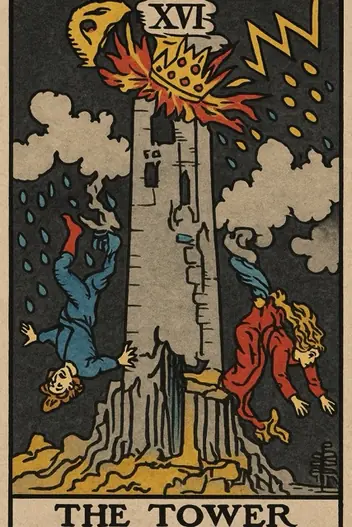

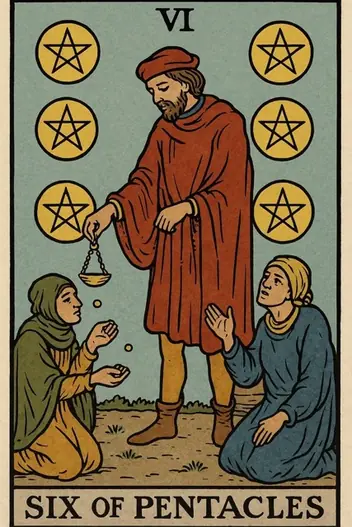
- Arcana
- The Tower — Major Arcana; Six of Pentacles — Minor Arcana, Pentacles
- Elements
- The Tower — Fire; Six of Pentacles — Earth
- Elemental interaction
- Neutral elements — energies coexist without conflict
- Numerology
- 16 + 6 = 22 → 4
When the Tower’s sudden collapse meets the Six of Pentacles’ structured giving, you face a crisis of resource and power dynamics. The Tower shatters your foundation—whether financial, relational, or psychological—while the Six of Pentacles asks, “Who holds the purse strings now?” This pair forces a pragmatic reassessment of dependency and control. You are no longer operating from a position of stability; you are negotiating survival and redefining what “fair exchange” means when the old order has crumbled. The key is to recognize that this disruption, while painful, strips away illusions of self-sufficiency and reveals where your true leverage lies.
Core Dynamics & Interpretation
The psychological state created by this combination is one of acute vulnerability mixed with a survivalist pragmatism. The Tower triggers a fight-or-flight response, stripping away ego defenses and revealing raw needs—money, shelter, support. Simultaneously, the Six of Pentacles activates the patron-client archetype: you may be forced to accept help from someone more powerful, or you may find yourself in a position to offer aid to others who are now destabilized. This dynamic creates a power imbalance that demands clear-eyed negotiation, not charity.
The core insight is that this is not a time for pride or denial. The Tower’s lightning strike has exposed a structural weakness in your resource management—perhaps an over-reliance on a single income source, a toxic financial dependency, or a relationship built on unequal giving. The Six of Pentacles then forces a choice: become the giver or the receiver. Neither role is inherently good or bad; the critical factor is whether the exchange is conscious and contractual rather than emotional and unspoken. This pair rewards those who treat the crisis as a rebalancing of accounts, not a moral judgment.
Your pair is already on the table. Ask your question and draw the clarifying card
or simply focus on it
What Do The Tower and Six of Pentacles Say About Love?
If you are single:
This combination suggests a sudden attraction to someone who appears “stable” or generous, but be wary of mistaking financial security for emotional compatibility. The Tower’s disruption may make you seek a savior, but this can lead to a dependency dynamic that stifles genuine connection.
If you are in a relationship:
Expect a crisis around money, duty, or caregiving—perhaps a job loss, illness, or a sudden shift in who supports whom. The power balance is shattered, and you must renegotiate contributions without resentment.
In relationships, this pair highlights the psychological contract of giving and receiving. The Tower often exposes a hidden imbalance: one partner has been carrying the emotional or financial load, and the collapse forces this into the open. Do not mistake generosity for love, or need for intimacy. The Six of Pentacles here is transactional—it asks you to define clear terms. If you are the giver, set boundaries to avoid burnout. If you are the receiver, accept help without shame, but maintain your agency by planning how to rebuild your own resources. The healthiest outcome is a mutual exchange that evolves into partnership, not permanent patronage.
Ask your specific question
Don't rely on generic meanings. Get a customized reading tailored specifically to your energies.
Career and Finances
Strategic Opportunities:
Use the disruption to audit your income streams. If you lose a job or client, immediately identify who in your network can offer a bridge—a loan, a contract, a referral. The Six of Pentacles favors strategic networking, not blind charity.
Strategic Opportunities:
Offer your expertise as a paid service to those in crisis. If you have skills in crisis management, restructuring, or negotiation, the Tower’s wake creates demand. Position yourself as a solution provider, not a victim.
Calculated Risks:
Avoid accepting help that carries hidden strings. A “generous” offer from a boss, partner, or investor may be a power play disguised as support. Read the fine print—emotional or contractual.
This is a pragmatic moment for financial triage. The Tower destroys the old structure, but the Six of Pentacles provides a lifeline—if you are willing to accept it on clear terms. Do not make long-term commitments under duress. A short-term loan or temporary job is acceptable; a permanent dependency is not. Focus on liquidity and leverage. If you are in a position to help others, do so with a contract or a clear repayment plan. This is not about being cold; it is about preventing the next collapse by building from a place of reality, not fantasy. The worst move is to pretend the crisis didn’t happen—that is the path to chronic instability.
Reversed The Tower and Six of Pentacles Explained
If The Tower is Reversed:
Destruction is avoided or delayed, but tension builds. You are trying to hold onto an old system of support that is already cracking at the seams. This is a dangerous illusion of stability. Instead of waiting for the inevitable collapse, it is better to voluntarily dismantle non-functional patterns—leave a toxic job or end an unequal relationship.
If the Six of Pentacles is Reversed:
You are refusing help or are unable to accept it. Pride or a fear of dependency is blocking resources. In combination with an upright Tower, this means you are left alone to face the catastrophe. Advice: overcome false shame and accept support, even if it is only a temporary measure.
If BOTH are Reversed:
Complete imbalance. The crisis drags on, and all attempts to find support fail. This is a state of "frozen chaos." The logical way to correct this is to admit your powerlessness and start small. Do not try to solve everything at once. Focus on one task: restore a basic resource (money, health, contact), and then build a new hierarchy.
The Tower and Six of Pentacles: Warning Signs
The shadow of this combination manifests as codependency, exploitation, or martyrdom. The Tower’s shock can trigger a cognitive bias of “learned helplessness” —where you believe you cannot rebuild without external rescue. Conversely, the Six of Pentacles can amplify a savior complex in the giver, who may use generosity to control or feel superior. Self-sabotage appears as refusing help out of false pride (Tower’s ego) or accepting help without a plan to become independent (Six’s passivity). Watch for resentment: the receiver feels indebted, the giver feels unappreciated. The shadow warns that unequal exchanges, left unexamined, breed bitterness and future collapses.
What Is the Overall Message of The Tower and Six of Pentacles?
How can the Tower's energy be used constructively to balance the Six of Pentacles? The answer is simple and harsh: embrace destruction as a tool for system cleansing. The Tower breaks precisely those structures that were unjust or unstable. Your task is not to try to glue them back together, but to extract the lessons and build a new model of relationships where help is not a form of control, and dependency is not a form of weakness.
The deep strategic advice lies in shifting from hierarchy to partnership. Instead of the "benefactor — supplicant" model (Six of Pentacles), build an "equal — equal" model. The crisis (Tower) offers a unique chance to renegotiate contracts: in business, in love, in friendship. Ask yourself: "What in my life has collapsed so that I could stop being a victim or a tyrant?"
Arm yourself with clarity: your worth is not determined by how much you receive or give. It is determined by your ability to adapt. Use the Tower's energy not for panic, but for clearing the rubble. And the Six of Pentacles — not as a crutch, but as a temporary springboard for a leap into a new, more autonomous reality.
Where to Go From Here
The Tower and Six of Pentacles together deliver a clear message: your foundation has cracked, and now you must negotiate a new deal—with yourself and others. The core lesson is pragmatic humility: accept help where it is genuine, give help where it is strategic, and always keep the long-term balance sheet in mind. You are not a victim of fate; you are a manager of resources in a time of recalibration.
While this article provides the universal archetype, the true power of Tarot lies in how these cards speak to your specific situation—your career, your relationship, your hidden fears. To get a deep, personalized interpretation of The Tower and Six Of Pentacles for your exact question, use the Fortune Cards app. Available on the web and for download, it applies these insights to your unique context, helping you see the actionable path forward right now.
Interpretation by the Fortune Cards editorial team, based on the Rider–Waite tradition and Jungian archetypes. About our methodology · Updated: 2026-08-26
Other Combinations with The Tower
Other Combinations with Six of Pentacles
Explore Individual Card Meanings
Table of Contents
Ready to find answers to your questions?
Start your first reading now and look at your situation with fresh clarity. The cards are ready to reveal deeper meaning.