Two of Cups and Four of Cups Meaning in Tarot

- Arcana
- Two of Cups — Minor Arcana, Cups; Four of Cups — Minor Arcana, Cups
- Elements
- Two of Cups — Water; Four of Cups — Water
- Elemental interaction
- Same element — energies intensify each other
- Numerology
- 2 + 4 = 6
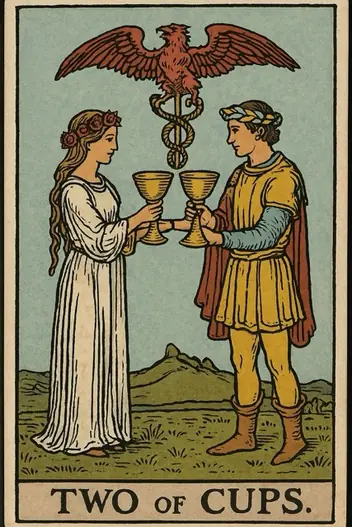
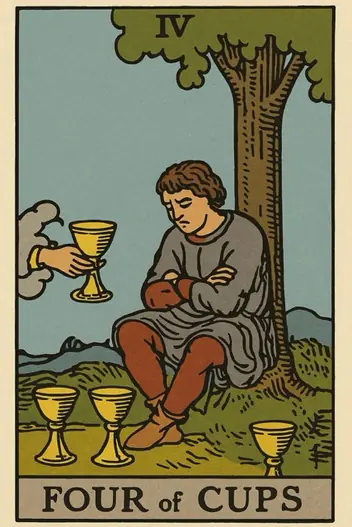
When the Two of Cups, a card of mutual attraction and emotional reciprocity, meets the Four of Cups, a card of introspection and dissatisfaction, a fascinating psychological tension emerges. You are offered a genuine bond—yet you may feel unmoved, unimpressed, or even numb. This combination signals a moment where opportunity and apathy collide. The seeker is often standing at the edge of a meaningful relationship or project, but their internal state—marked by boredom, over-familiarity, or hidden fear—prevents them from reaching out and grasping it.
From a Jungian perspective, the Two of Cups represents the Anima/Animus projection—the ideal partner or ally we seek to complete ourselves. The Four of Cups, however, represents the Shadow of disengagement—a refusal to see what is already present. Together, they ask a critical question: Are you truly rejecting what is on offer, or are you rejecting a part of yourself that feels unworthy of receiving it? This is not a call to force a connection, but to diagnose your emotional inertia before it costs you a real opportunity.
Two of Cups and Four of Cups: How These Energies Interact
The core dynamic here is a mismatch between external offering and internal receptivity. The Two of Cups provides a clear signal: someone is extending a hand, an invitation, or a sincere offer of partnership. This could be romantic, professional, or creative. The energy is balanced, mutual, and heartfelt. However, the Four of Cups introduces a psychological filter of discontentment or withdrawal. The seeker may be looking down, lost in thought, or comparing this offer to an idealized past or a fantasy future. The result is a state of emotional paralysis—you see the cup, but you cannot bring yourself to drink from it.
This combination often appears when the seeker has been through a cycle of disappointment. The Four of Cups can signal emotional burnout or a protective numbness that has become habitual. The Two of Cups then represents a test: can you break the pattern of waiting for a "better" offer? The practical implication is clear: your current mindset is the primary obstacle. The offer itself may be genuine, but your perception is clouded by past wounds or unrealistic standards. Psychologically, this is a call to differentiate between intuition and avoidance—are you wisely declining, or are you sabotaging a good thing because it feels unfamiliar?
Strategic action here requires a deliberate pause to examine your motives. Ask yourself: "Am I bored with this person/opportunity, or am I afraid of being vulnerable?" The Two of Cups demands reciprocity, but the Four of Cups suggests you are not ready to give it. The key insight is that you cannot force a connection if your internal state is closed off. Instead, use this moment to identify the specific fear or disappointment that is creating the distance. Once named, it loses its power to keep you frozen.
Two of Cups and Four of Cups in Love and Relationships
If you are single:
This pair suggests you may be overlooking a sincere, available partner because you are fixated on an unavailable ideal or a past relationship. Check your expectations against reality—are you seeking perfection, or a real connection?
If you are in a relationship:
You or your partner may be feeling emotionally disconnected, even though the foundation is solid. This is a warning against taking each other for granted or letting routine replace genuine engagement.
In a relationship context, the Two of Cups and Four of Cups often reveal a discrepancy in emotional investment. One person is offering warmth, attention, and a desire to connect, while the other is withdrawn, distracted, or unimpressed. This is not necessarily a sign of a bad relationship, but rather a signal that the emotional thermostat needs recalibrating. The Four of Cups partner may be processing unexpressed dissatisfaction—perhaps they feel unseen, or they are projecting past disappointments onto the current dynamic.
The most pragmatic advice is to initiate a conversation about emotional needs without blame. Use "I feel" statements to explore the gap. For example: "I notice I've been pulling back, and I think it's because I'm afraid of getting hurt again. Can we talk about what we both need to feel secure?" Do not assume the other person is the problem. The Four of Cups often points to an internal state of dissatisfaction that has little to do with the partner. The solution lies in re-engaging with curiosity, not in demanding more from the other person. If you are the one feeling disconnected, ask yourself: what am I avoiding by staying in this state of emotional distance?
Your pair is already on the table. Ask your question and draw the clarifying card
or simply focus on it
Two of Cups and Four of Cups in Career Readings
Strategic Opportunities:
A collaboration or partnership offer may be on the table. Evaluate it based on merit, not mood. Do not let temporary boredom cause you to dismiss a solid professional alliance.
Strategic Opportunities:
This is an excellent time to renegotiate terms in an existing partnership, as the Two of Cups energy supports fair exchange. Use the Four of Cups' introspection to clarify what you truly want.
Calculated Risks:
Beware of rejecting a good offer because it feels "too easy" or "not exciting enough." The Four of Cups can trick you into waiting for a dramatic opportunity that never comes.
In the professional realm, this combination often appears when you are being offered a role, a joint venture, or a mentorship that aligns with your skills, but you feel ambivalent. The Two of Cups represents the external offer—a balanced, mutually beneficial arrangement. The Four of Cups represents your internal hesitation. This is a critical decision point. Do not mistake emotional flatness for a lack of potential. The Four of Cups can indicate a period of professional burnout or creative stagnation that colors your perception of new opportunities.
A strategic approach is to separate your emotional state from the objective value of the offer. Create a pros-and-cons list that excludes feelings of boredom or apathy. Focus on tangible outcomes: financial gain, skill development, network expansion. If the numbers and logic support the move, the emotional resistance is likely a shadow reaction to past disappointments, not a valid warning. Financial warning: Do not walk away from a stable, fair offer simply because it lacks novelty. The Four of Cups can lead to a pattern of opportunity hoarding—rejecting the good in pursuit of the perfect, which rarely exists.
When Two of Cups and Four of Cups Signal Trouble
The shadow of this combination is emotional disengagement disguised as discernment. The Four of Cups can rationalize withdrawal as "waiting for the right thing," while the Two of Cups' offer is genuine. This is a classic cognitive bias known as the "sunk cost fallacy" reversed—you reject a new opportunity because you are still mentally invested in a past one that failed. The pitfall is self-sabotage through overthinking. You may analyze the offer to death, finding minor flaws to justify your reluctance, when the real issue is a fear of vulnerability or a fear of being let down again.
Another shadow manifestation is passive-aggressive withdrawal in relationships. Instead of communicating dissatisfaction, the seeker withholds affection or attention, creating a power imbalance. The Two of Cups requires equal giving; the Four of Cups can turn into a game of emotional scarcity where you test the other person's commitment by being distant. This is a recipe for resentment. The deeper psychological trap is the belief that you are "too complex" or "too wounded" to engage in a simple, healthy connection. This is a form of ego inflation—romanticizing your own disconnection as depth, when it is actually avoidance.
Ask your specific question
Don't rely on generic meanings. Get a customized reading tailored specifically to your energies.
Two of Cups and Four of Cups Reversed Meaning
If the Two of Cups is reversed:
Reciprocity is absent. You risk getting involved in a one-sided relationship, where you will invest resources without receiving anything in return. Instead of a healthy union, there is emotional dependency or manipulation. Advice: check how willing your partner is to compromise. If not — exit the game immediately.
If the Four of Cups is reversed:
Apathy gives way to a sudden, chaotic impulse. You may rush into a new relationship or project without assessing the risks. This is a state of "emotional hangover", where you grab at the first offer that comes along, just to escape boredom. Warning: do not confuse activity with productivity. Pause for 24 hours before making a decision.
If BOTH are reversed:
Complete imbalance. You are in a toxic cycle of "attraction-repulsion", where there is neither healthy intimacy nor peace. You may simultaneously experience strong attachment and deep irritation. Corrective strategy: a full digital detox from the object of your attention for 2 weeks. This is the only way to break the pattern and see the situation objectively.
Two of Cups and Four of Cups: Tarot Advice
Constructive use of this energy requires a conscious choice between "impulse" and "inertia." The Two of Cups gives you the energy to begin, but without the support of the Four of Cups, you risk burnout. The Four of Cups gives you time for reflection, but without action, it turns into a swamp.
Your strategy is "conscious rapprochement." Do not let apathy control you. Use it as a signal: "I need more information to make a decision." Ask yourself three questions:
- What do I truly want from this person/project?
- What fears of mine are preventing me from obtaining it?
- What one small step can I take right now to test reality, rather than my fantasies?
Key insight: The Four of Cups is not a verdict, but an invitation to reassess your values. Stop waiting for someone to come and "wake you up." Take responsibility for your emotional state. Start small: express gratitude, accept a compliment, agree to a spontaneous meeting. Only your action can turn the potential of the Two of Cups into reality, rather than yet another missed opportunity.
Applying This to Your Situation
The core message of the Two of Cups and Four of Cups is this: You are being offered a genuine connection, but your internal state is blocking you from receiving it. Whether in love, career, or self-growth, the key is to distinguish between wise caution and emotional inertia. Do not let past disappointments or present boredom cause you to reject something real. Take a moment to examine your feelings—are they based on this opportunity, or on old wounds?
To apply this insight to your exact situation, use the Fortune Cards app. This article provides the general archetype, but the true magic happens when Tarot is applied to your unique question, timing, and context. Whether on the web or through the app, you can get a deep, personalized interpretation of this exact combination for your specific relationship, career dilemma, or personal challenge. Stop guessing—get clarity now.
Interpretation by the Fortune Cards editorial team, based on the Rider–Waite tradition and Jungian archetypes. About our methodology · Updated: 2026-08-26
Other Combinations with Two of Cups
Other Combinations with Four of Cups
Explore Individual Card Meanings
Table of Contents
- Two of Cups and Four of Cups: How These Energies Interact
- Two of Cups and Four of Cups in Love and Relationships
- Two of Cups and Four of Cups in Career Readings
- When Two of Cups and Four of Cups Signal Trouble
- Two of Cups and Four of Cups Reversed Meaning
- Two of Cups and Four of Cups: Tarot Advice
- Applying This to Your Situation
Ready to find answers to your questions?
Start your first reading now and look at your situation with fresh clarity. The cards are ready to reveal deeper meaning.