Two of Cups and Seven of Swords Meaning in Tarot
- Arcana
- Two of Cups — Minor Arcana, Cups; Seven of Swords — Minor Arcana, Swords
- Elements
- Two of Cups — Water; Seven of Swords — Air
- Elemental interaction
- Neutral elements — energies coexist without conflict
- Numerology
- 2 + 7 = 9
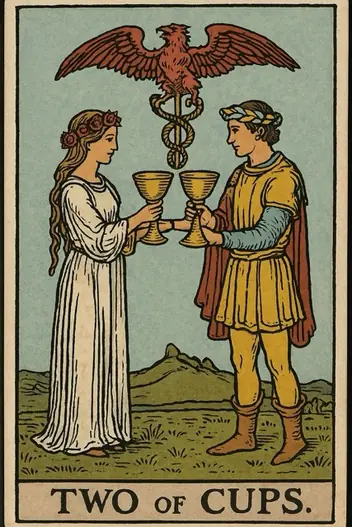
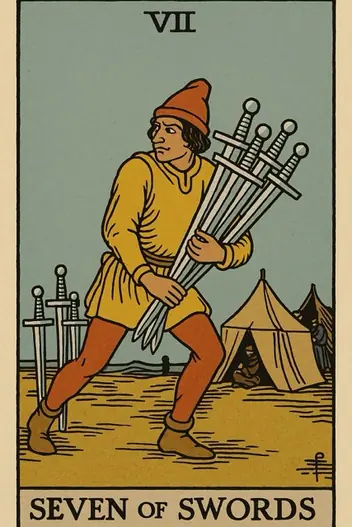
The Two of Cups represents genuine emotional connection, mutual respect, and the archetype of the Anima/Animus—the inner balance that draws two individuals into a harmonious union. It is the card of partnership, vulnerability, and shared intention. In contrast, the Seven of Swords embodies cunning, strategic withdrawal, and the Trickster archetype—a figure who operates through stealth, half-truths, and calculated moves to achieve a goal. When these cards appear together, they create a psychological tension between open-hearted trust and guarded self-interest.
This combination often signals a situation where love or partnership is real, but it is being tested by hidden agendas, unspoken doubts, or a need for strategic maneuvering. The seeker may feel torn between their desire for authentic connection and a nagging suspicion that not all is as it seems. The core challenge here is to discern whether the deception is external (from a partner or colleague) or internal (from your own fears and cognitive biases). Pragmatically, this pair asks: How do you protect your interests without sabotaging the very bond you value?
Two of Cups and Seven of Swords: How These Energies Interact
When the Two of Cups meets the Seven of Swords, the psychological landscape is one of ambivalent intimacy. The seeker likely feels a strong pull toward another person—romantic or professional—but also senses a need for caution or secrecy. This is not a sign of pure betrayal; rather, it reflects a strategic pause in vulnerability. The Seven of Swords here often represents a necessary defense mechanism: the mind is analyzing the relationship’s risks, looking for weak points, or considering how to exit gracefully if needed.
The core dynamic is a conflict between the heart’s desire for union and the mind’s need for control. The Two of Cups energy wants to merge, share, and trust; the Seven of Swords energy wants to observe, calculate, and protect. In a healthy context, this combination suggests a mature partnership where both individuals maintain healthy boundaries while still being emotionally committed. The key insight is that true intimacy requires strategic awareness—you cannot give your heart blindly, but you also cannot hold it so tightly that you strangle the connection.
In a shadow context, this pair warns of self-deception. You may convince yourself that you are being “strategic” when you are actually avoiding vulnerability out of fear. Alternatively, you might rationalize manipulative behavior as “necessary” for the relationship’s survival. The psychological task here is to distinguish between protective discernment and dishonest control. The Seven of Swords is not always malicious—it can be a wise advisor urging you to verify facts before fully committing.
Your pair is already on the table. Ask your question and draw the clarifying card
or simply focus on it
Two of Cups and Seven of Swords for Career and Money
Strategic Opportunities:
Use your social intelligence to build alliances that advance your career. Network with people who share your values (Two of Cups) but verify their reputation and track record (Seven of Swords) before committing to a partnership.
Strategic Opportunities:
This is an excellent time for negotiation and diplomacy. You can read between the lines of what colleagues or competitors say, allowing you to position yourself advantageously without being overtly aggressive.
Calculated Risks:
Avoid over-sharing your plans with untested collaborators. The Seven of Swords warns that information can be used against you. Do not assume good faith without evidence.
In professional settings, this combination often appears when you are forming a new business partnership, pitching to a client, or navigating office politics. The Two of Cups energy gives you genuine rapport and likability, which is invaluable for building trust. The Seven of Swords energy gives you the mental agility to anticipate objections, read between the lines, and protect your intellectual property. The most pragmatic approach is to build relationships on shared values while keeping your core strategy confidential until trust is proven. For financial planning, this pair suggests a conservative approach to joint investments—do not pool resources with someone until you have seen their financial history and decision-making patterns. Bold text: The Seven of Swords is a strong warning against signing contracts without independent legal or financial review.
Two of Cups and Seven of Swords as Feelings
If you are single:
This combination suggests a new connection that feels promising but requires careful evaluation. Do not rush into emotional investment until you have observed the other person’s consistency and integrity over time. The attraction is real, but there may be hidden information or mismatched intentions.
If you are in a relationship:
You or your partner may be withholding something—a concern, a past action, or a future plan. This does not necessarily mean cheating; it could be a fear of conflict or a desire to avoid hurting the other person. Honest communication is essential, but timing matters.
In existing relationships, the Two of Cups and Seven of Swords often indicates a power imbalance in transparency. One partner is more open, while the other is more guarded. The psychological risk is that the guarded partner’s secrecy erodes trust over time, even if their intentions are protective. The most pragmatic relationship advice here is to schedule a neutral, low-stakes conversation where both parties agree to share one thing they have been hesitant to reveal. This builds trust through small, strategic acts of vulnerability. Avoid accusations; instead, frame it as, “I want us to feel completely safe with each other. Is there anything you’ve been holding back that we could discuss?” Bold text: The goal is not to force full disclosure, but to create a container where honesty feels safe.
Deepen your understanding
Find out exactly what this reading means for your current life situation with our oracle.
Negative Meaning of Two of Cups and Seven of Swords
The shadow manifestation of the Two of Cups and Seven of Swords is a toxic blend of emotional dependency and manipulative control. The seeker may use the language of love (“I’m doing this for us”) to justify dishonest actions, such as hiding debts, lying about past relationships, or secretly planning an exit while maintaining a facade of commitment. This is a cognitive bias known as “self-serving bias” —you rationalize your own deception as necessary while condemning the same behavior in others.
Another shadow pattern is paranoid overprotection. The seeker becomes so obsessed with potential betrayal that they sabotage the relationship through constant testing, secret surveillance, or emotional withdrawal. This turns the Seven of Swords from a protective tool into a self-fulfilling prophecy: by acting as if betrayal is inevitable, you create the conditions for it to happen. The psychological pitfall is confusing intuition with projection—you may be projecting your own untrustworthiness onto your partner. If you find yourself constantly suspicious without evidence, the issue is likely internal. Pragmatic self-check: Ask yourself, “What am I afraid to see in myself that I am projecting onto them?”
Two of Cups and Seven of Swords Reversed: What Changes?
When cards appear in a reversed position, the dynamic becomes distorted, but does not disappear.
Reversed Two of Cups + Upright Seven of Swords:
Blocked potential and cynicism. You are so afraid of being vulnerable that you reject any intimacy in advance. Your strategy (the Seven) becomes not a defense, but a weapon against yourself. Advice: acknowledge that your fear is not an objective risk assessment, but a past traumatic experience.
Upright Two of Cups + Reversed Seven of Swords:
Internal resistance and weakness. You desire closeness, but your strategies are failing. You may try to manipulate, but you do it clumsily, provoking only irritation. Warning: your "tricks" are obvious to everyone. The only way out is direct confrontation.
BOTH reversed:
Complete imbalance. This is a state where you simultaneously reject emotions (the Two) and lose the ability for rational planning (the Seven). Chaotic behavior emerges: one moment you want to get close, the next you run away, not understanding why. Logical way to correct: take a pause. Cease all negotiations and relationships for 48 hours. Return to basic needs: food, sleep, solitude.
Two of Cups and Seven of Swords: The Combined Message
Constructive use of this pair requires conscious role separation. Your Two of Cups should be responsible for the "why" (why you need this person or project), while the Seven of Swords handles the "how" (how to protect this interest from risks). Do not let the Swords dictate your desires. First, feel what you need, then think about how to obtain it safely.
The deep strategic advice is as follows: use the Seven of Swords as a scout, not as a commander. Allow it to survey the terrain, but leave the final decision about approach to the Two. For example, in negotiations: first establish emotional contact, then engage the analytical mind. If you do it the other way around, you risk appearing cold and calculating, which will destroy trust.
Clarity comes when you acknowledge that your cunning is not a flaw, but a tool. But a tool that must serve your true emotional goals, not your fear. If you use this energy for protection rather than attack, you can build alliances that are both deep and strategically sound. This is the mature position: to be vulnerable, but not defenseless.
Where to Go From Here
The Two of Cups and Seven of Swords combination ultimately asks you to balance emotional openness with strategic discernment. The connection you are navigating is real, but it requires mindful navigation. Your next step is to identify one area where you can be more transparent and one area where you need to set a firmer boundary. This is not about choosing between love and caution—it is about integrating both.
While this article provides a deep archetypal analysis, the true meaning of these cards shifts based on your unique question, life situation, and personal history. To get a personalized, real-time interpretation of this exact combination for your specific relationship or career challenge, use the Fortune Cards app. Available on the web and for download, it applies Jungian psychology and tarot symbolism to your exact context, helping you move from general insight to actionable clarity. Don’t just read about the cards—let them speak directly to your situation.
Interpretation by the Fortune Cards editorial team, based on the Rider–Waite tradition and Jungian archetypes. About our methodology · Updated: 2026-09-17
Other Combinations with Two of Cups
Other Combinations with Seven of Swords
Explore Individual Card Meanings
Table of Contents
- Two of Cups and Seven of Swords: How These Energies Interact
- Two of Cups and Seven of Swords for Career and Money
- Two of Cups and Seven of Swords as Feelings
- Negative Meaning of Two of Cups and Seven of Swords
- Two of Cups and Seven of Swords Reversed: What Changes?
- Two of Cups and Seven of Swords: The Combined Message
- Where to Go From Here
Ready to find answers to your questions?
Start your first reading now and look at your situation with fresh clarity. The cards are ready to reveal deeper meaning.