Love Tarot: Two of Swords and Six of Pentacles
- Arcana
- Two of Swords — Minor Arcana, Swords; Six of Pentacles — Minor Arcana, Pentacles
- Elements
- Two of Swords — Air; Six of Pentacles — Earth
- Elemental interaction
- Opposing elements — energies create tension
- Numerology
- 2 + 6 = 8
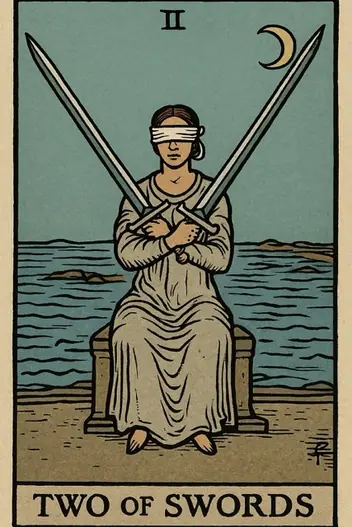
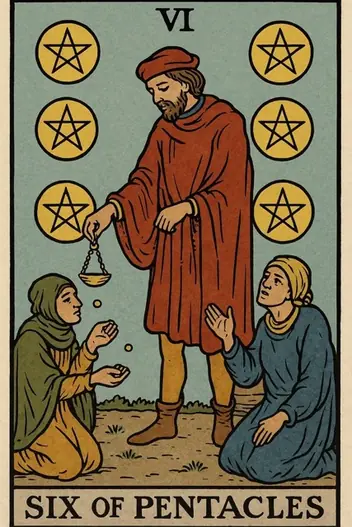
When the Two of Swords—a card of deliberate indecision, blindfolded choice, and mental stalemate—meets the Six of Pentacles—the archetype of measured generosity, power imbalances, and transactional giving—a unique psychological tension emerges. This pairing often surfaces when you are stuck in a situation where you feel obligated to decide based on someone else’s terms or resources. The mind is clouded not by ignorance, but by the uncomfortable awareness that any choice you make will involve accepting a form of dependency or indebtedness.
This combination forces a confrontation with the Shadow of conditional generosity. Are you refusing to see the truth because accepting help would require admitting vulnerability? Or are you holding yourself in limbo because you fear the strings attached to the support being offered? The core dynamic here is a conflict between emotional autonomy (Two of Swords) and material or social leverage (Six of Pentacles). The seeker must recognize that their paralysis is not about the options themselves, but about the perceived cost of choosing.
What Do Two of Swords and Six of Pentacles Mean Together?
The psychological state created by the Two of Swords and Six of Pentacles is one of calculated paralysis. You are likely aware of a power differential—someone has more resources, status, or emotional leverage—and you are frozen, weighing the pros and cons of accepting their terms. The blindfold of the Two of Swords is not about ignorance; it is a willful refusal to see the imbalance clearly because doing so would force an uncomfortable action. This is a defense mechanism against feeling like a supplicant.
In practice, this manifests as overthinking a decision that involves resource exchange. For example, you might be offered a loan, a job with strings attached, or a relationship where one partner clearly gives more. The Six of Pentacles reminds us that all exchanges have a price, even if unspoken. The key insight here is that indecision is itself a decision—one that maintains the status quo of imbalance. The healthy resolution requires you to remove the blindfold and honestly assess whether the exchange is fair, or if you are being asked to trade your autonomy for security. Boldly confronting the power dynamic is the first step toward breaking the stalemate.
Career and Finances
Strategic Opportunities:
This pairing can indicate a mentorship or sponsorship offer that requires you to commit to a specific path. Accepting it could unlock resources, but you must clearly define the terms of the exchange upfront.
Strategic Opportunities:
It may also signal a negotiation where you have more leverage than you realize. Your hesitation might be undervaluing your own position. Consider asking for a trial period or milestone-based agreement.
Calculated Risks:
Avoid accepting help that comes with unspoken expectations or vague promises. The biggest risk is agreeing to a deal that trades your long-term autonomy for short-term relief. Be wary of any arrangement where the giver holds all the power.
In your professional life, the Two of Swords and Six of Pentacles combination is a direct warning against making decisions under pressure. You might be considering a job offer, a partnership, or a loan, but the blindfold suggests you are ignoring red flags because the offer seems generous. The practical analysis here is to objectively audit the power dynamic. Who holds the leverage? What are the exit clauses? The Six of Pentacles often implies a "gift" that is actually a test of loyalty or compliance. Boldly, the best financial strategy is to delay the decision until you have all the information, even if it means losing the initial offer. If the opportunity is genuine, it will withstand scrutiny. If it disappears when you ask for clarity, it was a trap. Focus on creating a written agreement that protects your boundaries and ensures reciprocity.
Your pair is already on the table. Ask your question and draw the clarifying card
or simply focus on it
Two of Swords and Six of Pentacles in Love Tarot
If you are single:
This combination suggests you are stuck between two potential partners or approaches to dating, but your hesitation is rooted in fear of unequal emotional investment. You may be waiting for someone to "prove" their worth before you commit, keeping your heart blindfolded.
If you are in a relationship:
The dynamic often reveals a transactional imbalance—one partner may feel they are giving more financially, emotionally, or in terms of effort, while the other feels pressured to make a choice they are not ready for.
In relationships, this pairing signals a critical communication breakdown masked by politeness. The Six of Pentacles can represent a "savior" or "provider" archetype, while the Two of Swords represents the partner who feels trapped by that generosity. The key relationship advice is to stop pretending the imbalance doesn't exist. If you feel you owe your partner for their support, or if you are withholding affection because you resent their control, you are living in a psychological stalemate. Boldly ask: "Is this love, or is this a transaction?" The path forward requires you to either renegotiate the terms of the relationship or accept that your indecision is harming both of you more than a clear "no" ever could. Practical steps include setting explicit boundaries about what you can and cannot give, and scheduling a neutral conversation to air grievances without blame.
What If Two of Swords or Six of Pentacles Appears Reversed?
If the Two of Swords is reversed, it removes the blockage, but not for the better. You stop analyzing and act impulsively, making decisions under pressure. In the context of the Six of Pentacles, this means reckless generosity: you give away your last penny to buy approval, or take out a loan without assessing the risks. Advice: forcibly implement a "24-hour rule" before any financial or emotional investment.
When the Six of Pentacles is reversed and the Two of Swords is upright, you face an internal resistance to receiving help. You are stuck in pride: "I can handle it myself," yet you do nothing. This is paralysis of the will. Warning: your independence is currently an illusion. You refuse resources because you fear debt or obligation. Advice: accept help as a transaction, not a gift—this will relieve the psychological tension.
If BOTH cards are reversed, this is a complete imbalance of dynamics. You simultaneously fear making decisions and reject support. This is a state of "emotional bankruptcy," where you can neither give nor take. A logical way to correct this: start small. Find one micro-task (e.g., paying a bill or replying to an email) and complete it. This will reboot the "action-result" cycle and snap you out of the stupor.
Deepen your understanding
Find out exactly what this reading means for your current life situation with our oracle.
What Are the Risks of Two of Swords and Six of Pentacles?
The shadow manifestation of this combination is passive-aggressive martyrdom. The seeker may unconsciously adopt the role of the "needy" recipient in the Six of Pentacles, using their indecision (Two of Swords) to manipulate the giver into offering more. Alternatively, they might play the "blind judge," refusing to see how their own pride prevents them from accepting legitimate help. This leads to a cognitive bias known as "sunk cost fallacy" —staying stuck because you've already invested so much mental energy in the dilemma.
Another pitfall is emotional blackmail disguised as generosity. The seeker may be the one offering help, but using it to control the recipient's choices. This creates a toxic loop where the recipient's indecision (Two of Swords) is actually a healthy resistance to being controlled. Self-sabotage occurs when you mistake a boundary for ingratitude. The shadow lesson is that true generosity requires no repayment, and true decision-making requires no external approval. Avoid the trap of "helping" someone into a corner where they feel they owe you.
Synthesis: Strategic Conclusion
Constructive use of this combination requires a conscious shift from reactivity to proactivity. The energy of the Two of Swords is your analytical scalpel. Use it to dissect fear, rather than hide behind it. Ask yourself: "What exactly am I afraid of if I make a decision right now?" Most often, the answer will be: "Loss of control." Acknowledge this—and control will return to you.
The Six of Pentacles in this context is a tool for balancing, not for handouts. To activate its energy, stop thinking in terms of "giver-taker." Instead, use the "investment-return" model. Every time you give a resource (time, money, attention), ask: "What will I get in return?" This is not cynicism; it is healthy self-preservation.
Deep strategic advice: imagine your life as an investment portfolio. The Two of Swords is market analysis; the Six of Pentacles is diversification. Your task is not to guess the perfect moment, but to distribute risk. Start small: allocate 10% of your time or budget to an experiment. If it fails—you lose 10%. If it works—you gain 100%. This is the formula for calculated risk, which shatters the paralysis of choice.
Remember: refusing to decide is also a decision, and it has a cost. Remove the blindfold, look at your resources, and choose an action. Even an imperfect action is better than perfect inaction.
Applying This to Your Situation
The core message of the Two of Swords and Six of Pentacles is that your indecision is a symptom of an unequal exchange you are not ready to name. Whether in love, career, or personal growth, the path forward requires you to remove the blindfold and assess the transaction honestly. You are not being asked to choose between good and bad; you are being asked to choose between your autonomy and a security that may be illusory. The best decision is the one that aligns with your long-term values, not your short-term fears.
While this article provides the archetypal meaning, the true power of Tarot lies in its application to your unique situation. To get a deep, personalized interpretation of how the Two of Swords and Six of Pentacles specifically apply to your relationship, career, or personal question right now, use the Fortune Cards app. Available on the web and for download, it offers tailored readings that cut through the general advice and give you the exact psychological insight you need to break your stalemate. Click here to start your free reading and uncover the choice you've been avoiding.
Interpretation by the Fortune Cards editorial team, based on the Rider–Waite tradition and Jungian archetypes. About our methodology · Updated: 2026-10-08
Other Combinations with Two of Swords
Other Combinations with Six of Pentacles
Explore Individual Card Meanings
Table of Contents
- What Do Two of Swords and Six of Pentacles Mean Together?
- Career and Finances
- Two of Swords and Six of Pentacles in Love Tarot
- What If Two of Swords or Six of Pentacles Appears Reversed?
- What Are the Risks of Two of Swords and Six of Pentacles?
- Synthesis: Strategic Conclusion
- Applying This to Your Situation
Ready to find answers to your questions?
Start your first reading now and look at your situation with fresh clarity. The cards are ready to reveal deeper meaning.