Ace of Wands and Eight of Swords Tarot as Feelings
- Arcana
- Ace of Wands — Minor Arcana, Wands; Eight of Swords — Minor Arcana, Swords
- Elements
- Ace of Wands — Fire; Eight of Swords — Air
- Elemental interaction
- Friendly elements — energies support each other
- Numerology
- 1 + 8 = 9
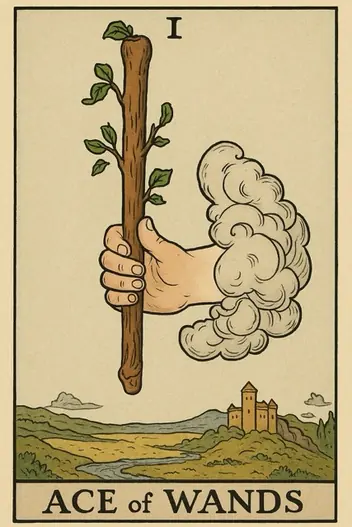
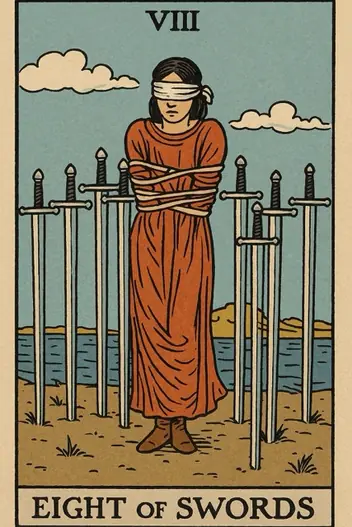
The Ace of Wands represents a raw, untamed spark of creative energy, ambition, or a new venture—a bolt of inspiration demanding action. The Eight of Swords, in stark contrast, depicts a figure blindfolded, bound, and surrounded by swords, symbolizing mental paralysis, self-imposed limitations, and a victim mindset. When these two archetypes collide, we see a powerful psychological tension: the potential for a breakthrough is present, but the seeker is trapped by their own negative thought patterns and perceived lack of options.
In real-world terms, this combination describes a situation where you have a brilliant idea or a clear opportunity for growth, yet you feel completely stuck. The core conflict is between your potential for action and your inner critic. The key insight is that the restraints are largely self-created; the blindfold is of your own making. Your next step requires not more resources or external validation, but a ruthless interrogation of the beliefs that are holding you back.
What Do Ace of Wands and Eight of Swords Mean Together?
The psychological state created by the Ace of Wands and Eight of Swords is one of frustrated potential. You are aware of a new path or a creative surge (Ace of Wands), but you feel unable to move forward due to overwhelming anxiety, confusion, or a sense of being trapped (Eight of Swords). This isn't a lack of capability; it's a cognitive distortion—your mind has built a prison of "what ifs" and "I can'ts." The energy of the Ace is pressing for action, but the Eight of Swords' energy is demanding you first confront your own shadow.
The real-world implication is that any attempt to force the new idea will backfire unless you first address the mental blocks. You may find yourself overthinking, seeking endless advice, or procrastinating on a project that genuinely excites you. The pragmatic approach here is to treat your own mind as the primary obstacle. The Eight of Swords is a warning: your current perspective is unreliable. You must actively challenge the narrative that you are powerless. The Ace of Wands offers the spark, but you must cut the ropes with clarity and self-awareness.
Your pair is already on the table. Ask your question and draw the clarifying card
or simply focus on it
Ace of Wands and Eight of Swords in Love Tarot
If you are single:
This pair suggests you may have a strong interest in someone new, but you are holding yourself back due to fear of rejection or past relationship trauma. The obstacle is not the other person, but your own limiting beliefs about your worthiness or the potential for connection.
If you are in a relationship:
You and your partner may be aware of a need for more passion or a new shared goal, but communication is blocked by unspoken resentments or a feeling of being unheard. One or both of you may feel trapped in a repetitive argument pattern.
The relationship dynamics here are a study in emotional intelligence versus self-sabotage. The Ace of Wands represents the raw desire for connection, intimacy, or a fresh start. The Eight of Swords reveals the psychological cage you or your partner are building. The most critical relationship advice is to stop assuming you know what the other person is thinking. The blindfold in the Eight of Swords is a metaphor for projection. You may be projecting your own fears—fear of vulnerability, fear of conflict, fear of losing control—onto your partner. A direct, honest conversation is the only way to untie the knots. If you are single, the risk is that you will miss a genuine opportunity because you are convinced it will fail before you even try. In a relationship, the risk is that you will turn a solvable problem into a permanent impasse through silence and assumption.
Career Meaning of Ace of Wands and Eight of Swords
Strategic Opportunities:
Identify one concrete, low-risk action you can take this week to test your new idea. A small experiment will break the cycle of analysis paralysis.
Strategic Opportunities:
Seek an objective third-party perspective. A mentor, coach, or trusted colleague can see the blind spots your own mind has created.
Calculated Risks:
Avoid making major financial commitments based on this idea until you have a written plan. The Eight of Swords warns against impulsive decisions fueled by desperation to escape a feeling of being stuck.
In your professional life, this combination signals a critical decision point. You have a strong new idea or a career opportunity that excites you, but you are overwhelmed by perceived obstacles—lack of funding, insufficient skills, office politics, or fear of failure. The pragmatic truth is that most of these obstacles are mental, not material. The Eight of Swords is a classic sign of impostor syndrome or a fear of stepping into a leadership role. The most important financial and strategic tip is to separate objective risk from subjective fear. Write down the actual, concrete risks of moving forward. Then write down the actual risks of staying still. You will likely find that the cost of inaction is higher than the cost of a calculated move. Do not let a perfect plan be the enemy of a good first step.
Deepen your understanding
Find out exactly what this reading means for your current life situation with our oracle.
What If Ace of Wands or Eight of Swords Appears Reversed?
If the Ace of Wands is Reversed:
The potential is blocked not by fear, but by a lack of energy or burnout. You aren't just afraid; you don't even have the strength for an impulse. This is a state of apathy where "wanting" is no longer possible. Advice: Don't try to force yourself to act. First, restore your resources: sleep, rest, letting go of toxic obligations. The reversed Ace is a sign that the battery is dead.
If the Eight of Swords is Reversed:
Fear becomes explicit and conscious. You are no longer denying your limitations, but you risk falling into excessive dramatization. Instead of feeling trapped, you start actively feeling sorry for yourself or blaming others. Warning: Don't turn the awareness of a problem into an excuse for inaction. The reversed Eight is a chance to see your shackles, but there is a risk you will start to "love" and cultivate them.
If BOTH are Reversed:
Complete imbalance: no energy, no clarity. You are simultaneously burned out and lost in your own illusions. This is a state of deep disorientation where any action seems meaningless, yet inaction is unbearable. Way to Correct: You need an external anchor. Turn to a mentor, psychologist, or trusted friend. You don't need advice; you need a "third eye" that can see the situation objectively while you cannot.
Shadow Side & Pitfalls
When the energy of this combination is blocked or acted upon irrationally, the shadow manifests as learned helplessness and self-sabotage. The seeker may become addicted to the fantasy of the new idea (Ace of Wands) without ever taking the necessary steps to realize it, using the Eight of Swords' narrative of "I can't" as a comfortable excuse. This is a classic cognitive bias known as the "sunk cost fallacy" applied to one's own potential—you have invested so much in the story of your limitations that you refuse to see the evidence that contradicts it. The seeker may also lash out in frustration, blaming external circumstances or other people for their paralysis, when the real enemy is their own inner critic. The worst-case scenario is that you miss the window of opportunity entirely, allowing the initial spark of the Ace of Wands to die out, leaving you with only the regret of what could have been.
What Is the Overall Message of Ace of Wands and Eight of Swords?
How to constructively use the energy of the Ace of Wands to balance the Eight of Swords? The first and most important step is to acknowledge that your feeling of hopelessness is an illusion, not a fact. This does not mean there are no problems. It means your interpretation of them as "insurmountable" is a trap. Start with a micro-step. Write down one specific thing you can do in 5 minutes to move closer to your goal. Don't think about the outcome; think about the process.
Second — use the energy of the Ace to destroy mental barriers, not to reinforce them. Fear is fuel. If you're afraid of public speaking — sign up for a course. If you're afraid of being fired — update your resume. Every action taken directly into the heart of fear robs the Eight of Swords of its power. Your task is not to get rid of fear, but to act in spite of it.
Third, the most profound conclusion: this combination teaches us to distinguish between real limitations and imaginary ones. Real ones (e.g., lack of money) can be overcome with strategy. Imaginary ones (fear of failure) can only be overcome with action. Strategic advice: make two lists. In the first, list objective obstacles (no experience, little time). In the second, list your fears (afraid of looking foolish, afraid of rejection). Work only with the first list. Ignore the second until you begin to act. The Ace of Wands gives you the power to start. The Eight of Swords is the test you must pass for that power to become reality.
Your Next Step: Personal Context Matters
The core message of Ace of Wands and Eight of Swords is that your greatest opportunity is currently held hostage by your greatest fear. The spark of creation is real, but it cannot ignite until you remove the blindfold and cut the ropes of your own limiting beliefs. Your next step is not to gather more information, but to take one courageous, imperfect action that challenges your current narrative.
While this article provides a general archetypal analysis, the true power of Tarot lies in its application to your unique life. To get a deep, personalized interpretation of this exact combination for your specific question—whether about a relationship, a career move, or a personal project—use the Fortune Cards app. You can access it on the web or download it now. It will help you see exactly where the ropes are tied and how to untie them for your situation.
Interpretation by the Fortune Cards editorial team, based on the Rider–Waite tradition and Jungian archetypes. About our methodology · Updated: 2026-08-26
Other Combinations with Ace of Wands
Other Combinations with Eight of Swords
Explore Individual Card Meanings
Table of Contents
- What Do Ace of Wands and Eight of Swords Mean Together?
- Ace of Wands and Eight of Swords in Love Tarot
- Career Meaning of Ace of Wands and Eight of Swords
- What If Ace of Wands or Eight of Swords Appears Reversed?
- Shadow Side & Pitfalls
- What Is the Overall Message of Ace of Wands and Eight of Swords?
- Your Next Step: Personal Context Matters
Ready to find answers to your questions?
Start your first reading now and look at your situation with fresh clarity. The cards are ready to reveal deeper meaning.