Ace of Wands and Two of Swords Tarot Combination

- Arcana
- Ace of Wands — Minor Arcana, Wands; Two of Swords — Minor Arcana, Swords
- Elements
- Ace of Wands — Fire; Two of Swords — Air
- Elemental interaction
- Friendly elements — energies support each other
- Numerology
- 1 + 2 = 3
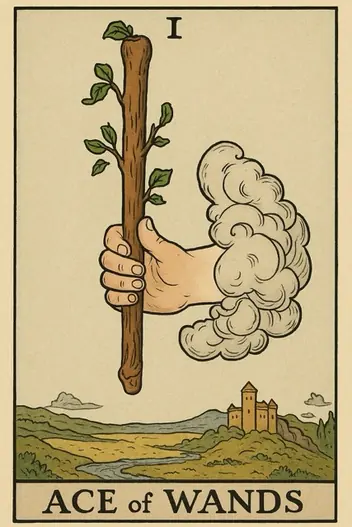
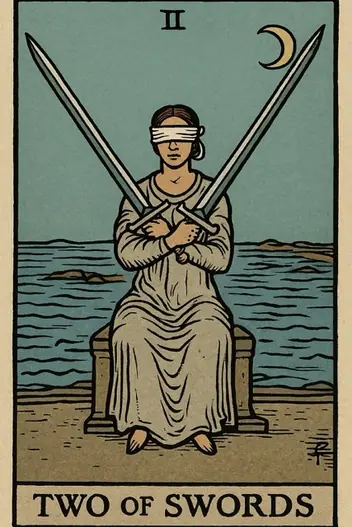
When the raw, creative spark of the Ace of Wands meets the calculated paralysis of the Two of Swords, we witness a classic psychological conflict: the urge to act versus the need to decide. The Ace of Wands represents a sudden burst of inspiration, a new venture, or a passionate impulse demanding immediate expression. In contrast, the Two of Swords embodies a state of deliberate avoidance—a mental blockade where the seeker refuses to see the full picture to avoid making a painful choice. This combination suggests you are holding a burning torch while blindfolded, standing at a crossroads you refuse to acknowledge. The tension here is not a curse; it is a call for strategic self-awareness and disciplined risk assessment.
Ace of Wands and Two of Swords Together: Meaning
The core dynamic of this pairing is a psychological standoff between desire and defense. The Ace of Wands injects high-stakes energy—a new job offer, a romantic confession, or a creative project that feels fated. However, the Two of Swords reveals that the seeker is actively suppressing critical information to maintain a false sense of control. This is not a case of lacking options; it is a case of fearing the consequences of choosing. Jungian psychology would frame this as a conflict between the libido (life force) and the persona (social mask of neutrality). The seeker may be rationalizing inaction as "being logical," when in reality, they are avoiding the emotional labor of commitment. The key insight here is that no decision is itself a decision. The longer you hold the wand without swinging, the more the energy dissipates into anxiety. To break the stalemate, you must remove the blindfold—not to see a perfect path, but to accept that action carries inherent risk.
Your pair is already on the table. Ask your question and draw the clarifying card
or simply focus on it
Ace of Wands and Two of Swords as Feelings
If you are single:
This combination signals a new romantic interest that feels both thrilling and terrifying. You may be receiving clear signals of attraction (Ace of Wands) but are refusing to acknowledge potential incompatibilities or past baggage (Two of Swords). The advice is to gather objective data before committing emotionally.
If you are in a relationship:
You and your partner may be stuck in a silent power struggle where one person wants to take a bold step (moving in, having a child) while the other is stonewalling by refusing to discuss it. The relationship is at a tipping point where avoidance will erode trust faster than any disagreement.
The relationship dynamic here is a test of emotional intelligence. The Ace of Wands brings a surge of passion or desire for change, but the Two of Swords indicates that one or both partners are using silence as a weapon. This is not a peaceful wait-and-see period; it is a deliberate refusal to engage. The most pragmatic advice is to schedule a direct, time-limited conversation about the elephant in the room. Avoid ultimatums, but be clear that inaction is a vote against the relationship's future. If you are single, resist the urge to romanticize a mystery. The Two of Swords warns that you are blinding yourself to red flags because the initial spark feels so potent. Ask yourself: Am I attracted to this person, or am I attracted to the idea of a new beginning? Honesty here prevents a six-month detour into disappointment.
Your unique Tarot reading
See how these cards interact with your destiny. Start a free personal reading now.
Ace of Wands and Two of Swords: Career and Money
Strategic Opportunities:
A high-risk, high-reward venture is presenting itself (e.g., a startup pitch, a job in a new industry, a major contract). The energy is right for execution, but only after you conduct a cost-benefit analysis.
Strategic Opportunities:
This is an ideal time to leverage your creative skills to solve a problem you've been ignoring. The Ace of Wands gives you the innovative solution; the Two of Swords forces you to stop pretending the problem doesn't exist.
Calculated Risks:
Avoid making any major financial commitment based on gut feeling alone. The Two of Swords warns that you are ignoring a critical data point—perhaps a hidden fee, a competitor's move, or a partner's lack of commitment. Do not sign contracts without a second opinion.
In a professional context, this combination is a yellow light, not a red light. The Ace of Wands is a green light for initiative—you have the drive, the idea, and the timing. However, the Two of Swords demands a pragmatic pause for due diligence. You might feel pressure to act fast, but rushing into a decision without weighing the trade-offs is the fastest way to burn out the wand's energy. Financially, this is a warning against "shiny object syndrome." You may be tempted to invest in a flashy new opportunity while ignoring a stable, boring one that requires a difficult decision. The best strategy is to create a simple pros-and-cons list, then sleep on it for 48 hours. If the opportunity still burns bright after that pause, act with confidence.
Ace of Wands and Two of Swords Reversed: What Changes?
When cards appear in a reversed position, the conflict intensifies, but its nature changes.
If the Ace of Wands is reversed:
The potential is not simply blocked, but actively destroyed from within. This is a state of burnout before action even begins. You may feel apathy or reckless anger. Advice: Do not try to artificially "ignite" yourself. Acknowledge that the resource is depleted. Rest for 48 hours before making any important decision.
If the Two of Swords is reversed:
The defense is broken, but not in a healthy way. This is a panicked flight from reality or, conversely, an impulsive decision made under pressure. Warning: You may tear the blindfold off, but see not the truth, but what you want to see. Use the "three facts" technique — write down three objective facts about the situation without judging them.
If BOTH are reversed:
Complete imbalance — chaos without energy and paralysis without thoughts. This is a state of "learned helplessness". The logical way to correct it is to return to basics: physical activity (restoring the Ace) and journaling (restoring the Two). Advice: Delegate decision-making to a trusted person for a week to break the cycle.
When Ace of Wands and Two of Swords Signal Trouble
The shadow of this combination manifests as cognitive dissonance and self-sabotage. The seeker may hold a powerful vision (Ace of Wands) but refuse to gather the information needed to execute it (Two of Swords). This leads to a frustrating loop: you feel the fire of potential, yet you remain frozen, blaming external circumstances for your inaction. This is a classic defense mechanism called "intellectualization." You tell yourself you are "thinking it through," but in reality, you are avoiding the emotional discomfort of failure. The pitfall is that the longer you wait, the more the wand's energy turns to resentment. You may begin to see the obstacle (the Two of Swords) as an enemy, rather than a signal to recalibrate. Another shadow behavior is impulsive decision-making under pressure. To escape the anxiety of the stalemate, you might suddenly "choose" without real clarity, leading to regret. The antidote is radical honesty with yourself: admit that you are scared, then ask what concrete information would reduce that fear to a manageable level?
Ace of Wands and Two of Swords: Tarot Advice
How can the energy of the Ace of Wands be used constructively to balance the Two of Swords? The answer lies in embracing imperfection. Your task is not to wait until fear disappears, but to act in spite of it, in small doses. Imagine the Ace of Wands as fuel and the Two of Swords as the steering wheel. If the wheel is locked, there's no point in stepping on the gas—the car will crash into a wall. Instead, you need to gently rock the wheel to release the lock.
Strategic advice: use the "one percent" method. Take the idea symbolized by the Ace and perform one microscopic action toward it right now. You don't need to write a business plan. Simply open the document and write the title. You don't need to confess your love. Just send an emoji. This action will remove the "blindfold" from the Two of Swords' eyes, showing that reality is not as frightening as the imagination painted it.
The deep conclusion is that this pair of cards teaches us to distinguish between intuition and fear. The Ace of Wands is pure intuition, the call of the heart. The Two of Swords is the voice of fear, masquerading as logic. Your task is to learn to hear the difference. If the voice says "wait, you need more data"—that is fear. If the voice says "now or never"—that is intuition. Armed with this knowledge, you can turn paralysis into a breakthrough.
Applying This to Your Situation
The Ace of Wands and Two of Swords together tell a story of potential blocked by indecision. The core message is this: you have the energy to start something new, but you are deliberately refusing to see the full picture. To move forward, you must first remove your own blindfold. This is not about finding a perfect answer—it is about accepting that any decision is better than the paralysis of neutrality. The power is in your hands, but only if you are willing to open your eyes.
Your unique situation requires a focused lens. While this analysis provides the general archetype, the true magic happens when Tarot is applied to your specific question. The Fortune Cards app offers a deep, personalized interpretation of this exact combination for your unique context, whether you're navigating love, career, or a personal crossroads. Don't settle for generic advice—use the app on the web or download it to get a reading that speaks directly to your life. Your next step is just a click away.
Interpretation by the Fortune Cards editorial team, based on the Rider–Waite tradition and Jungian archetypes. About our methodology · Updated: 2026-08-26
Other Combinations with Ace of Wands
Other Combinations with Two of Swords
Explore Individual Card Meanings
Table of Contents
- Ace of Wands and Two of Swords Together: Meaning
- Ace of Wands and Two of Swords as Feelings
- Ace of Wands and Two of Swords: Career and Money
- Ace of Wands and Two of Swords Reversed: What Changes?
- When Ace of Wands and Two of Swords Signal Trouble
- Ace of Wands and Two of Swords: Tarot Advice
- Applying This to Your Situation
Ready to find answers to your questions?
Start your first reading now and look at your situation with fresh clarity. The cards are ready to reveal deeper meaning.