Death and Ace of Pentacles Together in Tarot
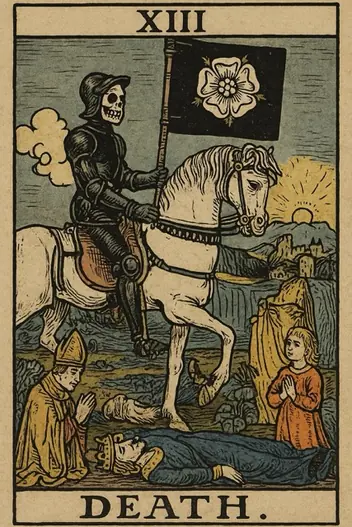

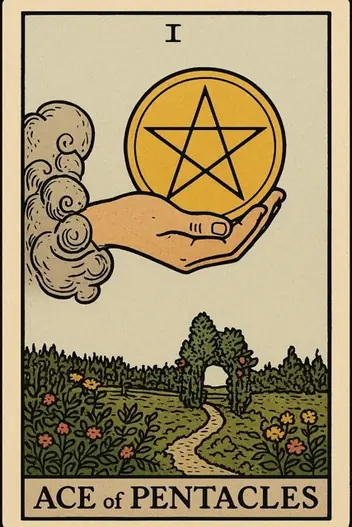
- Arcana
- Death — Major Arcana; Ace of Pentacles — Minor Arcana, Pentacles
- Elements
- Death — Water; Ace of Pentacles — Earth
- Elemental interaction
- Friendly elements — energies support each other
- Numerology
- 13 + 1 = 14 → 5
When the Death card meets the Ace of Pentacles, you are witnessing a collision between the end of one chapter and the birth of another, grounded in tangible reality. In Jungian terms, Death represents the shadow work of letting go—the psychological necessity of shedding outdated identities, beliefs, or attachments. The Ace of Pentacles, on the other hand, symbolizes the seed of potential in the material world: a new job, a relationship foundation, or a financial opportunity that is both real and ripe for cultivation.
Psychologically, this combination signals a pivotal moment where resistance to change is no longer sustainable. The seeker must confront the cognitive dissonance between holding onto a familiar but decaying structure and embracing an uncertain but promising new one. Pragmatically, this is not about dramatic apocalypse but about strategic pruning: cutting away what no longer serves you to make room for a concrete, measurable gain. The key insight here is that transformation is not an abstract concept—it is a resource allocation problem where you must decide what to invest in and what to discard.
What Do Death and Ace of Pentacles Mean Together?
The core dynamic of Death and Ace of Pentacles is a psychological reset tied to material outcomes. The Death card forces a reality check: you cannot move forward without acknowledging that something fundamental must change. This could be a career path that feels dead-end, a relationship that has run its course, or a financial habit that is draining your resources. The Ace of Pentacles then offers a tangible, small-scale opportunity to start anew—but it requires you to act decisively without overthinking.
From a Jungian lens, this pairing activates the individuation process: you are being called to integrate the shadow of loss (Death) with the ego’s desire for security (Ace). The psychological payoff is immense: by embracing the end of a cycle, you unlock the potential for genuine growth in the material world. However, the risk lies in mistaking the Ace’s promise for a quick fix. The Death card demands that you fully process grief, closure, or surrender before you can effectively plant new seeds. Rushing into the Ace without honoring the Death leads to half-hearted beginnings that lack sustainable roots.
In practical terms, this combination is a green light for calculated risk-taking. The Death card removes the emotional clutter, while the Ace of Pentacles provides the concrete blueprint. You are advised to audit your current situation: identify what is truly dead (a job, a project, a belief) and what is alive with potential. Then, take one specific, actionable step—like sending a resume, opening a savings account, or ending a draining commitment. The energy here is efficient, not frantic.
Death and Ace of Pentacles in Love Tarot
If you are single:
This combination suggests that a previous relationship pattern or emotional attachment must die before you can attract a stable, grounded partner. The Ace of Pentacles indicates a new connection is possible, but only if you first release the fantasy of what you thought you needed.
If you are in a relationship:
The Death card signals a necessary transformation in the dynamic—perhaps a conflict that forces a reset or a decision about the relationship’s future. The Ace of Pentacles offers a chance to rebuild on a more solid foundation, but only if both partners are willing to let go of old grievances.
In relationships, this pairing reveals a tension between closure and creation. The Death card often points to a power struggle or a communication breakdown that has reached a breaking point. The Ace of Pentacles, however, provides a practical lifeline: it could represent a shared financial goal, a move to a new home, or a commitment to therapy. The key psychological insight is that transformation requires mutual sacrifice. One partner may need to let go of control, while the other must release resentment. Bold advice: If you are holding onto a relationship out of fear of being alone, the Death card warns that this attachment is killing your potential. The Ace of Pentacles invites you to invest in a partnership that feels like a fresh start, not a repair job.
Emotional intelligence is critical here. The Death card can trigger grief or resistance, while the Ace of Pentacles demands pragmatic action. To avoid self-sabotage, set clear boundaries around what you will no longer tolerate. Use the Ace’s energy to initiate a concrete conversation about the future—whether that means ending things or starting anew. Do not ignore the red flags of stagnation; the Death card is a signal that inaction is the riskiest move.
Your pair is already on the table. Ask your question and draw the clarifying card
or simply focus on it
Career Meaning of Death and Ace of Pentacles
Strategic Opportunities:
A career pivot that requires leaving a stable but unfulfilling role. The Ace of Pentacles points to a specific job offer, project, or skill-building course that is worth the risk.
Strategic Opportunities:
Financial restructuring—paying off debt, cutting unnecessary expenses, or investing in a low-risk asset like real estate or a retirement fund. This is a time to plant seeds for long-term growth.
Calculated Risks:
Avoid impulsive spending or quick-profit schemes. The Death card warns against clinging to a failing business or job out of fear. The Ace of Pentacles rewards patience and diligence, not shortcuts.
In your professional life, this combination signals a critical juncture where you must let go of a dead-end trajectory to embrace a viable new path. The Death card often appears during layoffs, burnout, or industry shifts—situations where the old way is no longer working. The Ace of Pentacles, however, offers a concrete opportunity to rebuild. Strategically, this is the time to network, update your resume, or launch a side project that aligns with your core skills. Bold financial warning: Do not pour resources into a sinking ship just because you have invested time or money. The Death card demands sunk cost fallacy awareness—if something is dead, cut your losses and redirect your energy.
Resource management is paramount. The Ace of Pentacles is a seed, not a full harvest. Invest modestly in the new opportunity—whether that means a part-time course, a freelance gig, or a small business idea. Avoid over-leveraging yourself; the transformation process (Death) may take months, and you need financial buffer to sustain it. Key takeaway: This combination rewards disciplined action over grand gestures. Track your progress with measurable metrics, and be willing to pivot again if the new path doesn’t yield results within a reasonable timeframe.
What Are the Risks of Death and Ace of Pentacles?
The shadow side of Death and Ace of Pentacles emerges when the seeker resists the transformation or misinterprets the Ace as a magic bullet. Cognitive biases to watch for include loss aversion (clinging to the familiar despite its decay) and optimism bias (assuming the new opportunity will solve all problems without effort). When this energy is blocked, you may experience paralysis: you know you need to change, but you procrastinate because the Death card triggers fear of the unknown. Alternatively, you might rush into the Ace without honoring the Death, leading to half-baked projects or relationships that lack depth.
Self-sabotage manifests as perfectionism or over-planning. The Ace of Pentacles is about taking the first step, not having the entire blueprint. If you wait for the perfect moment, the Death card will force a crisis anyway. Poor judgment also appears when you confuse the Ace’s potential with a guarantee. This combination does not promise success—it promises opportunity that requires work. Avoid gambling with your savings or ignoring practical details like contracts, budgets, or timelines. The shadow trap is thinking that transformation is a one-time event; in reality, it is a cycle of Death and rebirth that requires continuous adaptation.
Uncover hidden insights
Let our advanced Tarot system interpret these archetypes specifically for your personal path.
Reversed Death and Ace of Pentacles Explained
If Death is Reversed:
You are stuck in a cycle of denial. The past has not been released, but the Ace of Pentacles is already knocking at the door. The result is paralysis of the will. Advice: acknowledge that the current situation is dead. Any action, even a mistaken one, is better than inaction. Blocked potential manifests as chronic fatigue and apathy.
If the Ace of Pentacles is Reversed:
The opportunity exists, but it is unrealistic or illusory. This could be an offer with poor terms, "easy" money, or an investment in a pyramid scheme. Internal resistance manifests as greed. Advice: check contracts for legal soundness. If Death is upright, you risk losing everything by chasing a phantom.
If BOTH are Reversed:
Complete imbalance. Chaos without reward. You are destroying what could still be saved and grasping at what has no value. A logical way to correct this: return to basic needs (food, sleep, safety). No decisions until the capacity for rational thought is restored.
What Is the Overall Message of Death and Ace of Pentacles?
Constructive use of Death's energy to activate the Ace of Pentacles requires discipline and a cool head. Your task is not to fight the inevitable, but to manage the process of ending. This means: 1) Clearly defining what exactly must die (a project, a habit, a relationship). 2) Drawing up a liquidation plan with minimal losses. 3) Keeping your focus on the Ace of Pentacles — on what you will receive in return.
Strategic advice: use the principle of "burn the field first." When you face a crisis (Death), do not try to save everything at once. Instead, channel all your energy into gathering resources (Ace of Pentacles). A layoff is not the end of a career, but a chance to renegotiate a contract on better terms. A breakup is not the end of love, but an opportunity to build a relationship with a more mature structure. Clarity comes not from avoiding pain, but from a precise calculation of what you are willing to pay for a new beginning.
Your Next Step: Personal Context Matters
The core message of Death and Ace of Pentacles is that strategic surrender leads to tangible growth. To harness this energy, you must identify what is truly dead in your life—whether it’s a job, a relationship, or a belief—and take one concrete step toward a new beginning. Remember: the Ace of Pentacles rewards patience, discipline, and risk assessment, not impulsive leaps. This is a time to act with both courage and calculation.
While this article provides the general archetype of Death and Ace of Pentacles, the true power of Tarot lies in personal context. Your specific situation—your career stage, relationship history, or financial goals—will shape how these cards manifest. To get a deep, personalized interpretation of this exact combination for your unique question, use the Fortune Cards app. You can access it on the web or download it to receive tailored insights that consider your current circumstances. Don’t rely on generic meanings alone—let the cards speak directly to your life right now.
Interpretation by the Fortune Cards editorial team, based on the Rider–Waite tradition and Jungian archetypes. About our methodology · Updated: 2026-08-26
Other Combinations with Death
Other Combinations with Ace of Pentacles
Explore Individual Card Meanings
Table of Contents
- What Do Death and Ace of Pentacles Mean Together?
- Death and Ace of Pentacles in Love Tarot
- Career Meaning of Death and Ace of Pentacles
- What Are the Risks of Death and Ace of Pentacles?
- Reversed Death and Ace of Pentacles Explained
- What Is the Overall Message of Death and Ace of Pentacles?
- Your Next Step: Personal Context Matters
Ready to find answers to your questions?
Start your first reading now and look at your situation with fresh clarity. The cards are ready to reveal deeper meaning.