Death and Eight of Wands Tarot as Feelings
- Arcana
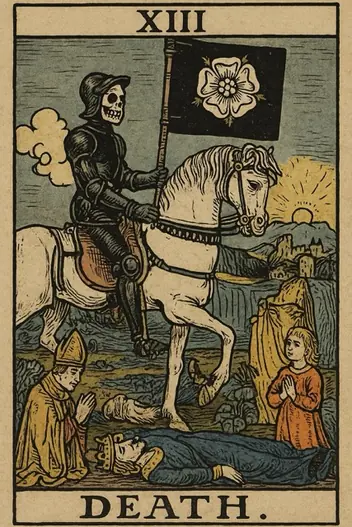
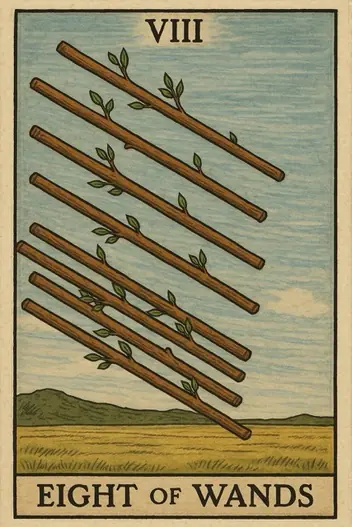
- Death — Major Arcana; Eight of Wands — Minor Arcana, Wands
- Elements
- Death — Water; Eight of Wands — Fire
- Elemental interaction
- Opposing elements — energies create tension
- Numerology
- 13 + 8 = 21 → 3
When the stark, inevitable end symbolized by Death meets the rapid-fire momentum of the Eight of Wands, we are not merely witnessing a change—we are witnessing a forced acceleration of a necessary ending. This is not a gentle transition; it is a psychological and situational "hard reset." The Eight of Wands provides the speed and direction, while Death provides the irrevocable finality. In practical terms, this combination suggests that a period of stagnation is being violently shattered, and the universe is forcing you to adapt quickly or be left behind. The psychological state here is one of controlled urgency—you know something must end, and you have no choice but to act on it immediately.
The core dynamic is a collision between the archetype of the Reaper (unavoidable conclusion) and the archetype of the Arrow (unstoppable motion). In a Jungian sense, this represents the individuation process hitting a critical inflection point. Old structures of the ego—outdated beliefs, toxic relationships, or unproductive career paths—are being dismantled not by slow decay, but by a sudden, overwhelming influx of external events. The strategic implication is clear: do not resist the change, but do not panic either. Instead, channel the energy of the Eight of Wands into precision. Identify what is truly dead and needs to be cleared away, then use the momentum to build the new foundation before the dust settles.
Death and Eight of Wands Combination Meaning
The psychological state created by Death and Eight of Wands is a paradox of clarity within chaos. The seeker is likely experiencing a "white-knuckle" period where multiple life events converge—a breakup, a job loss, or a personal crisis—all happening in rapid succession. The Eight of Wands strips away any illusion of control, while Death demands a ruthless audit of what is worth saving. The key insight here is that this is not a time for deep, prolonged reflection. It is a time for rapid triage: cut what is dead, salvage what is essential, and move forward without sentimentality. The biggest risk is analysis paralysis—trying to hold onto the past while the present is already moving.
This combination forces a confrontation with the Shadow of resistance. The Eight of Wands, in its shadow form, can manifest as frantic, unfocused activity—running from the pain of the ending rather than moving through it. When paired with Death, the healthy response is to surrender to the process of elimination. Think of a forest fire: it destroys the old growth but clears the ground for new seeds. Your task is to be the firefighter who knows which fires to let burn and which to contain. Bold action is required, but it must be targeted action. The archetypal lesson here is that you cannot outrun fate; you can only choose how you land.
What Do Death and Eight of Wands Say About Love?
If you are single:
This combination signals the sudden end of a non-viable romantic pattern or a "situationship." Expect a rapid, clean break from someone who was holding you back, creating space for a new, more aligned connection. Do not chase closure; the momentum will provide it.
If you are in a relationship:
Prepare for a major, fast-moving shift in the dynamic. This could be a decisive breakup or a deep, structural change (e.g., moving in together, ending a long-distance phase). The energy is too strong for half-measures.
In relationship readings, Death and Eight of Wands is a pressure cooker. It forces a "now or never" moment. The psychological dynamic is one of emotional velocity—feelings that have been suppressed are now erupting with force. For couples, this can be a powerful catalyst for healing if both partners are willing to let go of old grievances simultaneously. The key is to communicate with brutal honesty and speed. Dragging out a painful conversation will only amplify the chaos. If the relationship is healthy but stuck, this card pair can signal a rapid breakthrough—a sudden move, a new shared goal, or a crisis that bonds you tighter. However, if the foundation is rotten, this is the wind that blows the house down. Do not negotiate with a dead end.
Your pair is already on the table. Ask your question and draw the clarifying card
or simply focus on it
Career Meaning of Death and Eight of Wands
Strategic Opportunities:
Exit a failing project or role immediately. The Eight of Wands gives you the momentum to leave cleanly—negotiate a severance, reassign tasks, or pivot to a new department. This is the best time to make a clean break.
Strategic Opportunities:
Accelerate a high-stakes launch. If you have a product, pitch, or proposal ready, this combination favors rapid execution. The Death card ensures that old, competing initiatives are cleared out, giving your new idea maximum visibility.
Calculated Risks:
Avoid making long-term financial commitments during the storm. The speed of change can lead to impulsive spending or hasty investments. Objectively, this is a time to liquidate dead assets (e.g., sell a stagnant stock or close an underperforming side business) rather than acquire new ones.
In a career context, this combination is a strategic blitz. The Death card is not just about losing a job; it is about the death of a professional identity. You may be forced to pivot into a completely new industry, skill set, or role. The Eight of Wands provides the velocity to make this transition swiftly. Financially, the message is to cut losses and reallocate capital. This is not the time to "save" a sinking ship. Instead, use the rapid energy to secure new income streams or settle outstanding debts. Bold tip: If you are in a negotiation, move fast. The other party is also feeling the urgency. Demand clarity and close the deal before the energy dissipates. The biggest financial risk is staying still—your current budget or business model may already be obsolete.
Ask your specific question
Don't rely on generic meanings. Get a customized reading tailored specifically to your energies.
Death and Eight of Wands: Warning Signs
The shadow of Death and Eight of Wands manifests as catastrophic impulsivity. The seeker, overwhelmed by the speed of change, may act out of pure fear. Common cognitive biases include "sunk cost fallacy" (refusing to let go of a failed project because you've invested too much), "catastrophizing" (assuming the worst-case scenario is inevitable and acting rashly), and "reactive aggression" (blaming others for the change and lashing out). The psychological trap is mistaking speed for progress. Just because things are moving fast does not mean they are moving in the right direction. If the seeker resists the Death card—trying to resurrect a dead relationship or job—the Eight of Wands can turn into a maelstrom of stress, leading to burnout, anxiety, or physical exhaustion. The shadow warns: do not use the momentum to run away from your own shadow. The real work is not in escaping the ending, but in integrating the lesson it brings.
Reversed Death and Eight of Wands Explained
If Death is Reversed:
This indicates blocked potential or reckless resistance to change. You are clinging to outdated patterns, creating internal tension. The upright Eight of Wands only intensifies the pressure, making the situation explosive. Advice: Acknowledge that the past cannot be reclaimed, and consciously choose your point of entry into a new cycle; otherwise, reality will do it for you, harshly and painfully.
If the Eight of Wands is Reversed:
This signals internal resistance and weakness of will. The impulse for change is present (upright Death), but you are sabotaging it through procrastination, doubt, or fear. Movement slows down, and energy dissipates. Advice: Find an external deadline or "anchor" (a mentor, partner, contract) that will force you to act. Your internal motivation is currently insufficient.
If BOTH are Reversed:
This is a complete imbalance of dynamics. The situation is characterized by stagnation, apathy, and a lack of will to change. You simultaneously fear change and cannot remain where you are. Method for correction: Start small. Choose one area of life (e.g., physical activity or tidying your desk) and introduce a forced change into it. This will trigger a chain reaction and bring the system out of equilibrium.
Synthesis: Strategic Conclusion
How to constructively use the energy of Death to balance the Eight of Wands? First, accept the inevitability of loss. Death demands a sacrifice—voluntarily relinquish what no longer serves your goals. This could be an old habit, a toxic environment, or an outdated professional role. A conscious completion of a cycle strips it of its traumatic nature.
Second, use the speed of the Eight of Wands to build new structures. Do not try to "wait out" the storm. Instead, channel the impulse toward laying a new foundation. Strategic advice: create a "crisis protocol." Predefine 3-4 actions you will take when a force majeure occurs. This will reduce anxiety and allow you to act on autopilot when the moment of truth arrives.
Third, cultivate "flow thinking." The Eight of Wands is not chaos, but high velocity. Learn to see it not as a threat, but as an opportunity for rapid learning. Every crisis is an intensive course in managing reality. You cannot control the wind, but you can adjust the sails. The main resource right now is your capacity for adaptation and your readiness to act without guarantees. Clarity comes through action, not through contemplation.
Where to Go From Here
The core message of Death and Eight of Wands is that a necessary end is arriving faster than you expected. Your task is to be the pilot, not the passenger. You cannot stop the storm, but you can steer through it. This is a time for courageous action, ruthless prioritization, and emotional detachment from the past. The archetypes are clear: let go of what is dead, and use the speed of change to reach a new shore.
While this article provides a deep, archetypal analysis, the true power of Tarot lies in its application to your unique life situation. The general meaning of Death and Eight of Wands is a powerful guide, but it cannot account for the specific dynamics of your question—whether it’s about a particular person, a career decision, or a personal crisis. That is where personalized interpretation becomes invaluable. To get a precise, actionable reading tailored to your exact circumstances, I recommend using the Fortune Cards app. You can access it on the web or download it to receive a deep, customized interpretation of this exact combination for your specific question right now.
Interpretation by the Fortune Cards editorial team, based on the Rider–Waite tradition and Jungian archetypes. About our methodology · Updated: 2026-08-26
Other Combinations with Death
Other Combinations with Eight of Wands
Explore Individual Card Meanings
Table of Contents
Ready to find answers to your questions?
Start your first reading now and look at your situation with fresh clarity. The cards are ready to reveal deeper meaning.