Death and Page of Swords Reversed in Tarot
- Arcana
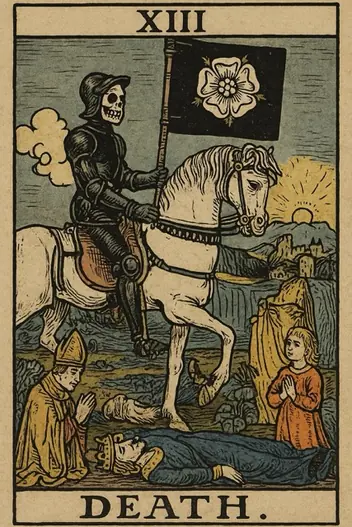
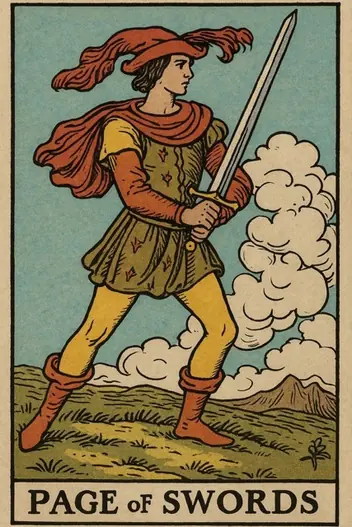
- Death — Major Arcana; Page of Swords — Minor Arcana, Swords
- Elements
- Death — Water; Page of Swords — Air
- Elemental interaction
- Neutral elements — energies coexist without conflict
- Numerology
- 13 + 11 = 24 → 6
When the Death card’s archetype of inevitable transformation meets the Page of Swords’ sharp, inquisitive intellect, you get a psychological cocktail of calculated destruction. This is not random chaos—it is a deliberate, mental dismantling of old structures. The Page of Swords brings the analysis, the questions, and the data; Death brings the execution. Together, they demand you cut away what no longer serves you with ruthless logic, not raw emotion.
In real-world terms, this combination often appears when you are on the verge of a major decision that requires you to kill a cherished belief, a comfortable habit, or a stagnant relationship to make room for a more authentic path. The Page of Swords provides the clarity; Death provides the courage to act. The risk lies in becoming detached or overly clinical—treating a human situation like a problem to be solved rather than a transition to be navigated.
Death and Page of Swords Card Meaning Explained
The psychological state here is one of intellectual crisis—a moment when your existing mental models collapse under the weight of new evidence. The Death card strips away your illusions, while the Page of Swords forces you to interrogate the corpse of your old self. This is not a gentle evolution; it is a strategic dismantling of outdated beliefs, often triggered by a shocking truth or a painful revelation.
This pairing is highly analytical, but it lacks the warmth of emotional processing. The seeker may feel a surge of mental clarity—seeing exactly what needs to end—but may also experience emotional numbness or a sense of detachment from their own feelings. The key insight here is that transformation requires not just willpower, but rigorous self-examination. You cannot change what you refuse to see clearly.
The most powerful dynamic is the synthesis of action and thought. The Page of Swords represents the mind that plans; Death represents the force that executes. When these energies align, you can strategically end a situation with precision, minimizing collateral damage. However, the shadow risk is overthinking the inevitable—using analysis as a defense mechanism to avoid the actual pain of letting go.
Death and Page of Swords in Love and Relationships
If you are single:
This combination suggests you are intellectually ready to end a pattern of attracting unavailable or emotionally immature partners. You may need to cut off a lingering connection with surgical precision—no drama, just a clean break.
If you are in a relationship:
A truth bomb is about to land that will fundamentally shift the power dynamic. One partner may confront the other with cold, hard facts about a breach of trust, a mismatch in life goals, or a need for radical honesty.
The relationship dynamics here are characterized by a need for brutal honesty and clear boundaries. The Death card indicates that the current form of the relationship cannot continue—something must die. The Page of Swords warns against using sharp words as weapons rather than tools for clarity. The key is to communicate your truth without aiming to wound. If you are the one delivering the hard news, prepare for a defensive reaction. If you are receiving it, resist the urge to argue or deflect. The most productive path is to treat this as a joint autopsy of what is broken, not a blame game. Emotional intelligence means recognizing that truth, without empathy, becomes cruelty.
Your pair is already on the table. Ask your question and draw the clarifying card
or simply focus on it
Death and Page of Swords: Career and Money
Strategic Opportunities:
End a failing project or partnership to free up resources for a more viable venture. The Page of Swords gives you the data to justify the hard cut.
Strategic Opportunities:
Use intellectual property or a new skill set to pivot your career entirely. Death clears the old resume; the Page drafts the new one.
Calculated Risks:
Avoid burning bridges with aggressive communication. The Page of Swords can be too blunt, and Death can be too final. Document everything before making a major financial move.
In professional life, Death and Page Of Swords signal a necessary restructuring. This could manifest as a layoff, a department overhaul, or a strategic pivot where old processes are scrapped for new, data-driven ones. The advice is to be the architect of your own transformation rather than a victim of it. If you sense change coming, use the Page’s analytical energy to anticipate the cuts and reposition yourself—update your resume, network with key players, and gather intelligence.
Financially, this is a time for ruthless auditing. The Page of Swords excels at spotting inefficiencies and hidden costs. Cut any recurring expense that doesn’t serve your long-term goals. The Death card warns against holding onto depreciating assets out of sentimentality. Sell the car, close the credit card, or end the subscription that is bleeding you dry. However, beware of making a financial decision based on incomplete information—the Page can be impulsive. Verify your data three times before executing a final move.
Uncover hidden insights
Let our advanced Tarot system interpret these archetypes specifically for your personal path.
Death and Page of Swords Reversed Meaning
When cards appear in a reversed position, the dynamic becomes distorted, turning the potential for destruction into chaos or stagnation.
If Death is Reversed:
This is a blocked crisis. You know something needs to change (the Page of Swords is active), but you lack the will to see it through. You are stuck in endless analysis and conversations, but cannot pull the trigger. Advice: Stop waiting for the perfect moment to leave. Your procrastination is equivalent to self-destruction. Acknowledge your fear and act despite it.
If the Page of Swords is Reversed:
This is an internal resistance to the truth. Death is approaching, but you refuse to acknowledge it. You are using your intellect not for analysis, but for self-deception: "It's not that bad," "I'll manage." Warning: You risk being crushed by circumstances because you haven't prepared for the blow. Stop devaluing the warning signs.
If BOTH are Reversed:
Complete imbalance — paralysis of will and mind. This is a victim state, where a person sees no way out and doesn't want to look for one. Chaos is mounting, and clarity is absent. Remedy: Urgently seek external support — a mentor, a therapist, a friend who will tell you the truth. You need someone to temporarily become your "Page of Swords" and help you see reality, and then your "Death," pushing you into action.
When Death and Page of Swords Signal Trouble
The shadow manifestation of this combination is cruel rationality—using the excuse of “honesty” to be unnecessarily harsh. The seeker may become over-identified with their intellect, dismissing their own or others’ emotions as irrelevant. This can lead to self-sabotage through premature endings—cutting ties before exploring repair options, or quitting a job in a fit of righteous anger without a safety net.
Cognitive biases to watch for:
The confirmation bias of the Page of Swords—only seeing evidence that supports your desire to end something. The sunk cost fallacy of Death’s opposite—refusing to let go because you’ve already invested so much. The real danger is acting on impulse while convincing yourself you are being strategic. If you feel a cold, detached certainty, pause and ask: “Am I solving a problem, or am I avoiding a feeling?”
Death and Page of Swords: The Combined Message
How can this energy be used constructively? The key lies in consciously separating the roles. Death represents your resolve and readiness for loss. The Page of Swords is your inner strategist and analyst. The task is not to let one suppress the other, but to make them work in tandem.
The strategic algorithm of action looks like this: First, activate the Page of Swords for a complete, ruthless diagnosis. Compile a list of what must die: a habit, a relationship, a job, a belief. Ask yourself: "What data am I ignoring to preserve the illusion of stability?" Write down this data. Then, activate Death — make a decision based on this data. Do not wait for emotional readiness. Making the decision is the act of Death itself. The emotions will catch up later.
Your primary resource in this combination is clarity at the cost of comfort. You pay for clarity with discomfort, but in return, you gain precious time and energy that would otherwise be spent in agony. Do not try to make the process "painless." Make it swift and honest. The faster you move through the surgical intervention of Death and the Page of Swords, the sooner the next phase — governed by life and creation — can begin.
Remember: this combination is not a curse, but a tool for clearing space. It gives you the opportunity to start with a clean slate — not with "rose-colored glasses," but with a cold, sword-sharp understanding that you will never repeat old mistakes again.
Your Next Step: Personal Context Matters
The Death and Page Of Swords combination is a powerful call to use your mind to navigate a necessary ending. It asks you to be both the surgeon and the patient—to cut with precision, but also to heal. The core message is that transformation is most effective when it is intentional, not reactive. You have the clarity to see what must change; now you need the courage to act.
However, every Tarot reading is unique to your specific situation. While this article provides the general archetype, the true power lies in applying it to your personal context. The Fortune Cards app allows you to input your exact question—about love, career, or growth—and receive a deep, personalized interpretation of this exact combination. Use it on the web or download it now to get the precise guidance you need to make your next move with confidence.
Interpretation by the Fortune Cards editorial team, based on the Rider–Waite tradition and Jungian archetypes. About our methodology · Updated: 2026-08-26
Other Combinations with Death
Other Combinations with Page of Swords
Explore Individual Card Meanings
Table of Contents
- Death and Page of Swords Card Meaning Explained
- Death and Page of Swords in Love and Relationships
- Death and Page of Swords: Career and Money
- Death and Page of Swords Reversed Meaning
- When Death and Page of Swords Signal Trouble
- Death and Page of Swords: The Combined Message
- Your Next Step: Personal Context Matters
Ready to find answers to your questions?
Start your first reading now and look at your situation with fresh clarity. The cards are ready to reveal deeper meaning.