Death and Six of Pentacles Tarot Combination
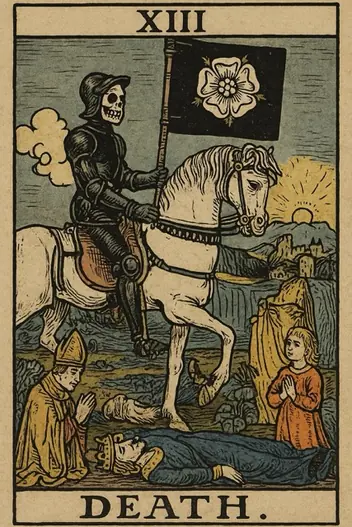
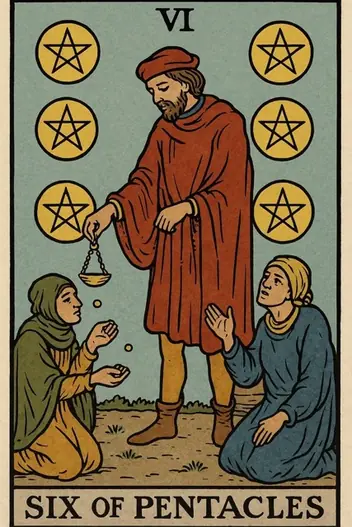
- Arcana
- Death — Major Arcana; Six of Pentacles — Minor Arcana, Pentacles
- Elements
- Death — Water; Six of Pentacles — Earth
- Elemental interaction
- Friendly elements — energies support each other
- Numerology
- 13 + 6 = 19 → 1
The intersection of the Death card and the Six of Pentacles creates a powerful tension between transformation and resource distribution. The Death card represents the ending of a cycle, a necessary loss that clears the way for new growth. The Six of Pentacles, by contrast, embodies the act of giving and receiving, the balance of power inherent in material exchange. When these two collide, the question becomes: How do we maintain our integrity and strategic footing when the ground is shifting beneath us?
Psychologically, this pairing confronts us with the reality that power dynamics often become most visible during times of transition. The Death card strips away the old structures—jobs, relationships, identities—that once defined our status. The Six of Pentacles then asks us to renegotiate our place in the social and material hierarchy. Are we the giver, the receiver, or someone who must learn to do both with grace and awareness? This combination forces a pragmatic examination of what we truly need versus what we merely cling to.
Death and Six of Pentacles Together: Meaning
The core dynamic of Death and the Six of Pentacles is a strategic recalibration of resources in the face of inevitable change. This is not a time for impulsive generosity or desperate clutching. Instead, it calls for a clear-eyed assessment of what is ending and what remains. The Death card’s energy is impersonal and transformational; it does not negotiate with sentimentality. The Six of Pentacles introduces the human element: how we treat others—and ourselves—during this transition reveals our deepest values.
The psychological state here is one of controlled surrender. You are being asked to release the old without abandoning your practical responsibilities. This might mean letting go of a career path while still honoring financial obligations, or ending a relationship while maintaining respectful boundaries around shared assets. The key insight is that transformation does not happen in a vacuum—it is funded, supported, and constrained by the resources you have and the power dynamics you navigate. Bold strategic patience is required: do not give away your power impulsively, but do not hoard it out of fear either.
In real-world terms, this combination often appears when someone is facing a major life transition—a bankruptcy, a divorce, a career change—and must decide how to allocate limited time, money, or emotional energy. The Six of Pentacles warns against creating new dependencies during this vulnerable period. Instead, focus on fair exchanges and temporary support systems that do not create long-term obligations. The Death card ensures that whatever you release will not return in its old form, so choose wisely what you hold onto.
Your pair is already on the table. Ask your question and draw the clarifying card
or simply focus on it
Death and Six of Pentacles as Feelings
If you are single:
This pairing suggests that a current attraction may be tied to a power imbalance rather than genuine connection. Evaluate whether you are attracted to someone because they represent stability or because you are projecting a need for rescue. Bold advice: Wait until you feel whole alone before entering a new dynamic.
If you are in a relationship:
The relationship is undergoing a necessary transformation that may involve renegotiating roles around money, care, or emotional labor. One partner may be feeling depleted while the other holds more power. Bold advice: Have an honest conversation about what each of you needs to give and receive to feel balanced.
In relationships, Death and the Six of Pentacles often signals a period where emotional intimacy is tested by material realities. This could manifest as one partner losing a job, inheriting wealth, or facing a health crisis that shifts the balance of care. The psychological work here is to separate your worth from your role as provider or dependent. Bold relationship advice: Do not use generosity as a means of control, nor accept help that creates resentment. True partnership requires that both parties feel they can both give and receive without losing themselves.
This combination also warns against the shadow of transactional love—where affection is used as currency to avoid confronting the need for change. If you find yourself bargaining for connection by offering material support, ask yourself what you are afraid to lose. The Death card demands that you face that fear directly, not bypass it with gifts or favors.
Death and Six of Pentacles: Career and Money
Strategic Opportunities:
This is an ideal time to restructure your finances after a major change. Consider consolidating debt, renegotiating contracts, or seeking professional advice to create a sustainable budget.
Strategic Opportunities:
If you are in a leadership role, delegate wisely. The Death card clears out underperformers or outdated projects; the Six of Pentacles suggests you can now redistribute resources to teams that show genuine potential.
Calculated Risks:
Avoid making long-term financial commitments during this transition. Do not lend money to friends or family, and be wary of investments that promise quick returns. The Death card’s energy is about ending, not starting new cycles.
Professionally, Death and the Six of Pentacles suggests a career pivot that requires careful resource management. You may be leaving a job, closing a business, or being laid off. The strategic move is to negotiate a fair severance, transition period, or reference before you walk away. Bold financial warning: Do not accept a “pity offer” that keeps you in a diminished role out of guilt or obligation. The Death card says the old role is over; the Six of Pentacles says you deserve to leave with dignity and practical support.
For entrepreneurs, this combination indicates a need to rebalance your client portfolio. Let go of low-paying or high-drain clients (Death) and focus on those who value your work and pay fairly (Six of Pentacles). Bold strategic tip: Use this time to create a tiered pricing structure that reflects your true worth. The transformation you are undergoing should be reflected in how you value your contributions.
Deepen your understanding
Find out exactly what this reading means for your current life situation with our oracle.
Death and Six of Pentacles Reversed: How to Read It
When cards appear reversed, the dynamic becomes distorted, losing its constructive quality.
If Death is reversed:
Blocked potential. The crisis is prolonged; the person clings to the ruins of the past. Paired with the Six of Pentacles, this indicates parasitic help. You or someone else is using support not to emerge from the crisis, but to exist within it indefinitely. Advice: immediately cease any funding or emotional support for the "dead" project or relationship. This only prolongs the agony.
If the Six of Pentacles is reversed:
Internal resistance or weakness. Even if the crisis (Death) has arrived, you refuse to accept help or, conversely, are unable to provide it. This manifests as "beggar's pride" or "miser's stinginess". The person cannot establish a proper hierarchy of support. Advice: acknowledge your vulnerability or, conversely, your power. If you cannot accept help, you condemn yourself to a harsher Death.
If BOTH are reversed:
Complete imbalance. This is chaotic collapse with no possibility of regrouping. Resources are draining away (Six of Pentacles reversed) into a hopeless cause (Death reversed). Logical way to correct: a full audit of all assets and liabilities. You need to artificially create a "minimal Death"—cut off everything that pulls you down to stop the resource drain.
The Shadow Side of Death and Six of Pentacles
The shadow side of Death and the Six of Pentacles is the cognitive bias of entitlement or martyrdom. You may cling to the belief that because you are undergoing a difficult transition, others owe you support. This can lead to passive-aggressive demands or a refusal to take responsibility for your own recovery. Conversely, you might fall into the trap of over-giving to avoid facing your own pain, using generosity as a shield against the Death card’s necessary grief.
Another pitfall is misreading power dynamics. You might assume that because you are in a position of loss, you are automatically the receiver. In reality, you may still have resources—time, skills, emotional intelligence—that are valuable. The shadow is to undervalue yourself and accept unequal exchanges out of low self-esteem. Bold warning: Do not mistake temporary vulnerability for permanent powerlessness. The Death card’s transformation will eventually empower you if you do not sabotage it with poor boundaries.
Finally, beware of catastrophizing the change. The Death card can feel overwhelming, but the Six of Pentacles reminds you that you have resources to navigate this. The shadow is to focus only on what you are losing, ignoring what you still have. This cognitive distortion can lead to rash decisions, such as abandoning all support systems or burning bridges out of fear.
Overall Meaning of Death and Six of Pentacles
To constructively harness the energy of Death for activating the Six of Pentacles, you must embrace the paradox of "destructive generosity." You must be willing to give something valuable (time, money, attention) precisely at the moment when everything around you is collapsing. This is not about wastefulness, but about strategic sowing. Death destroys the old soil, while the Six of Pentacles casts the seeds of the future into it. A profound strategic counsel: find one person, one idea, or one asset that you are willing to "subsidize" during your own period of decline. This will become your anchor and your point of assembly.
Psychologically, you need to separate two processes: "mourning losses" and "investing in the future." Do not mix them. Allocate a specific budget (emotional or financial) for supporting a new direction, and do not touch the reserves designated for the "funeral" of the old. The key action is to compile a list: "What I am finally releasing" (Death) and "To whom and how much I am ready to give right now so that it may survive" (Six of Pentacles). This alliance teaches us that true power is manifested not in controlling the inevitable, but in wisely distributing what remains after the crash. Only in this way does chaos transform into manageable transformation.
Your Next Step: Personal Context Matters
The Death and Six of Pentacles combination ultimately asks you to accept endings with grace while managing your resources with strategic intelligence. It is not a card of doom, but of recalibration. The core message is that transformation is inevitable, but how you navigate it—with fairness, self-awareness, and practical planning—determines whether you emerge stronger or diminished. Bold takeaway: Let go of what must end, but do not let go of your own worth in the process.
While this article provides a general framework, the true power of Tarot lies in its application to your unique situation. The specific details of your life—your history, your relationships, your financial reality—change how these archetypes express themselves. To get a deep, personalized interpretation of Death and the Six of Pentacles for your exact question, use the Fortune Cards app. Available on the web or for download, it offers a tailored reading that considers your personal context, giving you the clarity and strategic guidance you need right now.
Interpretation by the Fortune Cards editorial team, based on the Rider–Waite tradition and Jungian archetypes. About our methodology · Updated: 2026-08-26
Other Combinations with Death
Other Combinations with Six of Pentacles
Explore Individual Card Meanings
Table of Contents
- Death and Six of Pentacles Together: Meaning
- Death and Six of Pentacles as Feelings
- Death and Six of Pentacles: Career and Money
- Death and Six of Pentacles Reversed: How to Read It
- The Shadow Side of Death and Six of Pentacles
- Overall Meaning of Death and Six of Pentacles
- Your Next Step: Personal Context Matters
Ready to find answers to your questions?
Start your first reading now and look at your situation with fresh clarity. The cards are ready to reveal deeper meaning.