Love Tarot: The Devil and King of Cups
- Arcana
- The Devil — Major Arcana; King of Cups — Minor Arcana, Cups
- Elements
- The Devil — Earth; King of Cups — Water
- Elemental interaction
- Friendly elements — energies support each other
- Numerology
- 15 + 14 = 29 → 2
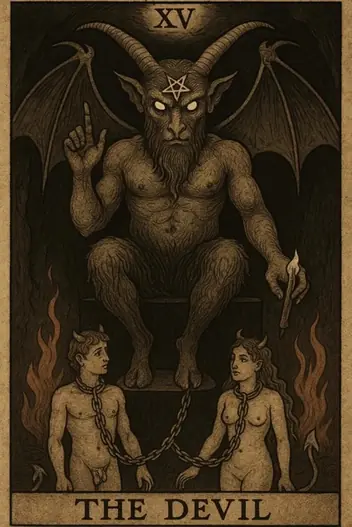
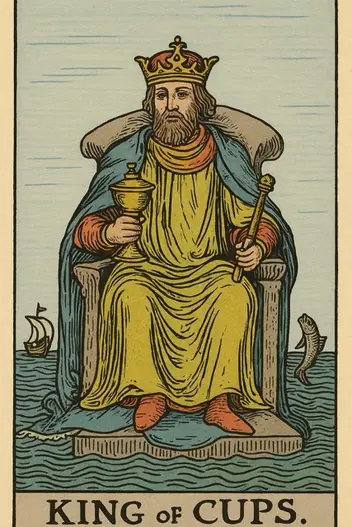
When The Devil meets the King of Cups, we witness a collision between raw, instinctual bondage and the calm mastery of the emotional realm. The Devil represents the shadow—addiction, obsession, materialism, and the fear that keeps us trapped in patterns we know are unhealthy. The King of Cups, by contrast, embodies emotional sovereignty—the ability to feel deeply without being overwhelmed, to wield empathy as a tool of influence, and to maintain composure under pressure. Together, they pose a critical question: Can you use emotional intelligence to break free from your own chains, or will you use your charm to rationalize staying stuck?
This combination often surfaces when a person is deeply attached to a situation—be it a relationship, a career, or a habit—that provides intense emotional gratification but also breeds dependency. The King of Cups offers a path: not to suppress the Devil’s energy, but to channel it with discipline. The pragmatic takeaway here is that self-awareness without action is just another form of avoidance. You must decide whether you are the master of your emotions or merely their caretaker.
Core Dynamics & Interpretation
The psychological tension in this pairing is profound. The Devil represents the shadow of the King of Cups—the part of the emotional master that secretly enjoys control, manipulation, or the thrill of forbidden attachments. When these cards appear together, the seeker is often in a state of emotional compartmentalization: they feel everything intensely (King of Cups) but use that feeling to justify staying in a toxic dynamic (The Devil). For example, a person might say, “I know this relationship is unhealthy, but I can’t imagine life without them,” revealing how emotional depth can become a prison.
The key insight here is the difference between feeling and acting. The King of Cups possesses the capacity to regulate emotions, but The Devil tempts him to use that regulation to maintain a harmful status quo rather than to escape it. In practical terms, this means you may have high emotional intelligence but are applying it to manage a bad situation instead of leaving it. Your empathy becomes a tool of self-deception, allowing you to sympathize with someone who is exploiting you, or to rationalize your own compulsive behaviors as “just being passionate.”
Strategically, this combination demands that you turn your emotional mastery inward. Instead of soothing others or managing external chaos, you must confront the internal chaos of your own attachments. The Devil’s energy is about fear—fear of scarcity, fear of loneliness, fear of losing control. The King of Cups’ true power lies in facing that fear without numbing it. If you can sit with the discomfort of your own dependency without acting on it, you break the Devil’s grip. This is not about becoming cold or detached; it is about choosing discipline over indulgence.
What Do The Devil and King of Cups Say About Love?
If you are single:
This combination warns against mistaking intensity for intimacy. You may be drawn to someone who is emotionally unavailable, controlling, or who triggers your own shadow patterns. Pause and ask yourself: does this connection make me feel alive, or does it make me feel trapped? The King of Cups suggests you have the emotional maturity to walk away—but only if you choose to use it.
If you are in a relationship:
You are likely navigating a dynamic where one partner is emotionally dominant and the other is subtly codependent. The Devil can indicate a shared secret, a power imbalance, or a mutual addiction (e.g., to drama, sex, or financial control). The King of Cups’ role is to bring this shadow into the light with calm, direct communication.
In a relationship, this pairing often manifests as a seductive but toxic bond where both parties are highly attuned to each other’s feelings yet use that attunement to manipulate or control. One partner may play the “savior” or “therapist,” while the other plays the “victim” or “temptress.” The key relationship advice here is to stop managing each other’s emotions and start managing your own. If you are the King of Cups, you must set firm boundaries and refuse to be the emotional caretaker of someone who refuses to heal. If you are the one drawn to The Devil, you must recognize that your partner’s calm exterior may be a mask for their own unexamined shadow.
Bold action is required: have a conversation where you name the pattern aloud. For example, “I notice we keep having the same argument about trust, and I feel like we’re both addicted to the intensity of it. I need us to commit to solving this, not just recycling it.” This combination rewards emotional honesty over emotional performance.
Your pair is already on the table. Ask your question and draw the clarifying card
or simply focus on it
Career and Finances
Strategic Opportunities:
Use your emotional intelligence to negotiate from a position of calm power in high-stakes situations. The King of Cups thrives in roles like leadership, counseling, or diplomacy—but The Devil warns you to avoid using these skills to manipulate others for personal gain.
Strategic Opportunities:
This is an excellent time to break a financial or career pattern that has kept you stuck. If you’ve been overworking, undercharging, or staying in a toxic job because of fear, the King of Cups gives you the composure to plan an exit strategy while The Devil’s energy fuels your motivation.
Calculated Risks:
Beware of over-leveraging emotional charm to get ahead. The Devil’s shadow in career can manifest as cutting ethical corners, exploiting colleagues, or becoming addicted to status and money. Do not mistake emotional intelligence for moral immunity.
In the professional realm, this combination signals a need for strategic detachment. You may be deeply invested in a project, a team, or a financial outcome—so much so that your judgment is clouded. The Devil represents the attachment to the result, while the King of Cups represents the process of managing it wisely. Your best move is to step back and assess whether your current path is truly serving your long-term goals or merely feeding a short-term compulsion.
For financial decisions, this pairing urges caution. The King of Cups is not impulsive, but The Devil is seductive. You might be tempted to take a high-risk investment, to buy something you can’t afford to “keep up appearances,” or to stay in a lucrative but soul-crushing job. The practical advice is to create a cooling-off period for any major financial commitment. Run the numbers, consult a trusted advisor, and ask yourself: Am I making this decision from a place of fear or from a place of calm confidence? The answer will reveal which card is truly in control.
Get a personalized interpretation
Unlock the combined meaning of your cards in the context of your unique question — for free.
The Devil and King of Cups: Warning Signs
The shadow manifestation of this combination is emotional manipulation disguised as wisdom. The King of Cups can become a “shadow therapist”—someone who uses their understanding of others’ psychology to control them, often under the guise of helping. The Devil amplifies this by adding a layer of addiction: the manipulator becomes addicted to the power they feel when someone depends on them. This is the archetype of the charismatic cult leader, the charming narcissist, or the “nice” partner who secretly enjoys your vulnerability.
Cognitive biases to watch for include the sunk cost fallacy (staying in a bad situation because you’ve invested so much) and emotional reasoning (believing something is true because it feels true). For example, you might think, “I feel so connected to this person, so it must be healthy,” even though the evidence says otherwise. The Devil’s trap is to replace logic with intensity. Another pitfall is self-sabotage through over-analysis: the King of Cups can endlessly dissect emotions without ever taking action, using introspection as a form of avoidance.
If this energy is blocked, you may see the opposite: a person who is too detached, suppressing all feeling to avoid the Devil’s pull. This leads to emotional numbness and a sterile, unfulfilling life. The goal is not to kill the Devil’s passion, but to integrate it with the King’s discipline.
Reversed The Devil and King of Cups Explained
When cards appear reversed, the dynamic breaks down, exposing weak points in the strategy.
If The Devil is reversed:
This is liberation from illusions, but at the cost of losing control. You no longer want to play by the system's rules, but you don't yet know how to manage your own life independently. The risk is falling into recklessness and destroying stable, albeit toxic, connections before you build new ones. Advice: don't burn your bridges until you've laid a new path.
If the King of Cups is reversed:
Emotional incompetence and vulnerability. You are losing your mask of control. Your manipulations become obvious and clumsy. Instead of cold calculation, you get hysterics or passive aggression. Warning: in this state, you are extremely vulnerable to external pressure and blackmail.
If BOTH are reversed:
Complete imbalance. This is a state of "emotional bankruptcy". You are simultaneously suffering from addiction (The Devil) and incapable of managing your feelings (King of Cups). The logical way to correct this is a short period of complete isolation. Stop trying to control others. Focus on basic needs: sleep, food, physical safety. Only by restoring the foundation can you reclaim your power.
What Is the Overall Message of The Devil and King of Cups?
How to constructively harness the Devil's energy to balance the King of Cups? Your task is to channel this powerful alliance toward "destruction for the sake of creation." Do not try to become "good"—that will not work. Instead, use your cold empathy and strategic thinking for diagnosing your own dependencies.
Imagine you are the CEO of your own life. The King of Cups is your best negotiator and HR director. The Devil is the audit. Your strategy is to conduct a total audit of emotional and material attachments. Ask yourself: "Which of my habits (smoking, overwork, toxic relationships) gives me a false sense of security? How can I replace this anchor with something healthier yet equally effective?" The answer lies in creating rituals and structures that provide control without destruction. For example, instead of controlling your partner, control your own schedule and finances. Deep advice: become the "emotional architect" of your reality, not the "warden" in a prison of others' feelings. Use your power to create a space where you and others can be vulnerable without fear of being crushed.
Applying This to Your Situation
The core message of The Devil and King of Cups is one of conscious choice: you have the emotional tools to either break free from your chains or to polish them until they look like jewelry. The combination asks you to examine your attachments with ruthless honesty and to use your emotional intelligence as a scalpel, not a bandage. True mastery is not about feeling in control—it’s about being willing to lose control in the service of growth.
While this article provides a deep archetypal overview, the real power of Tarot lies in how these cards speak to your specific situation. The same combination can mean something very different for a person asking about a divorce versus someone asking about a career pivot. That’s why I recommend using the Fortune Cards app—available on the web or for download—to get a personalized, detailed interpretation of this exact card pair for your unique question. The app combines Jungian psychology with practical, actionable advice, giving you the clarity you need to move forward with confidence. Don’t settle for generic meanings; let the cards speak directly to you.
Interpretation by the Fortune Cards editorial team, based on the Rider–Waite tradition and Jungian archetypes. About our methodology · Updated: 2026-08-26
Other Combinations with The Devil
Other Combinations with King of Cups
Explore Individual Card Meanings
Table of Contents
Ready to find answers to your questions?
Start your first reading now and look at your situation with fresh clarity. The cards are ready to reveal deeper meaning.