Eight of Cups and Ten of Pentacles Tarot Cards Combination: Meaning and Interpretation
- Arcana
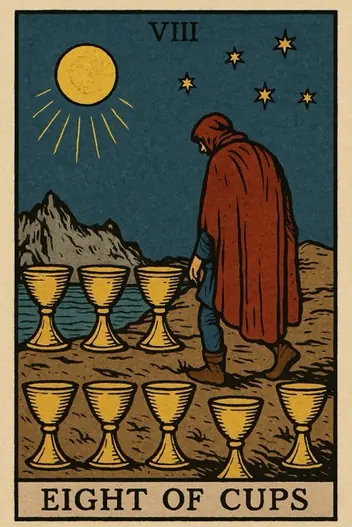
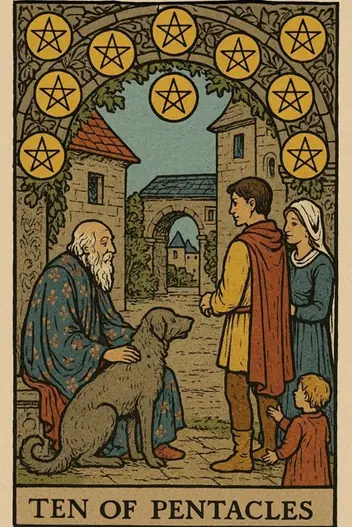
- Eight of Cups — Minor Arcana, Cups; Ten of Pentacles — Minor Arcana, Pentacles
- Elements
- Eight of Cups — Water; Ten of Pentacles — Earth
- Elemental interaction
- Friendly elements — energies support each other
- Numerology
- 8 + 10 = 18 → 9
When the Eight of Cups—the card of deliberate departure, emotional exhaustion, and the search for higher meaning—collides with the Ten of Pentacles—the card of material completion, family inheritance, and established security—a powerful tension emerges. This is not a simple conflict between "stay" or "go." It is a sophisticated psychological dilemma about whether a stable structure still serves your soul’s evolution.
In real life, this combination often appears when you have built something solid—a career, a relationship, a financial portfolio—but feel an unmistakable inner pull to walk away from it. The stakes are high because the Ten of Pentacles represents not just your own security, but the expectations of a family, a lineage, or a long-term commitment. The Eight of Cups asks: What is the price of staying when your spirit has already left?
What Do Eight of Cups and Ten of Pentacles Mean Together?
The psychological core of this pairing is a confrontation between the collective and the individual. The Ten of Pentacles embodies the archetype of the Pater Familias—the responsible steward who maintains traditions, financial stability, and generational continuity. The Eight of Cups embodies the Wanderer—the archetype of the seeker who must abandon the known in order to find authentic meaning. The tension is not about choosing one over the other, but about recognizing that the Wanderer cannot thrive if the Pater Familias is suffocating them.
Practically, this combination signals a critical decision point where the seeker must evaluate whether their current security is actually a cage disguised as a safety net. The Eight of Cups suggests that the emotional or spiritual cost of staying has become unsustainable. The Ten of Pentacles warns that leaving will disrupt systems that have been built over years or generations. The key insight is that the departure is not a failure—it is a necessary evolution. The seeker must ask: Am I leaving because I am running from responsibility, or because I have outgrown this structure?
Bold strategic advice:
Do not burn bridges impulsively. The Eight of Cups often tempts an abrupt exit, but the Ten of Pentacles demands a responsible handover or a phased transition. Plan your departure with the same care you used to build the legacy. This is not a rejection of the past; it is a recalibration of priorities.
Ask your question and flip the cards
or simply focus on it
Love and Relationships
If you are single:
This combination suggests you are attracted to partners who offer stability and commitment, yet you feel a persistent restlessness. You may be drawn to someone who represents "the safe choice" (family-oriented, financially secure) but sense that the emotional connection lacks depth. Your next step is to clarify whether you are seeking a partner or a parent figure.
If you are in a relationship:
You or your partner may be contemplating a major exit from the relationship, even though the external structure (marriage, shared property, children) appears stable. The dynamic may involve one person feeling suffocated by tradition, while the other is clinging to the security of the status quo.
In committed relationships, this pair often signals a crisis of authenticity. One partner may feel that the relationship has become a ritual of obligation rather than a source of genuine connection. The Ten of Pentacles represents the comfort of shared history and material stability, but the Eight of Cups reveals that the emotional well has run dry. The danger is that the leaving partner may not fully articulate their inner emptiness until it is too late. Bold relationship advice: Couples should engage in structured, honest conversations about unmet emotional needs before anyone makes a final decision. The Eight of Cups departure can sometimes be avoided if the Ten of Pentacles structure is adapted to include more freedom, spontaneity, or individual growth.
For singles, this combination warns against entering a relationship out of fear of being alone. The Ten of Pentacles can seduce you with the promise of a "complete package"—a partner with a stable job, family approval, and long-term potential. But the Eight of Cups whispers that you will eventually feel the need to walk away if the emotional connection is hollow. Your priority is emotional resonance, not external validation.
Deepen your understanding
Find out exactly what this reading means for your current life situation with our AI oracle.
Eight of Cups and Ten of Pentacles: Career and Money
Strategic Opportunities:
Exit gracefully from a role that no longer aligns with your values. Use your accrued reputation and network to transition into a new field or start a venture that feels more authentic. Your past success is a platform, not a prison.
Strategic Opportunities:
Reinvest your financial resources into personal development—therapy, education, or a sabbatical. The Ten of Pentacles provides the capital; the Eight of Cups tells you to spend it on your own evolution.
Calculated Risks:
Do not sabotage your financial stability in a fit of rebellion. The Eight of Cups can tempt you to quit without a plan. The Ten of Pentacles demands that you negotiate a severance, sell assets methodically, or secure a transition period before you walk away.
In a professional context, this combination is a red flag for burnout or ethical dissonance. You may be working in a family business, a legacy corporation, or a role that provides exceptional financial security but drains your sense of purpose. The Eight of Cups suggests that the emotional toll of staying has exceeded the practical benefits. However, the Ten of Pentacles warns that a sudden departure could damage relationships with mentors, family members, or long-term clients. Bold financial warning: Do not confuse the desire to leave with the need to escape. If you resign impulsively, you may lose the very resources you need to fund your next chapter. Instead, plan a six-month exit strategy that includes saving a safety net, training a successor, and formally communicating your decision with respect.
For entrepreneurs, this pair may indicate a pivot away from a profitable but soul-crushing business model. The Ten of Pentacles represents your established cash flow and client base; the Eight of Cups represents the new direction you feel called to pursue. The smartest move is to gradually shift resources toward your new venture while keeping the old one running until the new path is self-sustaining.
What If Eight of Cups or Ten of Pentacles Appears Reversed?
If the Eight of Cups is Reversed:
Departure is blocked by fear or false hope. You remain in a system that is destroying you because you fear loneliness or loss of status. Advice: Acknowledge that your fear of change is greater than your fear of stagnation. This is not strength, but a trap.
If the Ten of Pentacles is Reversed:
The system is collapsing on its own. The family business is cracking at the seams, inheritance is losing its value, reputation is undermined. You don't need to leave—you are being pushed out. Warning: Do not try to save what is already dead. Your departure is now not a choice, but a necessity.
If BOTH are Reversed:
Total chaos. You neither leave nor stay. You are stuck in a toxic cycle of "I want to, but I'm afraid." This leads to depression and apathy. Method for correction: Start small. Instead of a global departure, change one routine. Instead of saving the entire system, protect one of your own resources.
Shadow Side & Pitfalls
The shadow of this combination manifests when the seeker chooses the wrong response to the tension. One common pitfall is emotional paralysis—staying in a situation that is clearly dead because of fear of losing financial security or family approval. This leads to resentment, passive-aggressive behavior, and a slow erosion of self-worth. The seeker becomes a ghost in their own life, present but disconnected.
Conversely, the shadow can appear as reckless abandonment—leaving abruptly without regard for the consequences. This is the Wanderer archetype gone rogue, driven by a fantasy that "anything is better than this." The cognitive bias at play is the grass-is-greener syndrome, where the seeker overestimates the benefits of leaving and underestimates the value of what they are discarding. The result is often regret, financial hardship, and damaged relationships that could have been preserved with a more mature exit.
A third shadow manifestation is self-sabotage through guilt. The seeker may feel so indebted to the legacy represented by the Ten of Pentacles that they sacrifice their own happiness to avoid disappointing others. This leads to a life of quiet desperation, where the Eight of Cups energy is suppressed until it erupts destructively. The antidote is to recognize that honoring your own path is not a betrayal of your past—it is the highest form of integrity.
Eight of Cups and Ten of Pentacles: The Combined Message
Constructive use of this combination requires the courage to be a pragmatic egoist. You are not obligated to sacrifice yourself for a system that no longer serves your development. A deep strategic counsel: transform your departure into an investment. Think of the Eight of Cups not as a loss, but as a reallocation of capital—emotional, temporal, and financial. Your departure is not the destruction of the old, but the creation of conditions for a new cycle of growth.
To balance these energies, use the "three-step method": 1) Acknowledge the value of what you are leaving behind (Ten of Pentacles). Do not devalue the past. 2) Calculate the "worst-case scenario" and insure yourself against it (reserves, contracts, support). 3) Take the first step that does not destroy the system, but merely weakens your dependence on it. Your strength lies not in leaving loudly, but in building a new foundation without completely demolishing the old one. Only then can you depart without guilt and retain your self-respect.
Where to Go From Here
The Eight of Cups and Ten of Pentacles together deliver a powerful message: You can leave your legacy without destroying it. The core insight is that your departure is not a rejection of the past, but a necessary step toward a more authentic future. Whether you are leaving a relationship, a career, or a family expectation, the key is to honor the structure you are leaving while honoring the self you are becoming. This is not a binary choice between security and freedom—it is an invitation to redesign your life with both wisdom and courage.
Ready to apply this insight to your unique situation? While this article explains the general archetype of the Eight of Cups and Ten of Pentacles, the true power of Tarot lies in personalization. Your specific question—about a job, a relationship, or a life transition—deserves a reading that considers your exact circumstances, timing, and emotional state. The Fortune Cards app gives you a deep, AI-powered interpretation of this exact combination for your specific question, right now. Download it or use it on the web to get the clarity you need to make your next move with confidence.
Interpretation by the Fortune Cards editorial team, based on the Rider–Waite tradition and Jungian archetypes. About our methodology · Updated: 2026-08-01
Other Combinations with Eight of Cups
Other Combinations with Ten of Pentacles
Explore Individual Card Meanings
Table of Contents
Ready to Discover Your Path?
Join thousands of seekers who have found clarity and guidance through our platform. Your cosmic journey awaits.