Eight of Swords and Five of Pentacles Reversed in Tarot

- Arcana
- Eight of Swords — Minor Arcana, Swords; Five of Pentacles — Minor Arcana, Pentacles
- Elements
- Eight of Swords — Air; Five of Pentacles — Earth
- Elemental interaction
- Opposing elements — energies create tension
- Numerology
- 8 + 5 = 13 → 4
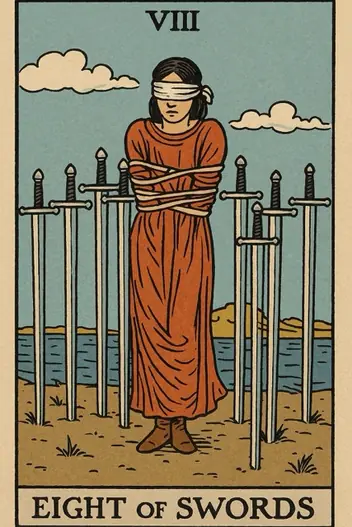
When the Eight of Swords meets the Five of Pentacles, we encounter a powerful psychological collision: the feeling of being trapped by your own thoughts, combined with a tangible sense of lack or exclusion. The Eight of Swords represents a cognitive cage—a mindset of paralysis, guilt, or over-analysis that blinds you to exits. The Five of Pentacles adds a material consequence: financial strain, social isolation, or a deep fear of not having enough. Together, they form a feedback loop where mental blocks create real-world hardships, and real-world hardships reinforce the belief that you are powerless. This is not a prediction of doom; it is a diagnosis of a self-reinforcing scarcity loop that requires both cognitive and practical intervention.
Eight of Swords and Five of Pentacles Together: Meaning
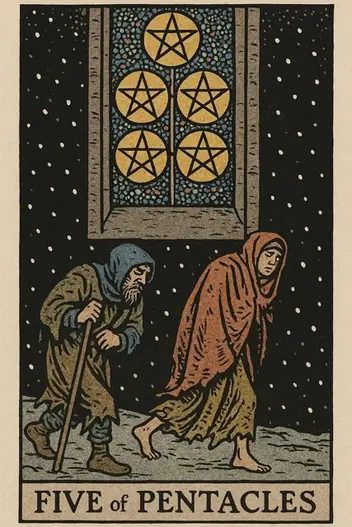
The central dynamic here is the illusion of helplessness. The Eight of Swords, as a Minor Arcana card, shows a figure blindfolded and surrounded by swords, yet the path is clear. This symbolizes how your own limiting beliefs—e.g., "I can't afford this," "I'm not good enough," or "No one will help me"—are the actual prison. The Five of Pentacles, depicting two figures outside a warm church in the snow, amplifies this by suggesting a real or perceived lack of resources. The key insight is that the scarcity is often exaggerated by the cognitive distortion of the Eight of Swords. For example, a person might believe they cannot ask for a raise (Eight of Swords) because they assume the company is struggling (Five of Pentacles), even when evidence suggests otherwise.
From a Jungian perspective, this combination points to an inferior function struggle—likely with sensation (practical reality) or thinking (objective analysis). The seeker is caught in a negative complex where past failures or rejections (Five of Pentacles) have been internalized as a permanent identity (Eight of Swords). The path forward requires cognitive reframing: first, identifying the specific thought that says "I have no options," and second, testing it against objective reality. Action is the antidote. Even a small, practical step—like checking your bank account, asking a friend for help, or applying for a job—can break the feedback loop. The cards are not saying you are doomed; they are saying your mindset is creating a self-fulfilling prophecy.
Eight of Swords and Five of Pentacles Love Outcome
If you are single:
This pair suggests you may be rejecting potential partners before giving them a chance, believing you are "not ready" or "not worthy." It also warns against mistaking emotional distance for virtue—you might be using self-isolation as a defense mechanism.
If you are in a relationship:
The dynamic likely involves one or both partners feeling financially or emotionally deprived, leading to passive-aggressive communication. The "victim" role may be used to avoid taking responsibility for personal happiness.
In relationships, the Eight of Swords and Five of Pentacles often indicate a cycle of emotional neglect and self-blame. One partner may feel unsupported (Five of Pentacles), but instead of communicating directly, they withdraw or engage in silent resentment (Eight of Swords). The other partner may feel confused or guilty, further deepening the isolation. The key relationship advice is to challenge the assumption that your partner can read your mind. If you feel "left out in the cold," it is your responsibility to knock on the door. Bold, honest communication about needs—especially around money, time, and emotional support—is critical. Avoid the trap of assuming the relationship is "destined" to fail. Instead, test reality: ask for what you need, and observe the response. This combination often resolves when one person breaks the silence and takes a concrete action to reconnect.
Your pair is already on the table. Ask your question and draw the clarifying card
or simply focus on it
Eight of Swords and Five of Pentacles in Career Readings
Strategic Opportunities:
The first growth point is to audit your actual financial situation—numbers don't lie. Create a budget or spreadsheet to separate objective reality from fear-based assumptions.
Strategic Opportunities:
The second growth point is to identify one small, low-risk action that challenges your sense of powerlessness, such as updating your resume, networking with a former colleague, or negotiating a payment plan.
Calculated Risks:
The specific warning is to avoid making important decisions from a place of panic or shame. Do not quit a job without a plan, and do not accept an offer that exploits your vulnerability. Objectively evaluate whether your "lack" is temporary or systemic.
Professionally, this combination signals a high risk of undervaluing your own work. The Five of Pentacles can indicate a real financial crunch—lost income, debt, or a toxic work environment. However, the Eight of Swords warns that you may be exaggerating the permanence of this setback. For example, a freelancer might believe no new clients will ever come (Eight of Swords) after one slow month (Five of Pentacles). The psychological trick is that fear of scarcity makes you act from a place of desperation, which leads to poor negotiations or accepting unfair terms. Strategically, the best move is to reframe your "lack" as a temporary problem to be solved, not a character flaw. If you are in a job search, focus on your transferable skills rather than your current bank balance. Bold advice: do not let the Five of Pentacles' fear of poverty drive you into the Eight of Swords' paralysis. Take one concrete action today to improve your financial literacy or professional network.
Eight of Swords and Five of Pentacles Reversed: What Changes?
Reversed cards in this pair indicate that the cycle is either beginning to break down or, conversely, becoming chronic and unconscious.
If the Eight of Swords is reversed:
This is a breakthrough. Mental shackles are cast off, and you begin to see ways out. However, without the support of the Five of Pentacles, this breakthrough can be illusory. Risk — recklessness. You might abruptly quit your job, end a relationship, or make a major purchase, thinking you are "free," but in reality, you are simply trading one trap for another. Advice: Take action, but check reality.
If the Five of Pentacles is reversed:
This points to internal resistance to accepting help. Resources are around you (friends, money, opportunities), but you stubbornly fail to notice or reject them, remaining in the position of a "proud sufferer." The upright Eight of Swords only reinforces this: "I cannot accept help because it is humiliating." Warning: your isolation is a choice, not a fate.
If BOTH are reversed:
Complete imbalance. This is the state of a person who has emerged from an acute crisis but is stuck in apathy and denial. They feel neither acute pain (Five reversed) nor acute fear (Eight reversed). The main danger — stagnation and loss of meaning. The logical way to correct this: it is necessary to consciously create a "healthy challenge" for yourself — to set a goal that requires effort to pull yourself out of the swamp of passivity.
Get a personalized interpretation
Unlock the combined meaning of your cards in the context of your unique question — for free.
When Eight of Swords and Five of Pentacles Signal Trouble
The shadow side of this combination is learned helplessness and martyrdom. The seeker may unconsciously use their perceived victimhood to avoid taking responsibility. For example, someone might say, "I can't leave this job because I have no savings," while simultaneously refusing to apply for higher-paying positions. The cognitive bias at play is catastrophizing—assuming the worst-case scenario is the only outcome. Another pitfall is projection: blaming external circumstances (the economy, a partner, a boss) for a situation that is partly self-created. The Eight of Swords also carries a risk of rumination—endlessly replaying past failures (Five of Pentacles) without moving toward a solution. The most dangerous behavior here is refusing help. The church in the Five of Pentacles is open, but the figures choose to stay outside. If you see this pair in a reading, ask yourself: "What support am I rejecting because I believe I don't deserve it or it won't work?"
Eight of Swords and Five of Pentacles: The Combined Message
How to constructively utilize the energy of this complex pair? Your primary task is to break the causal link between "I am afraid" and "I do not have." The Eight of Swords is your internal censor that says, "Don't even bother trying." The Five of Pentacles is your reality that confirms there were indeed no attempts.
The strategic advice is as follows: start with the smallest, most insignificant investment in yourself or the world. This could be buying quality food (breaking the "I don't deserve it" pattern), attending a free but interesting event (breaking the "I have nowhere to go" pattern), or simply asking for a small favor (breaking the "no one will help me" pattern).
Understand this: The Five of Pentacles is not about a lack of resources, but about an inability to see and claim them. The Eight of Swords is not about real obstacles, but about the fear of them. Your clarity will come not from passive analysis, but from a single active action that proves to your mind that you are not a victim of circumstance. You are the author of the script, and you have the right to rewrite it, starting from any line.
Your Next Step: Personal Context Matters
The core message of the Eight of Swords and Five of Pentacles is that your perception of scarcity is often more limiting than the scarcity itself. While real challenges exist, the cards urge you to distinguish between objective facts and fear-based narratives. The path forward requires small, deliberate actions to test your assumptions. By challenging your mental cage, you can begin to access the resources—both internal and external—that you already have.
However, this general interpretation can only go so far. The true magic of Tarot is in its personal application to your unique situation. To get a deep, personalized interpretation of this exact combination for your specific question—whether about a relationship, career move, or personal block—use the Fortune Cards app. You can access it on the web or download it to receive a tailored reading that speaks directly to your life. Don't stay trapped in the abstract—get the clarity you need to take your next step.
Interpretation by the Fortune Cards editorial team, based on the Rider–Waite tradition and Jungian archetypes. About our methodology · Updated: 2026-08-26
Other Combinations with Eight of Swords
Other Combinations with Five of Pentacles
Explore Individual Card Meanings
Table of Contents
- Eight of Swords and Five of Pentacles Together: Meaning
- Eight of Swords and Five of Pentacles Love Outcome
- Eight of Swords and Five of Pentacles in Career Readings
- Eight of Swords and Five of Pentacles Reversed: What Changes?
- When Eight of Swords and Five of Pentacles Signal Trouble
- Eight of Swords and Five of Pentacles: The Combined Message
- Your Next Step: Personal Context Matters
Ready to find answers to your questions?
Start your first reading now and look at your situation with fresh clarity. The cards are ready to reveal deeper meaning.