Eight of Swords and King of Swords Reversed in Tarot

- Arcana
- Eight of Swords — Minor Arcana, Swords; King of Swords — Minor Arcana, Swords
- Elements
- Eight of Swords — Air; King of Swords — Air
- Elemental interaction
- Same element — energies intensify each other
- Numerology
- 8 + 14 = 22 → 4
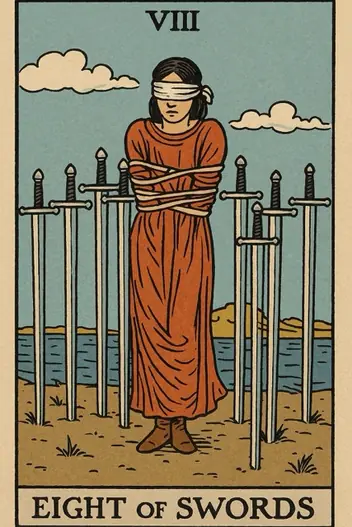
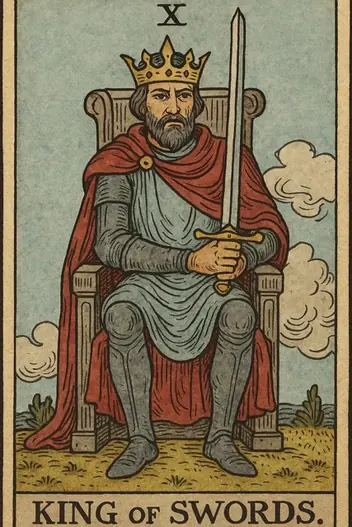
When the Eight of Swords—a card of mental entrapment, self-imposed limits, and perceived helplessness—meets the King of Swords—the archetype of objective logic, decisive authority, and intellectual mastery—a powerful tension emerges. The Eight of Swords represents the feeling of being bound by invisible ropes, often created by our own anxious thoughts, rigid beliefs, or a refusal to see alternatives. The King of Swords, in contrast, embodies the ruthless clarity of a surgeon’s scalpel: he cuts through illusion, demands evidence, and acts with cold precision. This combination asks a pragmatic question: Are you truly trapped, or have you simply failed to apply the right mental framework to escape? The collision of these energies forces a confrontation between emotional overwhelm and rational control—a dynamic that can either lead to breakthrough or burnout.
Eight of Swords and King of Swords Card Meaning Explained
The psychological state created by the Eight of Swords and King of Swords is one of cognitive dissonance. The seeker likely feels stuck, victimized, or unable to move forward—yet the King of Swords energy insists that a logical solution exists. This is not a passive waiting period; it is a call to analyze the structure of your own thoughts. The Eight of Swords often involves catastrophizing (assuming the worst-case scenario) or learned helplessness (believing you have no agency). The King of Swords demands you ask: "What evidence supports my feeling of being trapped? Is this a real external constraint, or a self-imposed rule I can rewrite?" The key insight here is that clarity is the tool that cuts the blindfold. When you apply detached, analytical thinking to your situation, the ropes often loosen—or reveal themselves to be illusions.
In practical terms, this combination warns against overthinking without action. The King of Swords can become a tyrant of analysis paralysis if he doesn't wield his sword decisively. The Eight of Swords, meanwhile, tempts you to stay in a victim narrative. The healthy integration requires using reason to identify one specific, actionable step that disrupts the pattern of stagnation. For example, if you feel trapped in a job, the King of Swords would have you list three objective facts about your options (e.g., savings, skills, network) and commit to one step—like updating your resume—within 48 hours. This is not about feeling better; it's about seeing clearly enough to act.
Eight of Swords and King of Swords Love Outcome
If you are single:
This pair suggests you may be dating with a self-limiting belief—perhaps assuming you're "not their type" or that rejection is inevitable. The King of Swords advises you to objectively evaluate compatibility rather than projecting fears onto potential partners.
If you are in a relationship:
You or your partner may be using cold logic to avoid emotional intimacy (King of Swords shadow), or feeling silently trapped by unspoken resentments (Eight of Swords). The solution is structured, honest dialogue about boundaries and expectations.
In relationships, this combination reveals a power imbalance between emotional vulnerability and intellectual control. The Eight of Swords partner may feel silenced or judged, believing they cannot speak their truth without being "proven wrong." The King of Swords partner, meanwhile, may dismiss feelings as irrational, focusing only on "facts." The core relationship advice here is to blend logic with empathy: the King must learn that emotions are data, not weaknesses, while the Eight must recognize that clarity is not cruelty. If you're feeling stuck in a cycle of arguments or silent resentment, schedule a neutral conversation with a clear agenda (e.g., "We'll each share one need without interruption for 10 minutes"). This combination rewards structured emotional intelligence, not raw emotional expression or pure logic.
Your pair is already on the table. Ask your question and draw the clarifying card
or simply focus on it
Eight of Swords and King of Swords in Career Readings
Strategic Opportunities:
Use the King of Swords' analytical precision to map out a step-by-step escape plan from a dead-end role or toxic work environment. Focus on skill audits and networking with mentors.
Strategic Opportunities:
Re-evaluate your financial assumptions. The Eight of Swords may have you believing you "can't afford" a change; the King of Swords demands you review your budget with a critical eye for unnecessary constraints.
Calculated Risks:
Avoid over-committing to a decision without sufficient data. The King of Swords can rush into a "logical" choice (like quitting a job) that ignores emotional consequences (e.g., stress of a gap). Don't confuse clarity with impulsivity.
Professionally, this is a decisive but cautious energy. The Eight of Swords suggests you feel boxed in by a boss, a project, or a market condition. The King of Swords advises you to gather objective information—industry reports, performance metrics, or competitor data—to assess if your perception of being trapped is accurate. A key financial warning here is to avoid making major moves purely out of frustration. Instead, use the King's logic to create a risk-reward matrix for three possible paths (stay, pivot, or leave). This combination is excellent for negotiation (e.g., asking for a raise or redefining your role), but only if you come prepared with data that counters the feeling of powerlessness. Your next step is to write down one concrete, measurable goal that moves you from "stuck" to "strategic."
Eight of Swords and King of Swords Reversed Meaning
When cards appear reversed, the dynamic becomes distorted, yet more predictable.
If the Eight of Swords is reversed:
This indicates sudden and chaotic liberation. The person tears off the blindfold, but not through analysis—through impulse. The risk is acting recklessly, "headlong," without calculating the consequences. Advice: slow down. Your liberation is real, but without the King's strategy, you may jump from one trap into another.
If the King of Swords is reversed:
This is the tyranny of incompetence. Power (intellectual or administrative) is used for suppression, not clarity. The person becomes a cruel cynic or, conversely, weak and indecisive. Advice: examine your motives. Are you using "logic" to justify cruelty or avoid responsibility?
If BOTH are reversed:
Complete imbalance. This is chaos and internal war. Fear (Eight of Swords) mixes with incompetent aggression (King of Swords). The person creates problems for themselves and then "heroically" fails to solve them. Advice: stop. The only logical step is to admit you are not in control of the situation and delegate decision-making to a third, objective party.
Deepen your understanding
Find out exactly what this reading means for your current life situation with our oracle.
When Eight of Swords and King of Swords Signal Trouble
The shadow of this pairing emerges when the King of Swords' detachment becomes arrogance and the Eight of Swords' victimhood becomes manipulation. The seeker may use "logic" to justify harshness, telling themselves they are "just being realistic" while dismissing their own or others' legitimate emotional needs. Alternatively, they may intellectualize their pain—analyzing their trauma endlessly without ever taking action to heal it. This is a classic cognitive bias trap: the Dunning-Kruger effect (overestimating one's rationality) or confirmation bias (only seeking evidence that supports feeling trapped). Self-sabotage appears as "over-preparation" —refusing to act until you have "all the answers," which is a disguised form of fear. The most dangerous pitfall is using the King of Swords to silence your own intuition. If you feel a gut instinct that contradicts your logical plan, do not dismiss it outright; integrate it as another data point.
Eight of Swords and King of Swords: Tarot Advice
The strategy for working with this pair is to use the cold intellect of the King of Swords to analyze and deconstruct the illusory walls of the Eight of Swords. Do not try to "feel" your way out of the trap. Think your way out. Your task is to draw a mental map of the terrain. Where are the real obstacles, and where are the shadows you have mistaken for walls? The King of Swords will give you a scalpel to separate fact from fiction.
The key principle is discipline over drama. The Eight of Swords loves to dramatize. The King of Swords demands dry facts. Introduce a rule: "Before you complain about a situation, formulate it in one sentence without emotion." This will switch your brain from fear mode to solution mode. For example, instead of "I'm trapped in this terrible job," say, "My current skills do not allow me to qualify for the position I desire."
A deep strategic counsel — become your own lawyer. Imagine you are defending yourself in court. What arguments would you present to prove that you are capable of more? What facts refute your fears? This mental game activates the resourceful state of the King of Swords and neutralizes the helplessness of the Eight of Swords. Your freedom is not the result of a miracle, but the result of an intellectual and volitional effort.
Where to Go From Here
The core message of Eight of Swords and King of Swords is that your mind can be both prison and key. The path forward is not to ignore feelings but to examine them with the precision of a scientist. This combination asks you to differentiate between real external constraints and self-imposed mental blocks, then act decisively on what you discover. The solution is rarely dramatic—it is a series of small, clear-headed choices that rebuild your sense of agency.
While this article provides the general archetype, the true power of Tarot lies in applying it to your unique situation. The Fortune Cards app offers a deeply personalized interpretation of this exact combination for your specific question—whether about a relationship, career move, or personal dilemma. Use it on the web or download it now to get a reading tailored to your life, right when you need it most.
Interpretation by the Fortune Cards editorial team, based on the Rider–Waite tradition and Jungian archetypes. About our methodology · Updated: 2026-08-26
Other Combinations with Eight of Swords
Other Combinations with King of Swords
Explore Individual Card Meanings
Table of Contents
- Eight of Swords and King of Swords Card Meaning Explained
- Eight of Swords and King of Swords Love Outcome
- Eight of Swords and King of Swords in Career Readings
- Eight of Swords and King of Swords Reversed Meaning
- When Eight of Swords and King of Swords Signal Trouble
- Eight of Swords and King of Swords: Tarot Advice
- Where to Go From Here
Ready to find answers to your questions?
Start your first reading now and look at your situation with fresh clarity. The cards are ready to reveal deeper meaning.