Eight of Swords and Ten of Pentacles Tarot as Feelings
- Arcana
- Eight of Swords — Minor Arcana, Swords; Ten of Pentacles — Minor Arcana, Pentacles
- Elements
- Eight of Swords — Air; Ten of Pentacles — Earth
- Elemental interaction
- Opposing elements — energies create tension
- Numerology
- 8 + 10 = 18 → 9
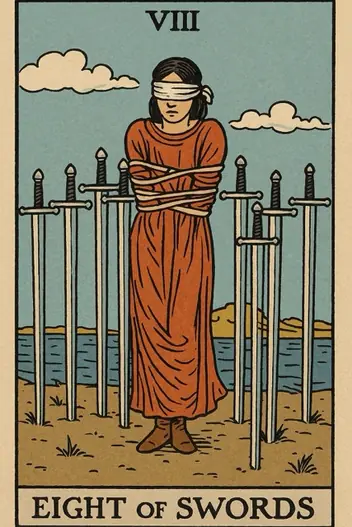
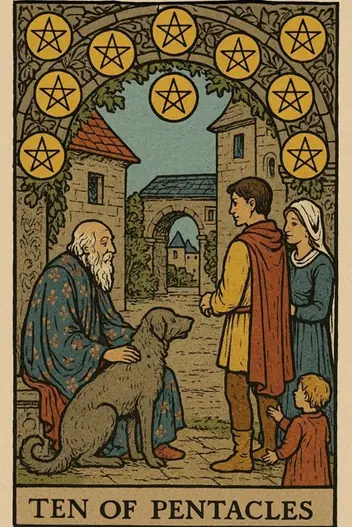
When the Eight of Swords—a card of mental paralysis, self-imposed restriction, and perceived helplessness—collides with the Ten of Pentacles—the archetype of legacy, material stability, and generational wealth—we witness a profound psychological tension. This pairing often appears when a person feels bound by their own thinking while simultaneously standing on the brink of significant material or familial success. The core question here is: Are you allowing past conditioning or fear-based beliefs to sabotage a stable foundation that is already within reach?
The Eight of Swords represents the cognitive prison we build with our own thoughts: imposter syndrome, fear of failure, or rigid adherence to outdated rules. The Ten of Pentacles represents the external reality of security: a family business, inherited property, a long-term relationship, or a career legacy. Together, they reveal a seeker who may have everything they need materially, yet feels psychologically shackled by the very structures meant to provide safety. This is not a warning of external loss, but an invitation to examine the internal narrative blocking full enjoyment of what is already present.
What Do Eight of Swords and Ten of Pentacles Mean Together?
The psychological state created by this combination is one of internal conflict between perceived limitation and objective stability. The Eight of Swords whispers that you are trapped, blindfolded, and surrounded by obstacles. The Ten of Pentacles counters with evidence of a solid foundation: a supportive family, a reliable income stream, or a long-term commitment. The result is a cognitive dissonance where the seeker cannot see the forest for the trees—they focus on the mental barriers (the swords) rather than the material wealth and security (the pentacles) surrounding them.
In real-world terms, this often manifests as self-sabotage within a stable environment. For example, a person may inherit a successful business but feel incapable of running it, believing they lack the skills or worthiness. Alternatively, someone in a committed relationship might feel trapped by expectations of family tradition, mistaking security for suffocation. The key insight is that the "trap" is not the situation itself, but the story you tell yourself about it. The Ten of Pentacles provides the resources—emotional, financial, or relational—to solve the Eight of Swords' dilemma, but only if the seeker removes the mental blindfold and sees their own agency.
Strategic action here requires a shift from victimhood to stewardship. Instead of asking "How do I escape?" the more productive question is "How do I use this stability to break free from my limiting beliefs?" The Ten of Pentacles offers a safety net, making this the ideal moment to take calculated risks—like seeking therapy, delegating responsibilities, or learning new skills—that would otherwise feel too dangerous. The combination suggests that the material foundation is solid enough to support psychological growth; the real work is internal.
Your pair is already on the table. Ask your question and draw the clarifying card
or simply focus on it
What Do Eight of Swords and Ten of Pentacles Indicate for Your Career?
Strategic Opportunities:
Use your existing stability to address skill gaps. The Ten of Pentacles provides resources (time, money, mentorship) to overcome the Eight of Swords' limitations. Invest in training, hire a coach, or automate tasks you find paralyzing.
Strategic Opportunities:
Leverage legacy networks for growth. If you feel stuck in a family business or inherited role, delegate or partner with someone whose strengths complement yours. The trap is doing everything alone; collaboration is the key.
Calculated Risks:
Avoid over-committing to tradition at the expense of innovation. The Eight of Swords warns against rigidly following "how it's always been done." Do not let fear of change blind you to new revenue streams or career paths.
Professionally, this combination often appears when someone inherits a role or business but feels psychologically unprepared to lead. The Ten of Pentacles offers a clear asset—a stable client base, financial reserves, or a strong reputation—but the Eight of Swords reveals a mindset block that prevents effective stewardship. The practical solution is to treat your career as a system to be managed, not a burden to be carried. Break down your responsibilities into actionable steps, and identify the one specific fear that is causing paralysis (e.g., fear of disappointing a parent, fear of failure, fear of success).
Bold financial warning: Do not confuse stability with stagnation. The Ten of Pentacles can become a trap if you use it as an excuse to avoid risk. The biggest threat to your financial legacy is not external competition, but your own reluctance to adapt. For example, a family business that refuses to modernize will eventually decline. Use the Eight of Swords as a diagnostic tool: what outdated belief is blocking innovation? The most strategic move is to invest in your own psychological flexibility—whether through executive coaching, therapy, or simply delegating tasks that trigger anxiety.
Love and Relationships
If you are single:
This pairing suggests you may be over-idealizing stability while simultaneously feeling unworthy of it. You might attract partners who offer material security, but your own mental blocks—fear of intimacy, past trauma, or perfectionism—prevent you from seeing their genuine interest. Focus on identifying the specific belief that makes you feel "not enough."
If you are in a relationship:
The dynamic here often involves inherited expectations clashing with personal autonomy. One partner may feel pressured to fulfill a family legacy (e.g., marriage, children, business involvement) while the other feels mentally trapped by these obligations. Clear communication about boundaries and shared goals is critical.
In relationships, this combination reveals a tension between inherited patterns and personal freedom. The Ten of Pentacles represents the weight of tradition—family expectations, cultural norms, or financial interdependence. The Eight of Swords represents the psychological cost of compliance: feeling bound by duty, unable to voice dissatisfaction, or believing you have no choice but to stay. The most important relationship advice here is to distinguish between real obligations and perceived ones. Ask yourself: Is this pressure coming from external demands, or from an internalized belief that you must sacrifice your happiness for stability?
Bold key relationship advice: The stability of the Ten of Pentacles is a resource, not a cage. Use the material or emotional security of your partnership as a foundation for honest conversations. If you feel trapped, explore whether this is a communication issue (e.g., unspoken needs) or a genuine mismatch in values. The Eight of Swords often improves when you name the fear aloud—vulnerability can dissolve the illusion of helplessness. For singles, avoid projecting the "perfect family" fantasy onto new connections; instead, examine why you might sabotage relationships that offer real, imperfect stability.
Your unique Tarot reading
See how these cards interact with your destiny. Start a free personal reading now.
What If Eight of Swords or Ten of Pentacles Appears Reversed?
When cards appear reversed, the dynamic becomes distorted, but does not disappear.
Eight of Swords Reversed:
Limiting beliefs begin to weaken. This is a moment of awakening. You may suddenly realize that your fears were unfounded. However, there is a danger of recklessness: you might destroy old structures too quickly without having a new foundation. Advice: take action, but don't burn bridges until you've built new ones.
Ten of Pentacles Reversed:
Symbolizes an internal resistance to accepting help or resources. A person may sabotage their own well-being out of guilt or pride. This can manifest as refusing an inheritance, breaking ties with family, or losing a stable income due to unwillingness to follow the rules.
Both cards reversed:
Complete imbalance. External chaos (job loss, breakup) combines with internal chaos (panic, inability to think rationally). This is a crisis demanding an immediate reset. Strategy: reduce the number of decisions you make to a minimum. Focus on basic survival (food, sleep, safety) and only then begin to analyze what went wrong.
Eight of Swords and Ten of Pentacles: Warning Signs
The shadow manifestation of this combination is learned helplessness masked as loyalty. The seeker may rationalize their paralysis by saying they are "protecting the family legacy" or "honoring tradition," when in reality they are avoiding the discomfort of personal growth. This can lead to passive-aggressive behavior, where the individual resents the very stability they rely on, creating a toxic environment. Cognitive biases at play include the "sunk cost fallacy" (staying in a situation because of past investment) and "confirmation bias" (only noticing evidence that supports feeling trapped, while ignoring signs of freedom).
Another dangerous pitfall is scapegoating the Ten of Pentacles—blaming the job, the family, or the relationship for one's unhappiness, rather than owning the internal work. This can manifest as financial recklessness (e.g., suddenly quitting a secure job without a plan) or emotional withdrawal (e.g., silently resenting a partner instead of communicating). The shadow of the Eight of Swords is self-victimization; the shadow of the Ten of Pentacles is rigidity. Together, they create a cycle where the seeker feels too trapped to change, yet too resentful to appreciate what they have. The antidote is radical self-honesty: Are you truly stuck, or are you choosing to stay stuck because it feels safer than the unknown?
What Is the Overall Message of Eight of Swords and Ten of Pentacles?
How can the energy of the Eight of Swords be used constructively to balance the Ten of Pentacles? The answer lies in the domain of rational analysis. The Eight of Swords is not an enemy, but a signal. It cries out that your belief system has become outdated and requires revision. The Ten of Pentacles is not a prison, but a platform. It provides you with resources for growth, but does not dictate the direction.
Your strategic task is to conduct an audit of your fears. Take a sheet of paper and write down every "I cannot" or "I am afraid" that comes to mind. Then, next to each point, write an objective fact from your reality (the Ten of Pentacles). For example: "I am afraid I won't be able to handle the new project" — "I have a team of 10 people and a budget." This exercise shifts the problem from the emotional plane to the cognitive one.
A deep strategic counsel:
do not try to get rid of fear. Instead, use the principle of "acting despite fear". Choose one small but significant task that you have been putting off due to anxiety. Complete it. This will trigger a "success-trust" cycle that will loosen the grip of the Eight of Swords and allow you to fully enjoy the fruits of the Ten of Pentacles. Remember: stability without movement turns into stagnation. Your growth requires breaking old patterns.
Where to Go From Here
The core message of Eight of Swords and Ten of Pentacles is that your cage is made of thoughts, not walls. You have more resources—financial, relational, and structural—than you realize. The stability you seek in the future already exists in the present; the only missing piece is your willingness to see it and act. The path forward requires you to name the specific fear, use your foundation as a launchpad, and take one small, deliberate step toward agency.
While this analysis provides a powerful archetypal map, the true magic of Tarot lies in how it applies to your unique situation. Your specific question, timing, and personal history will shape the meaning of these cards in ways a general article cannot capture. To get a deep, personalized interpretation of this exact combination for your specific question—whether about a relationship, career move, or inner block—use the Fortune Cards app. You can access it on the web or download it now to receive a custom reading that cuts through the generalities and speaks directly to your life.
Interpretation by the Fortune Cards editorial team, based on the Rider–Waite tradition and Jungian archetypes. About our methodology · Updated: 2026-08-26
Other Combinations with Eight of Swords
Other Combinations with Ten of Pentacles
Explore Individual Card Meanings
Table of Contents
- What Do Eight of Swords and Ten of Pentacles Mean Together?
- What Do Eight of Swords and Ten of Pentacles Indicate for Your Career?
- Love and Relationships
- What If Eight of Swords or Ten of Pentacles Appears Reversed?
- Eight of Swords and Ten of Pentacles: Warning Signs
- What Is the Overall Message of Eight of Swords and Ten of Pentacles?
- Where to Go From Here
Ready to find answers to your questions?
Start your first reading now and look at your situation with fresh clarity. The cards are ready to reveal deeper meaning.