Five of Cups and Eight of Pentacles Tarot as Feelings

- Arcana
- Five of Cups — Minor Arcana, Cups; Eight of Pentacles — Minor Arcana, Pentacles
- Elements
- Five of Cups — Water; Eight of Pentacles — Earth
- Elemental interaction
- Friendly elements — energies support each other
- Numerology
- 5 + 8 = 13 → 4
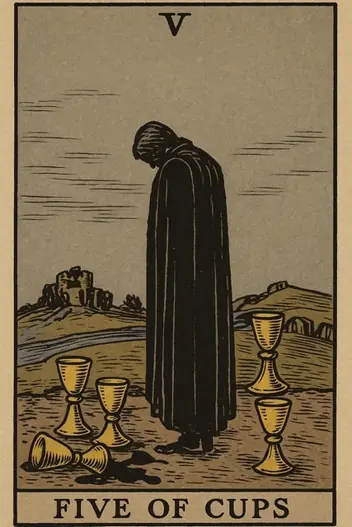
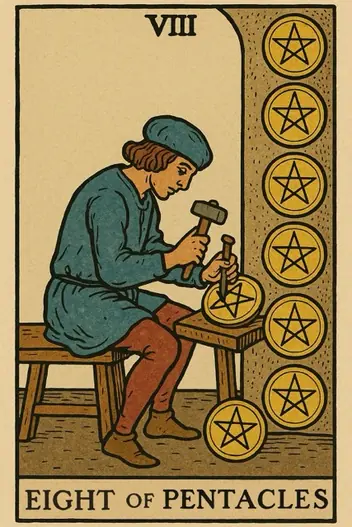
The Five of Cups represents loss, disappointment, and the painful focus on what has been spilled. It is the archetype of mourning, where the emotional energy is locked into a past failure or missed opportunity. The Eight of Pentacles, in stark contrast, is the archetype of disciplined craftsmanship, repetitive effort, and the slow mastery of a tangible skill. When these two cards collide, we see a psychological battlefield: the ego wants to drown in regret, while the unconscious pushes toward productive, grounding work.
This combination is not about ignoring pain. Instead, it suggests that the healthiest way to process loss is through structured, purposeful action. The mind cannot ruminate on the past if the hands are busy building the future. The key strategic insight here is that grief can be alchemized into expertise, but only if you consciously choose to redirect your attention from what is gone to what can now be built.
Five of Cups and Eight of Pentacles Combination Meaning
The core dynamic of the Five of Cups and Eight of Pentacles is a tension between emotional fixation and practical discipline. The Five of Cups represents a psychological state of selective attention—you see the three spilled cups (the losses) while ignoring the two standing cups (the remaining opportunities). This cognitive bias, known as negativity bias, can paralyze decision-making. The Eight of Pentacles steps in as the antidote: it demands that you engage in repetitive, small-scale actions that rebuild confidence through tangible results.
In real-world terms, this combination often appears when a person has experienced a significant setback—a failed project, a breakup, or a financial loss—and is now facing the choice to either wallow or rebuild. The psychological work here is grief integration: acknowledging the loss without letting it define your identity. The Eight of Pentacles provides a behavioral framework for this: you do not need to feel ready or healed to start working. You simply need to begin the next small, focused task. Over time, the repetition of effort creates a new narrative that competes with the old story of failure.
This pairing warns against the trap of performative productivity—using work to numb feelings rather than process them. The healthy path involves scheduled reflection (e.g., 15 minutes a day to journal about the loss) followed by sustained, focused work on a specific skill or project. The goal is not to escape the pain, but to build a structure around it so it does not consume your entire mental landscape.
Love and Relationships
If you are single:
This combination suggests you may be holding onto a past relationship disappointment (a breakup, a rejection) so tightly that it prevents you from seeing a new, promising connection. The advice is to treat your emotional healing as a craft: take one small, concrete action each day to move forward—update your dating profile, join a new social group, or practice a new conversation skill.
If you are in a relationship:
The pair indicates a dynamic where one partner is stuck in grief over a past argument or betrayal, while the other is trying to fix the relationship through practical efforts (e.g., planning dates, doing chores). The core issue is a misalignment of emotional processing: the grieving partner needs validation, not solutions, while the fixer partner needs to slow down and listen before acting.
In relationships, the Five of Cups and Eight of Pentacles often signal a power imbalance in emotional labor. One person may be carrying the weight of past disappointments, while the other is focusing on "working on the relationship" through practical tasks. The key is to integrate both energies: allow space for the grieving partner to express their sadness without judgment, while the fixer partner channels their need to help into supportive, non-intrusive actions—like cooking a meal, offering a hug, or simply sitting in silence together. Avoid the trap of "fixing" the other person's feelings. Instead, collaborate on a shared project that rebuilds trust and mutual respect, such as planning a weekend trip or taking a class together. This combination also warns against using work or hobbies to avoid intimacy; if you are constantly busy with projects, you may be running from the emotional work the relationship requires.
Your pair is already on the table. Ask your question and draw the clarifying card
or simply focus on it
What Do Five of Cups and Eight of Pentacles Indicate for Your Career?
Strategic Opportunities:
Reframe a recent failure as a learning experience. If a project flopped or you missed a promotion, use the Eight of Pentacles energy to systematically analyze what went wrong and build a new skill set to address the gap. This is the ideal time to enroll in a certification course or develop a new technical competency.
Strategic Opportunities:
Focus on incremental, high-quality output. The Eight of Pentacles rewards patience and precision. If you are rebuilding after a loss, do not chase quick wins. Instead, commit to producing one small, excellent piece of work each day—whether it’s a code snippet, a client proposal, or a financial model.
Calculated Risks:
Avoid over-committing to a single project out of fear of starting over. The Five of Cups can make you cling to a failing venture because you have already invested so much. Objectively assess if the sunk cost fallacy is driving your decisions. If the project is not yielding results, it is better to cut losses and redirect your disciplined effort elsewhere.
Professionally, this combination is a call to strategic resilience. The Five of Cups represents a financial or career loss—a missed bonus, a client who left, a layoff. The Eight of Pentacles advises you to respond not with panic, but with focused skill-building. The most important financial warning here is against emotional spending: do not try to compensate for the loss by buying things or making risky investments to "feel better." Instead, create a detailed plan for the next 90 days that includes specific, measurable goals for skill development and income generation. Treat your career recovery like an apprenticeship: break down your big goal (e.g., "get a better job") into micro-skills (e.g., "learn Python basics," "network with three people per week"). This approach reduces anxiety by giving you a clear, controllable process. If you are self-employed, this is a strong signal to diversify your income streams while maintaining high standards in your core craft. The Eight of Pentacles rewards consistency over intensity.
Ask your specific question
Don't rely on generic meanings. Get a customized reading tailored specifically to your energies.
Five of Cups and Eight of Pentacles: Warning Signs
The shadow side of this combination manifests as ruminative perfectionism. The Five of Cups feeds the belief that "I have already failed, so why try?" while the Eight of Pentacles twists into obsessive, joyless labor. The seeker may become trapped in a cycle of self-criticism, where they work endlessly on a task but never feel the work is good enough, because the underlying grief has not been addressed. This is a classic cognitive distortion known as "mental filtering" —focusing only on the negative details of your performance while ignoring progress.
Another pitfall is emotional bypassing: using relentless work as a way to avoid feeling the pain of the loss. You might stay late at the office, take on extra projects, or obsessively learn new skills, but the grief will eventually surface as burnout, physical illness, or sudden rage. The shadow warns that productivity is not the same as healing. If you find yourself working harder but feeling emptier, you are likely in this trap. The solution is to schedule deliberate downtime for emotional processing—therapy, journaling, or even a short break—before returning to your craft.
Finally, this pair can indicate poor judgment in resource allocation. The seeker might pour time and money into a failing venture (Five of Cups sunk cost) while neglecting more promising opportunities. The cognitive bias here is "loss aversion" : the fear of realizing a loss leads to doubling down on a bad bet. The Eight of Pentacles energy, when shadow-driven, becomes stubborn repetition of a flawed method rather than flexible adaptation. To avoid this, set objective criteria for when to pivot (e.g., "If this project does not break even by next quarter, I will redirect my effort") and honor those boundaries.
What If Five of Cups or Eight of Pentacles Appears Reversed?
If the Five of Cups is reversed:
Blocked potential or recklessness. Instead of constructive grief, there is a denial of loss and impulsive decisions. Psychologically, this manifests as overcompensation: the person starts a new project or relationship without having mourned the old one. Advice: Consciously set aside time for a ritual of farewell to the past, otherwise it will return in the form of sabotage.
If the Eight of Pentacles is reversed:
Inner resistance or weakness. A lack of discipline, procrastination, or fear of a "not good enough" result. This is the state of the "eternal student" who doesn't start a task because they fear mistakes. Advice: Lower the quality bar. Make a "bad" version of the work rather than none at all. Movement is more important than perfection.
If BOTH are reversed:
Complete imbalance of dynamics. The person simultaneously denies their losses (doesn't learn from mistakes) and is incapable of systematic work. This leads to a chronic crisis with no way out. A logical way to correct it: Introduce an external structure—a mentor, a coach, or a strict deadline. There are no internal resources for self-discipline right now; an external container is needed.
Five of Cups and Eight of Pentacles Combined Message
The Five of Cups and Eight of Pentacles are not merely a combination of cards, but a psychological protocol for emerging from crisis. Rather than waiting for feelings to "settle down," this combination proposes using the body and hands to reprogram the psyche. Neuroscience confirms: repetitive, purposeful actions (especially fine motor skills) reduce amygdala activity and strengthen the prefrontal cortex, which is responsible for planning.
Constructive Strategy:
Take a specific loss (a breakup, a firing, a failure) and translate it into a learning task. For example, if you lost a client due to a poor presentation, do not berate yourself — enroll in a public speaking course and deliver 10 presentations in a month. Each subsequent attempt is the Eight of Pentacles, erasing the pain of the previous Five.
Deep Strategic Advice:
Do not try to "process" the feelings — process the material. Create a physical artifact of your learning: a portfolio, a skills journal, a product prototype. When you see the result of your labor, your brain receives proof that you are not a victim of circumstance, but the author of your own reality. The Five of Cups speaks of the past; the Eight of Pentacles speaks of the future you are building right now, one stitch at a time.
Applying This to Your Situation
The core message of the Five of Cups and Eight of Pentacles is that grief is not a dead end—it is raw material. The pain of loss can be transformed into the discipline of mastery, but only if you consciously choose to turn your attention from the past to the present task. You cannot change what was spilled, but you can craft something meaningful from what remains. This combination asks you to be both the mourner and the artisan: honor the loss, then pick up your tools and build.
However, archetypes are general—your situation is specific. The meaning of this combination shifts dramatically depending on whether you are grieving a relationship, a career setback, or a personal dream. To get a deep, personalized interpretation of exactly how these energies apply to your unique question, use the Fortune Cards app. It analyzes your full spread and your exact context to give you actionable, tailored advice. You can use it on the web or download it now to turn this insight into a concrete next step.
Interpretation by the Fortune Cards editorial team, based on the Rider–Waite tradition and Jungian archetypes. About our methodology · Updated: 2026-08-26
Other Combinations with Five of Cups
Other Combinations with Eight of Pentacles
Explore Individual Card Meanings
Table of Contents
- Five of Cups and Eight of Pentacles Combination Meaning
- Love and Relationships
- What Do Five of Cups and Eight of Pentacles Indicate for Your Career?
- Five of Cups and Eight of Pentacles: Warning Signs
- What If Five of Cups or Eight of Pentacles Appears Reversed?
- Five of Cups and Eight of Pentacles Combined Message
- Applying This to Your Situation
Ready to find answers to your questions?
Start your first reading now and look at your situation with fresh clarity. The cards are ready to reveal deeper meaning.