Five of Cups and Page of Cups Together in Tarot
- Arcana
- Five of Cups — Minor Arcana, Cups; Page of Cups — Minor Arcana, Cups
- Elements
- Five of Cups — Water; Page of Cups — Water
- Elemental interaction
- Same element — energies intensify each other
- Numerology
- 5 + 11 = 16 → 7
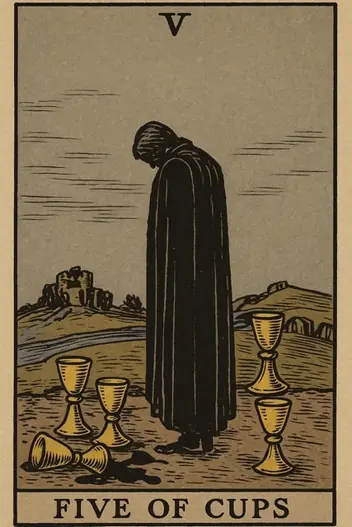
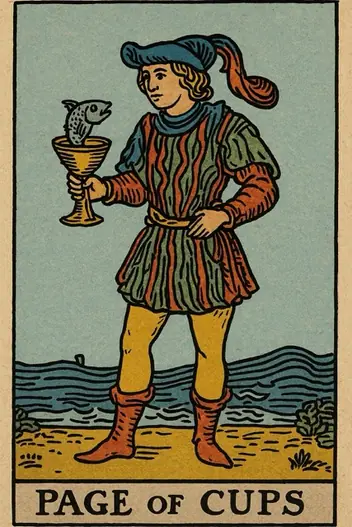
When the Five of Cups—the card of loss, disappointment, and turning away from the spilled—collides with the Page of Cups—the archetype of emotional openness, creative intuition, and a fresh perspective—you get a powerful psychological paradox. This is not a static state of despair; it is a transitional moment where the mind is caught between the desire to mourn what is gone and the subtle pull of a new emotional beginning. The core dynamic here is the tension between resignation and receptivity. The Five of Cups asks, "Why bother?" while the Page of Cups whispers, "What if you looked at this differently?"
The practical reality of this combination is that the seeker is likely experiencing a recent emotional setback—a breakup, a failed project, or a broken trust—but is simultaneously being offered a low-stakes opportunity to re-engage with their feelings. The Page is not demanding a full recovery; it is simply presenting a small, innocent invitation to be curious again. This is a moment of psychological recalibration, where the task is not to ignore the pain, but to hold it lightly while exploring a new emotional channel. The key insight is that grief and curiosity can coexist, and acting on the Page's impulse is the most effective way to process the Five's sorrow.
Core Dynamics & Interpretation
The psychological state created by the Five of Cups and Page of Cups is one of ambivalent processing. You are emotionally stuck in a loop of "what went wrong," yet you are also subconsciously scanning for a new emotional input. This is not a contradiction; it is a natural stage of healing. The Five of Cups represents the cognitive bias of loss aversion—where the brain overweights the two spilled cups (the pain) and ignores the two standing cups (the remaining assets). The Page of Cups enters as the healthy counterbalance, representing the curiosity drive that can override the fixation on loss. The real-world implication is that the seeker must consciously shift their attention from the past to a small, present-moment emotional experiment.
In practical terms, this combination often manifests as a person who is verbally focused on their disappointment but is simultaneously drawn to a new hobby, a creative project, or a gentle conversation with someone new. The danger is that the Five's narrative dominates, causing the seeker to dismiss the Page's invitation as trivial or irrelevant. The strategic action here is to lower the stakes. Do not try to "fix" the loss. Instead, allow yourself to engage with a low-risk emotional expression—write a poem, listen to a new genre of music, have a lighthearted conversation without expectation. The Page's energy is about playful exploration, not deep commitment. The most important takeaway is that healing does not require forgetting the loss; it requires letting the Page's curiosity dilute the Five's fixation.
What Do Five of Cups and Page of Cups Say About Love?
If you are single:
This pair suggests you are carrying emotional baggage from a recent disappointment, but a new, low-pressure connection is available. Do not compare this new person to your past pain. Instead, treat this as a "soft introduction" to test your emotional availability without committing to a relationship.
If you are in a relationship:
You or your partner may be stuck on a past argument or betrayal, while the other is trying to initiate a fresh, playful interaction. The core issue is a mismatch in emotional timing. One is grieving, the other is hoping.
The relationship dynamic here is fundamentally about emotional pacing. The Five of Cups partner needs validation for their loss; they need to be heard, not fixed. The Page of Cups partner needs permission to be light and creative without feeling guilty. The risk is that the Page's attempts to cheer up the Five are perceived as dismissive, while the Five's grief is perceived as a wall. The key relationship advice is to create a structured space for both energies. For example, schedule 15 minutes of "grief time" where the Five can talk about their disappointment without interruption, followed by 15 minutes of "Page time" where you engage in a silly, creative activity together—no agenda, no analysis. This prevents one energy from dominating. Bold action: Use active listening for the Five, and playful initiation for the Page. This is not about solving the problem; it is about allowing both emotional states to exist without conflict.
Your pair is already on the table. Ask your question and draw the clarifying card
or simply focus on it
Career Meaning of Five of Cups and Page of Cups
Strategic Opportunities:
Leverage disappointment as data. Use the Five of Cups' analytical hindsight to identify what went wrong in a recent project, then apply the Page of Cups' creativity to prototype a new, low-cost solution. This is the perfect time for a pivot, not a restart.
Strategic Opportunities:
Network with emotional intelligence. The Page of Cups suggests a new, informal connection—a mentor, a junior colleague, or a client—who can offer a fresh perspective. Focus on building rapport, not closing deals.
Calculated Risks:
Avoid major financial commitments. The Five of Cups indicates a high risk of making decisions out of "loss recovery" (e.g., chasing a sunk cost). The Page of Cups is not mature enough for large-scale planning. Objectively avoid investing in anything that requires a long-term emotional or financial bet.
In a professional context, this combination signals a post-mortem phase with a twist. You are likely recovering from a failed pitch, a rejected proposal, or a budget cut. The temptation is to either ruminate on the failure (Five) or to impulsively chase a shiny new idea (Page). The pragmatic strategy is to use the Page's curiosity to reframe the Five's data. For example, ask: "What small, creative experiment can I run this week that costs less than $50 and takes less than 2 hours?" The financial warning is clear: do not use the Page's enthusiasm to justify the Five's regret. Do not spend money to "make up for" the loss. Instead, focus on low-cost learning. The Page is about gathering emotional intelligence, not capital. The strategic tip is to treat this as a research and development period, not a recovery period.
Reversed Five of Cups and Page of Cups Explained
If the Five of Cups is reversed, the energy of grief is blocked or repressed. The person may display a facade of calm, but tension builds within. Instead of constructive mourning, there is emotional suppression, which risks a neurotic breakdown. Advice: allow yourself to experience the loss in a healthy way — through therapy, sports, or writing practices.
If the Page of Cups is reversed, this points to immaturity or an inability to offer sincerity. The person either manipulates others' feelings (false vulnerability) or is so afraid of rejection that they sabotage any attempts at closeness. Advice: work on your self-esteem and learn to say "no" before offering your help.
If BOTH cards are reversed, a complete imbalance arises: cynicism mixed with passive aggression. This is a dead end where there is neither genuine sorrow nor genuine hope. The only logical way out is a complete change of context: changing jobs, social circles, or even place of residence to break the vicious cycle.
Ask your specific question
Don't rely on generic meanings. Get a customized reading tailored specifically to your energies.
Five of Cups and Page of Cups: Warning Signs
The shadow manifestation of this combination is emotional immaturity disguised as healing. The seeker may use the Page of Cups' "fresh start" energy to avoid processing the real grief of the Five of Cups. This is not curiosity; it is escapism. You might jump into a new relationship, a new job, or a new creative project without acknowledging the lesson from the loss. The cognitive bias at play is the "fresh start effect" illusion—the belief that a new beginning automatically erases past pain. It does not. The result is a recurring cycle: you experience a loss, you distract yourself with a novelty, the novelty wears off, and you are left with the original grief plus the disappointment of a failed distraction.
Another critical pitfall is emotional manipulation. The Page of Cups can be charming and naive, while the Five of Cups can be self-pitying. In a toxic dynamic, one partner may use their "grief" to guilt the other into providing constant emotional support, while the other uses their "innocence" to avoid accountability. Self-sabotage occurs when you mistake emotional openness for emotional maturity. The Page is not a healer; it is a student. If you act on the Page's impulse without first acknowledging the Five's lesson, you are setting yourself up for a repeat of the same disappointment. The key is to ensure that the Page's energy is informed by the Five's wisdom, not detached from it.
Five of Cups and Page of Cups Combined Message
Constructive use of this pair begins with acknowledging a simple fact: grief and hope can coexist. You don't need to be "cured" of the Five of Cups before you can act like the Page of Cups. On the contrary, it is precisely through small, sincere actions (the Page) that you can transform your pain (the Five of Cups) into wisdom, rather than cynicism.
Your strategy is to focus on the process, not the outcome. The Five of Cups is fixated on the outcome (loss), while the Page is focused on the process (exploration). Your next step is to choose one simple action that does not require you to feel happy or confident. For example, sign up for a course that interests you, even if you feel apathetic. Or tell your partner: "I'm feeling sad right now, but I want to be here with you."
Deep strategic advice:
Imagine that your sorrow is not an enemy, but a compass. It points to what was truly valuable to you. Use this information so that the Page of Cups doesn't wander chaotically, but moves toward those same values, albeit in a new form. Did you lose a relationship? Then the value was in intimacy. Create intimacy through friendship or volunteering. Transmute pain into direction, rather than denying it.
Your Next Step: Personal Context Matters
The core message of Five of Cups and Page of Cups is that emotional recovery is not linear. You are allowed to grieve and to be curious at the same time. The path forward is not to force yourself to be happy, but to grant yourself permission for a small, low-stakes experiment with your feelings. The two standing cups in the Five are your remaining resources—use the Page's creativity to see them anew.
While this article provides a general psychological map, the true power of Tarot lies in how these archetypes apply to your specific situation. The meaning shifts dramatically depending on whether you are asking about a breakup, a career pivot, or a family conflict. To get a deep, personalized interpretation of this exact combination for your unique question, use the Fortune Cards app. You can access it on the web or download it now to receive an analysis tailored to your context, your timing, and your emotional landscape. Get your personalized reading today.
Interpretation by the Fortune Cards editorial team, based on the Rider–Waite tradition and Jungian archetypes. About our methodology · Updated: 2026-08-26
Other Combinations with Five of Cups
Other Combinations with Page of Cups
Explore Individual Card Meanings
Table of Contents
- Core Dynamics & Interpretation
- What Do Five of Cups and Page of Cups Say About Love?
- Career Meaning of Five of Cups and Page of Cups
- Reversed Five of Cups and Page of Cups Explained
- Five of Cups and Page of Cups: Warning Signs
- Five of Cups and Page of Cups Combined Message
- Your Next Step: Personal Context Matters
Ready to find answers to your questions?
Start your first reading now and look at your situation with fresh clarity. The cards are ready to reveal deeper meaning.