Five of Cups and Queen of Pentacles Tarot Combination
- Arcana
- Five of Cups — Minor Arcana, Cups; Queen of Pentacles — Minor Arcana, Pentacles
- Elements
- Five of Cups — Water; Queen of Pentacles — Earth
- Elemental interaction
- Friendly elements — energies support each other
- Numerology
- 5 + 13 = 18 → 9
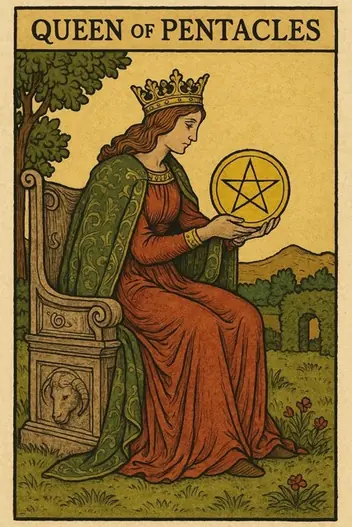
The collision of the Five of Cups—a card of loss, regret, and emotional withdrawal—with the Queen of Pentacles—an archetype of practical nurturing, financial stability, and earthy sensuality—creates a powerful psychological tension. You are essentially holding the weight of past disappointment while being called to manage the tangible demands of the present. This combination suggests a seeker who is struggling to integrate emotional pain with the need for functional stability.
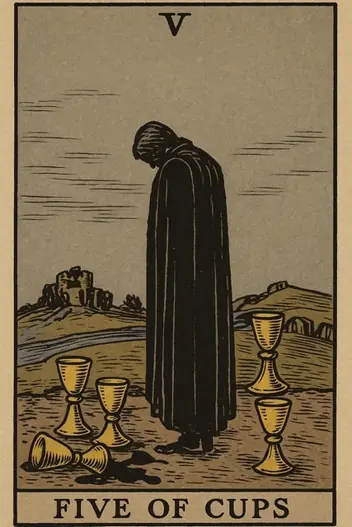
Psychologically, this reflects a classic avoidance-coping mechanism: the mind fixates on what has been lost (the spilled cups) while the body and responsibilities demand attention to what remains (the two standing cups and the Queen's grounded domain). The strategic challenge here is not to ignore the grief, but to prevent it from sabotaging your material security. The Queen of Pentacles represents the part of you that must still show up, pay the bills, and nurture relationships—even when your heart feels hollow. This is a crisis of emotional resource management, not just financial prudence.
Five of Cups and Queen of Pentacles: How These Energies Interact
The core dynamic is a battle between emotional paralysis and practical duty. The Five of Cups energy fixates on the past, often leading to a state of rumination where the seeker replays losses, betrayals, or missed opportunities. Meanwhile, the Queen of Pentacles demands a focus on tangible outcomes: a stable home, healthy finances, and consistent care for others. When these two cards appear together, the central question becomes: How do you honor your grief without letting it bankrupt your life?
The psychological state here is one of fragmented attention. You may find yourself physically present in your daily routines—working, cooking, managing a household—but mentally and emotionally absent, lost in a loop of "what ifs." This is a high-risk pattern for burnout and passive neglect. The Queen of Pentacles is a master of boundaries and resource allocation, but the Five of Cups distorts this into over-control or emotional withholding. For example, a person might over-invest in work to avoid feeling the pain of a recent breakup, or they might become hyper-critical of their partner's spending as a displacement for their own grief. The insight here is clear: stability built on emotional denial is fragile. The path forward requires a conscious decision to re-invest emotional energy into what still stands, not just what has fallen.
Your pair is already on the table. Ask your question and draw the clarifying card
or simply focus on it
Five of Cups and Queen of Pentacles Love Outcome
If you are single:
This combination warns against entering new connections while still mourning a past one. You risk projecting past hurt onto a new partner or, conversely, using a new relationship as a distraction from unresolved grief. The Queen of Pentacles advises you to get your own house in order first—financially and emotionally—before seeking a partner.
If you are in a relationship:
This pair often signals a disconnect in emotional and practical support. One partner may be withdrawn and grieving (Five of Cups), while the other is trying to maintain the household, finances, and routine (Queen of Pentacles). This can lead to resentment and a feeling of being taken for granted.
In a relationship context, the Five of Cups and Queen of Pentacles reveal a critical need for transparent communication about emotional labor. The grieving partner must articulate their needs without making the other feel responsible for fixing them. The practical partner must set boundaries around how much emotional weight they can carry without sacrificing their own well-being. Key relationship advice here is to schedule intentional time to discuss both practical matters (budgets, chores, schedules) and emotional states (grief, disappointment, fear) separately. Do not let financial stress become the stand-in for unspoken hurt. If you are the one trying to "fix" the situation by being overly nurturing, recognize that this can enable a partner's emotional stagnation. The healthiest outcome is when both individuals use their respective strengths to rebuild together: one providing the vision of what was lost (to learn from it), and the other providing the stable ground to build upon.
Uncover hidden insights
Let our advanced Tarot system interpret these archetypes specifically for your personal path.
Five of Cups and Queen of Pentacles: Career and Money
Strategic Opportunities:
Use the Queen of Pentacles' pragmatic oversight to audit your current resources. Identify one area of your career or finances that is actually stable and thriving (the two standing cups). Double down on that asset rather than obsessing over what you lost.
Strategic Opportunities:
Channel the Five of Cups' emotional intelligence into a product or service that helps others manage loss—financial planning after a divorce, grief counseling, or career transition coaching. Your personal pain can become a unique professional asset.
Calculated Risks:
Beware of catastrophic thinking leading to overly conservative financial moves. The Five of Cups can make you hoard resources out of fear, while the Queen of Pentacles encourages smart, sustainable growth. Do not sell off assets or reject a promising opportunity simply because of a past failure.
Professionally, this combination demands a ruthless audit of your risk tolerance. The Five of Cups energy can make you overestimate the probability of further loss, causing you to miss viable opportunities. Conversely, the Queen of Pentacles energy can make you underestimate the emotional cost of a high-stakes decision. The key is to separate objective data from emotional narrative. For example, if you lost a major client last quarter, the Five of Cups says "you are failing," while the Queen of Pentacles says "review your budget and diversify your client base." Important financial warning: Do not make major career moves (quitting a job, starting a business, making a large investment) while in a state of acute grief. Wait until you can think with the Queen's grounded logic rather than the Five's reactive despair. If you are in a leadership role, this combination suggests you need to balance compassion for a struggling team member with the hard reality of performance metrics. You cannot carry someone who refuses to stand up, no matter how much you want to.
Five of Cups and Queen of Pentacles Reversed: What Changes?
When cards appear in a reversed position, the dynamic becomes distorted, revealing hidden issues.
If the Five of Cups is reversed:
You risk falling into reckless denial of loss. Instead of grieving, you may chaotically "grasp" at new projects, acquaintances, or opportunities without digesting the old experience. Advice: stop. Acknowledge that the pain exists, otherwise it will manifest in psychosomatics or impulsive mistakes.
If the Queen of Pentacles is reversed:
An internal resistance to self-care arises. You may ignore basic needs (sleep, food, financial discipline), completely immersed in sorrow. This leads to chaos in daily life and at work. Warning: if you stop paying bills or neglect your home, you worsen your crisis, depriving yourself of a foundation.
If BOTH are reversed:
Complete imbalance — "toxic stagnation." You simultaneously deny the pain and destroy your material base. A person may drown their grief in alcohol while simultaneously losing their job and home. A logical way to correct this: return to the basics — start by tidying up one room and paying one bill. Only by restoring the material foundation can you begin to process the emotions.
The Shadow Side of Five of Cups and Queen of Pentacles
The shadow manifestation of this pairing is a toxic cycle of martyrdom and neglect. The seeker may adopt a "victim" identity (Five of Cups) while simultaneously over-functioning (Queen of Pentacles) to mask their pain. This creates a dynamic where they resent doing everything for others, yet they refuse to ask for help or let go of the past. Common cognitive biases include the sunk cost fallacy (staying in a bad job or relationship because of what you've already invested) and emotional reasoning ("I feel like a failure, therefore I am a failure"). The greatest risk is self-sabotage through perfectionism: you become so focused on not making another mistake that you become paralyzed, or you over-control your environment to the point of alienating those who care for you. If you notice yourself withholding affection, micromanaging finances, or refusing to celebrate small wins, you are likely in the shadow of this combination. The antidote is to consciously practice gratitude for what remains (the two cups) and to delegate one tangible task to someone else this week, breaking the cycle of isolated over-responsibility.
Overall Meaning of Five of Cups and Queen of Pentacles
Constructive use of this combination requires a paradoxical strategy: to accept grief, but not allow it to paralyze your will, and to use resources, not for masking, but for healing. The Five of Cups indicates you have lost something valuable. Instead of denying this, you need to give yourself time and space for a ritual of farewell. The Queen of Pentacles provides the ideal environment for this: a safe, warm, materially stable place.
Your strategic move is to integrate these two archetypes into a unified action plan. Start small: allocate a specific sum of money for "grief therapy"—this could be a session with a psychologist, buying materials for creative work, or even just paying for a cozy café where you allow yourself to cry. The Queen of Pentacles says: "You have the resources to get through this." The Five of Cups replies: "Yes, but first I must acknowledge the pain." This is not a struggle, but a collaboration.
Deep strategic advice:
Keep a "double-entry journal." In one column, write down what you have lost and what you feel (Five of Cups). In the other, write down what you have and how to protect it (Queen of Pentacles). This exercise trains the mind not to fixate on lack, but to see the whole picture. By accepting the loss, you free up energy that the Queen of Pentacles will channel into creation. Only by passing through grief can you build something more stable and authentic.
Applying This to Your Situation
The core message of the Five of Cups and Queen of Pentacles is that you can carry grief and responsibility at the same time, but you cannot carry them well without strategy. Your past losses are real, but they do not define your current capacity for stability and nurture. The path forward is to acknowledge the pain without letting it dictate your decisions, and to use your practical skills as a foundation for emotional healing, not a substitute for it.
While this article provides a general archetypal analysis, the true power of Tarot lies in how these cards interact with your specific question, relationship, or career crossroads. The Fortune Cards app is designed to give you a deep, personalized interpretation of this exact combination—tailored to your unique situation, not a generic template. You can use it right now on the web or download it to get an immediate, context-aware reading. Stop guessing how grief and responsibility fit into your life. Let the cards speak directly to your circumstances.
Interpretation by the Fortune Cards editorial team, based on the Rider–Waite tradition and Jungian archetypes. About our methodology · Updated: 2026-08-26
Other Combinations with Five of Cups
Other Combinations with Queen of Pentacles
Explore Individual Card Meanings
Table of Contents
- Five of Cups and Queen of Pentacles: How These Energies Interact
- Five of Cups and Queen of Pentacles Love Outcome
- Five of Cups and Queen of Pentacles: Career and Money
- Five of Cups and Queen of Pentacles Reversed: What Changes?
- The Shadow Side of Five of Cups and Queen of Pentacles
- Overall Meaning of Five of Cups and Queen of Pentacles
- Applying This to Your Situation
Ready to find answers to your questions?
Start your first reading now and look at your situation with fresh clarity. The cards are ready to reveal deeper meaning.