Five of Cups + Ten of Pentacles: What This Tarot Pairing Means

- Arcana
- Five of Cups — Minor Arcana, Cups; Ten of Pentacles — Minor Arcana, Pentacles
- Elements
- Five of Cups — Water; Ten of Pentacles — Earth
- Elemental interaction
- Friendly elements — energies support each other
- Numerology
- 5 + 10 = 15 → 6
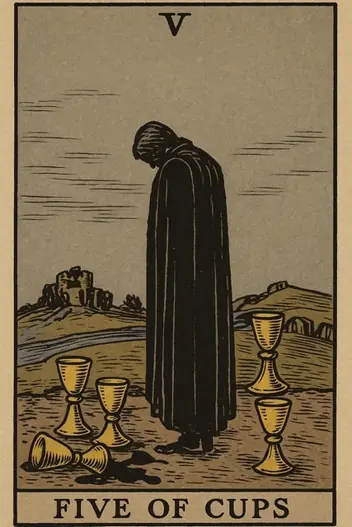
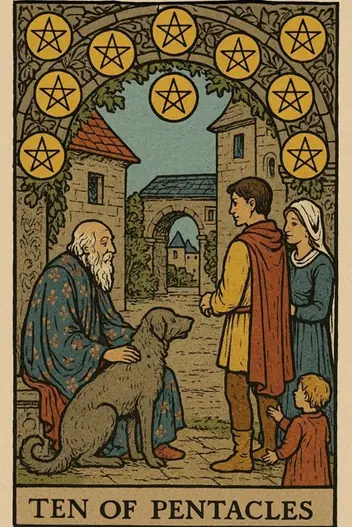
When the Five of Cups—a card of grief, regret, and focusing on what is lost—meets the Ten of Pentacles—a card of legacy, family wealth, and established systems—the result is a profound psychological conflict. This combination often signals a crisis of value: you are holding onto a past loss that threatens to destabilize a long-standing foundation. The core tension here is between emotional attachment to what has passed and the practical necessity of maintaining or inheriting a stable structure.
In real life, this might look like inheriting a family business after a painful breakup, or feeling deep regret over a financial decision that jeopardizes a trust fund or inheritance. The strategic question is not whether the loss is real, but whether you are allowing it to blind you to the resources and responsibilities that still remain. The Five of Cups asks you to process the grief, while the Ten of Pentacles demands you protect the legacy.
Core Dynamics & Interpretation
The psychological state created by this pairing is one of selective perception. You are acutely aware of the three spilled cups (loss, disappointment, failure) while ignoring the two remaining upright cups (what is still viable, the support network, the material stability). The Ten of Pentacles represents a collective structure—family, tradition, or long-term wealth—that is often resistant to emotional upheaval. The clash occurs when personal grief threatens to unravel a system that depends on continuity and rational decision-making.
From a Jungian perspective, this is the Shadow of the grieving self confronting the Persona of the responsible heir. You may feel torn between honoring your pain and fulfilling your duties. The key insight is that these are not mutually exclusive. The Ten of Pentacles can provide a container for your grief—a stable environment where you can process loss without destroying your future. However, if you remain fixated on the spilled cups, you risk turning the Ten of Pentacles into a prison of obligation, where you feel trapped by expectations while secretly mourning a different path.
The real-world implication is a crisis of prioritization. You must decide: Are you willing to temporarily set aside your personal sorrow to secure a long-term goal? Or is the grief so profound that it requires restructuring the legacy itself? The healthiest integration involves acknowledging the loss while actively maintaining the foundation. This is not about denial; it is about strategic compartmentalization.
Ask your question and flip the cards
or simply focus on it
Five of Cups and Ten of Pentacles in Love and Relationships
If you are single:
This combination suggests you may be carrying unresolved grief from a past relationship that is preventing you from seeing the stability and potential in a new connection. Focus on whether your current expectations are based on the past or on the present reality.
If you are in a relationship:
You and your partner may be stuck in a dynamic where one person is grieving a past loss (a previous partner, a missed opportunity) while the other is trying to build a secure future. This requires a clear conversation about whether the grief is being used as a shield against intimacy.
In relationships, this pairing often reveals a power imbalance in emotional investment. One partner may be deeply focused on what went wrong in the past, while the other is oriented toward building a shared legacy (marriage, home, children). The Five of Cups' energy can create a self-fulfilling prophecy: the grieving partner's withdrawal triggers the other to feel unappreciated, leading to further disconnection.
Key relationship advice:
Do not mistake the Ten of Pentacles' stability for emotional safety. A secure structure (shared finances, family approval) does not automatically heal emotional wounds. You must create explicit space for grief processing within the relationship. Schedule regular check-ins where the grieving partner can express their sadness without judgment, while the other partner affirms their commitment to the future. Avoid the trap of "should" statements—"You should be happy because we have everything we need." This only deepens the resentment.
Uncover hidden insights
Let our advanced Tarot system interpret these archetypes specifically for your personal path.
What Do Five of Cups and Ten of Pentacles Indicate for Your Career?
Strategic Opportunities:
Leverage existing assets to fund a recovery plan. The Ten of Pentacles provides a safety net—use it to pivot or retrain after a professional disappointment.
Strategic Opportunities:
Re-evaluate your network. The Ten of Pentacles often represents family connections or long-standing professional alliances. Reach out to mentors or senior colleagues who can offer perspective on your loss.
Calculated Risks:
Do not make impulsive financial moves based on emotional pain. The Five of Cups can drive reckless spending or investment decisions as a way to "prove" you have moved on.
This combination is a major test of financial discipline. You may have experienced a significant professional loss—a demotion, a failed project, or a lost client. The Five of Cups tempts you to wallow in that failure, potentially neglecting your existing responsibilities. The Ten of Pentacles warns that this neglect can damage your long-term reputation and financial security.
Strategic action:
Create a two-track plan. Track A: A structured grieving process (e.g., journaling, therapy, a fixed period of reflection). Track B: A concrete action plan for maintaining your current role or inheritance. Do not let Track A bleed into Track B. For example, if you lost a key account, allow yourself one week of mourning, then immediately focus on strengthening relationships with existing clients. Bold financial warning: Avoid mixing personal grief with business decisions. Do not sell assets, dissolve partnerships, or quit a stable job during the first 30 days of this emotional wave.
Reversed Positions: What Changes?
Reversed cards in this pair shift the emphasis from external drama to internal work.
If the Five of Cups is reversed:
The emotional block is removed. This indicates acceptance of loss and the beginning of movement. The person stops staring at the spilled cups and notices the two that remain standing. In the context of the Ten of Pentacles, this means you are ready to reintegrate past experience into your life structure without denying it. Advice: Use this moment for reconciliation with family or to restore old business connections on new terms.
If the Ten of Pentacles is reversed:
This indicates internal resistance to stability or the destruction of structure. The person may consciously sabotage their own success (quitting jobs, divorcing, arguing with relatives) because stability is perceived as a cage. Warning: Risk of impulsive rejection of real assets in an attempt to escape emotional pain. Do not burn bridges until you understand what exactly you are seeking on the other side.
If BOTH are reversed:
Complete imbalance. Emotions are denied, and structures are collapsing. This could be a midlife crisis or a sharp break with one's lineage. Logical method for correction: Temporary isolation (a retreat) is necessary for an honest "audit of values." Ask yourself: "What do I truly feel if I remove the social masks?" The answer will become the foundation for building a new, more sustainable life.
The Shadow Side of Five of Cups and Ten of Pentacles
The shadow of this combination manifests as emotional blackmail or martyrdom. You may unconsciously use your grief to manipulate others into providing extra support, or you may adopt a victim identity that absolves you of responsibility. The cognitive bias here is the sunk cost fallacy—you continue to invest energy in what is lost, rather than redirecting it toward what remains.
Another pitfall is rigid adherence to tradition as a defense mechanism. The Ten of Pentacles can become a fortress: you cling to family expectations or outdated career paths because they feel safe, even though they are no longer aligned with your authentic self. This creates a false dichotomy—either you grieve the loss of your freedom or you suppress your emotions to maintain the structure. The truth is that the structure can be modified to accommodate your grief, but only if you are willing to communicate and negotiate.
Self-sabotage appears when you unconsciously repeat the loss to validate your grief. For example, you might pick a fight with a supportive partner or neglect a lucrative contract because you are "too sad" to focus. This is a defense mechanism that keeps you from having to face the fear that your grief might be resolved—and then what would you do? The shadow asks: Are you more invested in your pain or in your future?
What Is the Overall Message of Five of Cups and Ten of Pentacles?
Constructive use of this combination requires a paradoxical action: using the stability of the Ten of Pentacles as a safe platform to fully experience the grief of the Five of Cups. Most people try to drown out the pain with work or duty, but this only deepens the crisis. Your strategy is to legitimize your sorrow.
Imagine the Ten of Pentacles as the solid foundation of your house, and the Five of Cups as the room where you keep broken things. Your task is not to throw them out the window or lock the door forever. You need to open that room, sort through each item, mourn it, and decide: keep it as a memory, repair it, or discard it. Only then can you use the freed space for something new.
A deep strategic counsel: Integrate the past, do not isolate it. If you lost a business, do not pretend it never existed. Include that experience in your resume as "crisis management." If you have gone through a divorce, do not build new relationships on a denial of the pain. Make it part of your story. Key clarity for decision-making: Ask yourself which part of your "abundance" (Ten of Pentacles) is actually a compensation for unlived pain. Once you see this, you can stop paying that price.
Your Next Step: Personal Context Matters
The core message of the Five of Cups and Ten of Pentacles is that grief and legacy can coexist. You do not have to abandon your past to secure your future, nor must you sacrifice your emotional health for the sake of stability. The key is to compartmentalize without repressing—allow yourself to mourn, but use the structure of the Ten of Pentacles as a scaffold for recovery. Your inheritance, whether financial, relational, or professional, is not a punishment; it is a resource.
Now, apply this insight to your specific situation. This article provides the general archetype, but the true power of Tarot lies in personalized interpretation. The Fortune Cards app can give you a deep, tailored reading of this exact combination for your unique question—whether about a relationship, career crisis, or family legacy. Use it on the web or download it now to get the clarity you need to navigate this crossroads with both emotional honesty and strategic precision. Your next step is just a click away.
Interpretation by the Fortune Cards editorial team, based on the Rider–Waite tradition and Jungian archetypes. About our methodology · Updated: 2026-08-01
Other Combinations with Five of Cups
Other Combinations with Ten of Pentacles
Explore Individual Card Meanings
Table of Contents
- Core Dynamics & Interpretation
- Five of Cups and Ten of Pentacles in Love and Relationships
- What Do Five of Cups and Ten of Pentacles Indicate for Your Career?
- Reversed Positions: What Changes?
- The Shadow Side of Five of Cups and Ten of Pentacles
- What Is the Overall Message of Five of Cups and Ten of Pentacles?
- Your Next Step: Personal Context Matters
Ready to Discover Your Path?
Join thousands of seekers who have found clarity and guidance through our platform. Your cosmic journey awaits.