Love Tarot: Four of Cups and Ace of Pentacles

- Arcana
- Four of Cups — Minor Arcana, Cups; Ace of Pentacles — Minor Arcana, Pentacles
- Elements
- Four of Cups — Water; Ace of Pentacles — Earth
- Elemental interaction
- Friendly elements — energies support each other
- Numerology
- 4 + 1 = 5
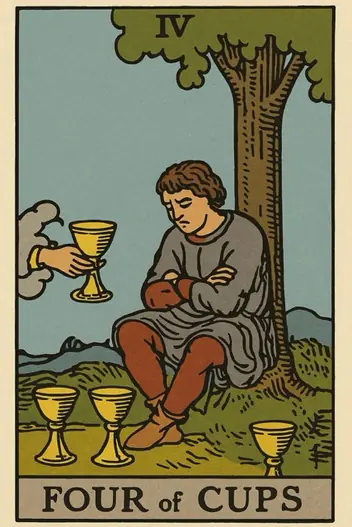
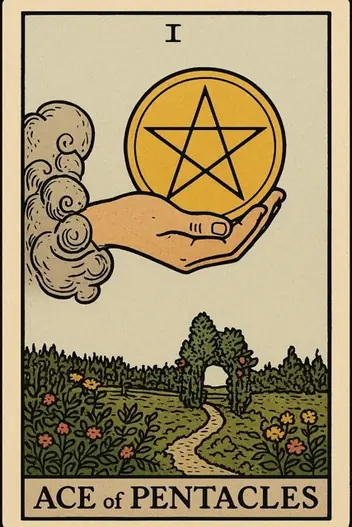
The Four of Cups represents a state of emotional withdrawal, boredom, and missed opportunities—a psychological freeze where the seeker is so focused on what’s lacking or disappointing that they fail to see a new offer right in front of them. The Ace of Pentacles, by contrast, is the embodiment of raw potential: a seed of material opportunity, a new job offer, a financial gift, or a tangible starting point. When these two archetypes collide, we witness a classic Jungian tension between disillusioned introversion and grounded external potential.
This combination is not about a sudden miracle or a dramatic life shift. Instead, it describes a subtle, often uncomfortable turning point where the seeker must consciously choose to break free from their own apathy. The Ace of Pentacles is knocking, but the Four of Cups is refusing to answer the door. Psychologically, this is the moment where chronic dissatisfaction meets a concrete chance for change—and the decision to accept or reject that chance will define the next cycle of your life. The core dynamic is a battle between comfortable stagnation and uncomfortable growth.
Core Dynamics & Interpretation
The fundamental psychological state here is dissociation from reality. The Four of Cups often signals a period where the seeker has become overly introspective, perhaps even depressed or cynical, after previous disappointments. They are looking inward, replaying old grievances, or feeling entitled to something "better" without taking action. The Ace of Pentacles then appears as an external stimulus—a job offer, a financial opportunity, a practical proposal from a partner—that demands a response. The key insight is that this opportunity is almost never flashy or perfect. It’s a small, tangible seed, not a grand solution.
The conflict arises because the seeker’s internal narrative ("nothing works out for me," "this isn't good enough") directly contradicts the external reality of a viable option. The trap is not the opportunity itself, but the seeker’s refusal to see its value. Pragmatically, this combination urges you to objectively assess whether your discontent is justified or simply a habit. Are you rejecting a genuine chance at stability because you’re waiting for a fantasy? Or is this opportunity genuinely insufficient? The answer requires ruthless self-honesty.
To navigate this, the seeker must shift from a reactive, ego-driven stance ("I deserve better") to a proactive, reality-based stance ("What can I build from this?"). The Ace of Pentacles is not a lottery win; it’s a shovel. The Four of Cups is the feeling that digging is beneath you. Your task is to pick up the shovel and assess the soil. The psychological breakthrough happens when you stop judging the opportunity and start evaluating your own willingness to engage with the world.
What Do Four of Cups and Ace of Pentacles Say About Love?
If you are single:
This pair suggests you may be overlooking a practical, stable, or "boring" potential partner because you are fixated on an idealized romantic fantasy or nursing a past wound. The new connection likely appears unexciting at first—it’s the Ace of Pentacles, not the Ace of Wands. Evaluate them based on reliability, shared values, and long-term compatibility, not emotional fireworks.
If you are in a relationship:
You or your partner may be in a state of emotional withdrawal or resentment, feeling that the relationship "isn't enough." The Ace of Pentacles appears as a concrete gesture—a proposal, a shared financial goal, a practical project. The relationship’s health depends on whether you can accept this tangible offering as a form of love, rather than demanding emotional excitement.
In relationships, this combination often reveals a power imbalance in emotional investment. One partner is disengaged, perhaps feeling stuck or undervalued (Four of Cups), while the other is offering a practical, nurturing path forward (Ace of Pentacles). The danger is that the disengaged partner may dismiss this offering as "empty" or "not romantic enough." The critical advice is to recognize that love is expressed through actions, not just feelings. If your partner is showing up with a plan for the future, a financial commitment, or a solution to a practical problem, that is the Ace of Pentacles. To reject it without reflection is to sabotage the relationship’s foundation.
Key relationship advice: Focus on the substance of the offer, not its packaging. Ask yourself: Is this person reliable? Do they share your long-term goals? Are they willing to invest in a shared life? If yes, your boredom or dissatisfaction may be a symptom of your own unprocessed expectations, not a flaw in the relationship.
Your pair is already on the table. Ask your question and draw the clarifying card
or simply focus on it
Career and Finances
Strategic Opportunities:
Look for a small, unglamorous offer—a part-time role, a freelance contract, a mentorship, or a low-risk investment. This is not a career-defining moment, but a foundation-building move.
Strategic Opportunities:
Consider renegotiating an existing agreement or accepting a position that offers stability over excitement. The Ace of Pentacles values consistency and growth over speed.
Calculated Risks:
Avoid rejecting an offer because it feels "beneath you" or because you are waiting for a "perfect" break. The biggest risk here is inaction fueled by pride.
Professionally, this combination is a reality check. The Four of Cups often appears after a period of career disappointment—a missed promotion, a failed project, or simply burnout. The seeker may feel entitled to a better role without doing the incremental work. The Ace of Pentacles then presents a concrete, tangible next step: a job that isn’t glamorous but pays the bills, a side hustle with real earning potential, or a budget that requires tightening. Your strategic move is to accept the offer as a platform, not a destination.
Financially, this is a warning against the "all or nothing" mindset. The Four of Cups can lead to rejecting small, consistent gains (budget adjustments, side income) in favor of a big win that never comes. The Ace of Pentacles demands you plant a seed today and water it daily. If you are in debt or under financial stress, this combination says: Take the practical step now, no matter how small. A part-time job, a debt consolidation plan, or a strict savings goal is the Ace of Pentacles. Your pride or boredom is the Four of Cups.
Important financial warning: Do not let your dissatisfaction with the current situation blind you to a viable lifeline. The most expensive mistake you can make here is to say "no" to a good offer while waiting for a perfect one.
What If Four of Cups or Ace of Pentacles Appears Reversed?
When one or both cards appear reversed, the dynamic of the combination shifts toward something more acute or blocked.
If the Four of Cups is reversed:
The state of apathy gives way to impulsive action. You might quit a good job, break off a stable relationship, or invest money in a dubious venture, just to escape the feeling of stagnation. Warning: Do not confuse activity with productivity. Use the "24-hour rule" — do not make important decisions until the initial emotional impulse has passed.
If the Ace of Pentacles is reversed:
A material opportunity exists, but it is blocked by your internal resistance, fear of success, or disbelief in your own abilities. You may sabotage a job interview, turn down a promotion, or miss out on a profitable deal due to a subconscious belief that "you don't deserve it." Advice: Work through the "I am not worthy of stability" mindset with a psychologist or through concrete small victories.
If BOTH are reversed:
A complete imbalance arises — chaotic sabotage. You reject opportunities while simultaneously impulsively destroying what you have. This is a signal for a full stop. Correction: Return to a basic structure. Start with a daily routine, a simple budget, and a list of three essential tasks per day. Do not seek new opportunities until you have restored minimal order in your current reality.
Get a personalized interpretation
Unlock the combined meaning of your cards in the context of your unique question — for free.
What Are the Risks of Four of Cups and Ace of Pentacles?
The shadow of this combination is passive-aggressive entitlement. The seeker may feel they deserve more without having earned it, leading to a cycle of complaint and inaction. This is a classic cognitive bias: the "grass is greener" fallacy, where you devalue what is available because you compare it to an idealized, nonexistent alternative. The shadow also manifests as fear of commitment to the mundane. The Ace of Pentacles is not exciting; it’s work. The Four of Cups shadow says, "I’m too good for this," while secretly fearing failure if they try.
Another pitfall is self-sabotage through neglect. The seeker receives an opportunity (Ace of Pentacles) but fails to act on it due to apathy or depression (Four of Cups). This can look like ignoring a job interview, delaying a financial decision, or dismissing a partner’s effort. The psychological trap is confusing emotional numbness with objective reality. Just because you feel nothing doesn’t mean the opportunity is worthless. Beware of using your mood as a decision-making tool.
Finally, there is the risk of over-idealizing the past. The Four of Cups often involves longing for a previous success or relationship that has passed. The Ace of Pentacles asks you to build something new, but the shadow clings to the old. This is a recipe for stagnation. If you find yourself saying, "Things used to be better," or "I’ll wait for the right thing," you are likely in the shadow territory of this combination.
What Is the Overall Message of Four of Cups and Ace of Pentacles?
How can the energy of the Four of Cups be used constructively to activate the Ace of Pentacles? The answer is paradoxical: accept your apathy as a given, but do not allow it to dictate your decisions. Your emotional fatigue is not a command to retreat, but a signal that the old ways of finding satisfaction have exhausted themselves. The Ace of Pentacles offers you a new, material, and stable path that does not require an immediate emotional uplift.
Your strategy must be built on the principle of "action precedes feeling." Do not wait until you feel like taking on a new task or responding to an offer. Begin to act mechanically: send out a resume, agree to a meeting, open an account. Structure and discipline are the only bridge between apathy and abundance. Remember: the Four of Cups is a subjective state, while the Ace of Pentacles is an objective reality. You are not obligated to change your mood in order to change your life. You only need to take one concrete step.
A deep piece of advice for making the right decision: ask yourself whether your "no" is a reaction to past experience, rather than a response to the current offer. If you are turning down an opportunity because it "reminds" you of a failure, you are in the grip of the Four of Cups. If you are refusing because it is objectively disadvantageous by clear criteria, you are wisely using the Ace of Pentacles. Learn to distinguish between these two states, and you will hold the key to managing your destiny.
Where to Go From Here
The core message of the Four of Cups and Ace of Pentacles is simple but uncomfortable: Your next opportunity is already here, but you are too busy looking away to see it. This is not about waiting for a sign or a miracle. It’s about recognizing that the seed of your next chapter is small, practical, and unglamorous. Your job is to overcome your own apathy, pride, or fear, and to take the first tangible step forward—even if it feels like a step backward.
While this article provides the general archetype, the true power of Tarot lies in applying it to your specific situation. The meaning of this combination changes dramatically depending on whether you are single or partnered, employed or job-hunting, hopeful or burnt out. To get a deep, personalized interpretation of this exact combination for your unique question, use the Fortune Cards app. You can access it on the web or download it to receive a tailored reading that addresses your specific circumstances, helping you move from insight to action.
Interpretation by the Fortune Cards editorial team, based on the Rider–Waite tradition and Jungian archetypes. About our methodology · Updated: 2026-08-26
Other Combinations with Four of Cups
Other Combinations with Ace of Pentacles
Explore Individual Card Meanings
Table of Contents
- Core Dynamics & Interpretation
- What Do Four of Cups and Ace of Pentacles Say About Love?
- Career and Finances
- What If Four of Cups or Ace of Pentacles Appears Reversed?
- What Are the Risks of Four of Cups and Ace of Pentacles?
- What Is the Overall Message of Four of Cups and Ace of Pentacles?
- Where to Go From Here
Ready to find answers to your questions?
Start your first reading now and look at your situation with fresh clarity. The cards are ready to reveal deeper meaning.