Four of Cups and King of Swords Reversed in Tarot

- Arcana
- Four of Cups — Minor Arcana, Cups; King of Swords — Minor Arcana, Swords
- Elements
- Four of Cups — Water; King of Swords — Air
- Elemental interaction
- Neutral elements — energies coexist without conflict
- Numerology
- 4 + 14 = 18 → 9
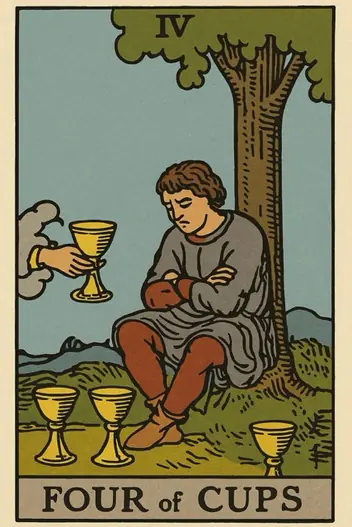
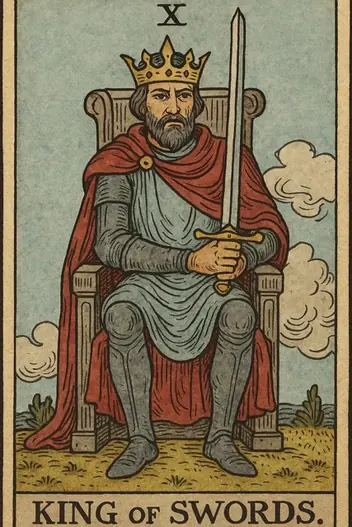
When the Four of Cups—a card of emotional withdrawal, dissatisfaction, and missed opportunities—collides with the King of Swords—the archetype of intellectual clarity, objective truth, and decisive authority—you get a powerful tension between feeling and thinking. This combination often signals a moment where emotional stagnation is confronted by cold, rational analysis. The seeker may be stuck in a state of passive discontent, yet the King demands they cut through the fog with logic and action.
Psychologically, this pairing represents the clash between the introverted feeling function (dwelling on what’s missing) and the extraverted thinking function (imposing structure and truth). The result is a critical juncture: either the King’s clarity will break the Four’s apathy, or the Four’s resentment will undermine the King’s authority. In practice, this is a call to stop waiting for external solutions and start applying disciplined, objective reasoning to your discontent.
Four of Cups and King of Swords: How These Energies Interact
The core dynamic of the Four of Cups and King of Swords is a standoff between emotion and intellect. The Four of Cups represents a state of emotional detachment, where the seeker feels unfulfilled by current circumstances, yet refuses to engage with new offers or possibilities. This is often a defense mechanism against disappointment. The King of Swords, however, brings uncompromising clarity—he sees the situation for what it is, not what the seeker wishes it to be. Together, they create a psychological environment where self-deception is no longer sustainable.
In practical terms, this combination suggests a person who is over-analyzing their dissatisfaction. They may be cataloging reasons why opportunities are inadequate, relationships are flawed, or career paths are dead ends—yet they remain paralyzed, waiting for a perfect solution that never comes. The King forces a reality check: “What are you actually doing to change this?” The key insight here is that apathy is a choice, and the King demands accountability. The seeker must shift from passive critique to active decision-making, even if the choice is uncomfortable.
The strategic takeaway is to use the King’s analytical power to diagnose the root cause of the apathy, not to justify it. Ask: Is this dissatisfaction a sign to pivot, or is it a fear of commitment? The King’s sword cuts through both possibilities, but only action resolves the tension.
Your pair is already on the table. Ask your question and draw the clarifying card
or simply focus on it
Four of Cups and King of Swords Love Outcome
If you are single:
This combination warns against dismissing potential partners too quickly based on superficial criteria or past disappointments. The King of Swords demands you be honest about your standards, but the Four of Cups cautions against letting cynicism blind you to genuine connection.
If you are in a relationship:
Expect a period of intense, perhaps uncomfortable, communication. The King of Swords brings a need for truth and clarity, while the Four of Cups indicates one partner may feel emotionally neglected or unappreciated.
In relationships, this pairing often reveals a power imbalance in communication. One partner (the King) may be overly rational, critical, or detached, while the other (the Four) feels unheard, resentful, or withdrawn. The result is a cycle of analysis without resolution—discussing problems but never feeling emotionally safe enough to solve them. The bold truth here is that logic cannot heal emotional wounds. If the King dominates, the relationship risks becoming a cold transaction. If the Four dominates, resentment builds silently.
Key relationship advice:
If you are the King, temper your need for correctness with empathy. Ask your partner what they feel, not just what they think. If you are the Four, take responsibility for your dissatisfaction—communicate your needs clearly rather than waiting for your partner to guess them. The combination works best when the King’s clarity helps the Four define what they actually want, and the Four’s emotional awareness softens the King’s rigidity. Actionable steps include scheduling a “no-phone” conversation to discuss unmet needs, or writing down three specific things you appreciate about your partner to counter the Four’s tendency to focus on what’s missing.
Deepen your understanding
Find out exactly what this reading means for your current life situation with our oracle.
Four of Cups and King of Swords for Career and Money
Strategic Opportunities:
Use the King of Swords’ analytical rigor to audit your current role or business model. Identify what is genuinely underperforming versus what is just “boring but stable.” The Four of Cups can help you recognize when you’re undervaluing a steady opportunity because it lacks novelty.
Strategic Opportunities:
Leverage the King’s decisiveness to make a bold career pivot—apply for a new position, renegotiate your contract, or launch a side project. The Four of Cups’ dissatisfaction is a signal that inertia is costing you more than risk.
Calculated Risks:
Avoid making decisions purely out of boredom. The Four of Cups can tempt you to quit a job or abandon a project prematurely. The King of Swords insists on data-driven reasoning—do not act until you have objective evidence that a change is warranted.
In career and finances, this combination is a call for strategic reevaluation. The Four of Cups suggests you may be overlooking hidden opportunities—perhaps a mentor’s advice, a lateral move, or a skill upgrade—because you’re fixated on what you lack. The King of Swords demands you list your assets and liabilities objectively. Bold financial warning: Do not make major investments or career changes based on emotional dissatisfaction alone. The King requires a cost-benefit analysis of every move. For example, if you feel stuck in your job, the King would ask: “What is the net gain of leaving now versus in six months?” The Four would reply: “I’m just tired of it.”
Strategic advice:
Create a decision matrix with columns for “Pros,” “Cons,” “Timeline,” and “Emotional Cost.” This forces the Four’s vague discontent into the King’s structured framework. If you are negotiating a salary or contract, let the King lead—prepare facts, benchmarks, and clear terms. But also acknowledge the Four’s need for meaning—if the role lacks purpose, no amount of money will satisfy you long-term.
When Four of Cups and King of Swords Signal Trouble
The shadow side of this combination emerges when intellect becomes a weapon against emotion. The King of Swords can turn into a cold, critical tyrant who dismisses the Four’s feelings as “irrational” or “whining.” This creates a dangerous cognitive bias of rationalization—the seeker uses logic to justify their own apathy or cruelty. For instance, they might say, “I’ve analyzed this relationship, and it’s objectively flawed, so there’s no point in trying,” when in reality, they are avoiding vulnerability.
Conversely, the Four of Cups’ shadow can passively sabotage the King’s best efforts. The seeker may intellectually agree with a plan but emotionally refuse to execute it, leading to procrastination, passive-aggression, or self-sabotage. This is the “I know what I should do, but I don’t want to” trap. The biggest pitfall is decision paralysis—endless analysis that never leads to action. The King’s clarity becomes a prison when the Four’s apathy refuses to move.
Cognitive biases to watch for:
Confirmation bias (seeking evidence that supports your dissatisfaction), sunk cost fallacy (staying in a bad situation because you’ve invested time), and emotional reasoning (believing that because you feel stuck, you are stuck). To counter these, the King must set a deadline for analysis, and the Four must commit to one small action—even if imperfect. Self-sabotage warning: If you find yourself critiquing every option as “not good enough,” ask yourself: “Am I protecting myself from failure, or am I avoiding success?”
Four of Cups and King of Swords Reversed: What Changes?
If the Four of Cups is reversed, this indicates a breakthrough from a state of apathy. The person is no longer rejecting opportunities but actively begins to seek them out. However, paired with the upright King of Swords, this can lead to impulsive and ill-considered actions riding a wave of sudden enthusiasm. Advice: slow down. Your desire to "make up for lost time" is dangerous, as the King of Swords demands a clear plan, not spontaneous decisions.
If the King of Swords is reversed, this manifests as inner weakness and an inability to make a decision. Intellect is suppressed, logic is replaced by passive aggression or empty promises. In combination with the upright Four of Cups, this creates toxic stagnation: you know what needs to be done, but you lack the strength or will to carry it out. Advice: delegate decision-making. Find a mentor or partner who can temporarily take on the role of the "King of Swords" so you can break out of your stupor.
If BOTH cards are reversed, this is a complete imbalance. The apathy of the Four of Cups turns into irrational anxiety, and the authority of the King of Swords turns into cruelty. The person may self-sabotage, rejecting good opportunities out of fear, or conversely, aggressively impose their will, destroying relationships. Method for correction: relinquish control. Acknowledge that you cannot control everything with your mind (King of Swords), and allow yourself to feel (Four of Cups). Start small: keep an emotion journal to separate real feelings from fabricated fears.
Four of Cups and King of Swords: Tarot Advice
Constructive use of this combination requires conscious paradox: you must simultaneously accept your apathy as a fact and apply intellect to overcome it. Do not try to "force" yourself to feel enthusiasm. Instead, use the King of Swords to create a clear roadmap out of the crisis. Write it down: "I am at point A (apathy). I want to reach point B (goal). What 3 rational steps do I need to take?" The Four of Cups gives you the honesty to acknowledge the problem, and the King of Swords provides the tool to solve it.
A deep strategic piece of advice: turn your detachment into objectivity. The "I don't care" state offers a unique opportunity to see the situation without distortion. You are not subject to emotional swings, so you can make the most balanced decisions. Use this period to audit your life: relationships, finances, goals. Cut away what is truly dead, but do so with the cold precision of a surgeon, not the fury of a butcher. Your strength now lies in clarity, not action. A plan made in this state will be the most stable and realistic.
Where to Go From Here
The core message of the Four of Cups and King of Swords is this: Your dissatisfaction is a signal, but only your disciplined action can decode it. Apathy and analysis are two sides of the same coin—both can keep you stuck if you don’t integrate them. The King demands you think clearly; the Four asks you to feel honestly. Together, they challenge you to stop waiting for the perfect opportunity and start making the most of the one in front of you. The path forward requires courage to choose, even when no choice feels ideal.
Your next step is to apply this archetypal wisdom to your unique situation. While this article provides the general dynamics, the true insight comes when the cards speak to your specific question. That’s why I recommend using the Fortune Cards app—available on the web or for download. It offers a deep, personalized interpretation of this exact combination for your love, career, or personal growth question. Instead of guessing how these archetypes apply to you, let the app guide you with precision and context. Click or tap to start your reading now—your clarity is one card away.
Interpretation by the Fortune Cards editorial team, based on the Rider–Waite tradition and Jungian archetypes. About our methodology · Updated: 2026-08-26
Other Combinations with Four of Cups
Other Combinations with King of Swords
Explore Individual Card Meanings
Table of Contents
- Four of Cups and King of Swords: How These Energies Interact
- Four of Cups and King of Swords Love Outcome
- Four of Cups and King of Swords for Career and Money
- When Four of Cups and King of Swords Signal Trouble
- Four of Cups and King of Swords Reversed: What Changes?
- Four of Cups and King of Swords: Tarot Advice
- Where to Go From Here
Ready to find answers to your questions?
Start your first reading now and look at your situation with fresh clarity. The cards are ready to reveal deeper meaning.