Four of Cups and Page of Swords Meaning in Tarot
- Arcana
- Four of Cups — Minor Arcana, Cups; Page of Swords — Minor Arcana, Swords
- Elements
- Four of Cups — Water; Page of Swords — Air
- Elemental interaction
- Neutral elements — energies coexist without conflict
- Numerology
- 4 + 11 = 15 → 6
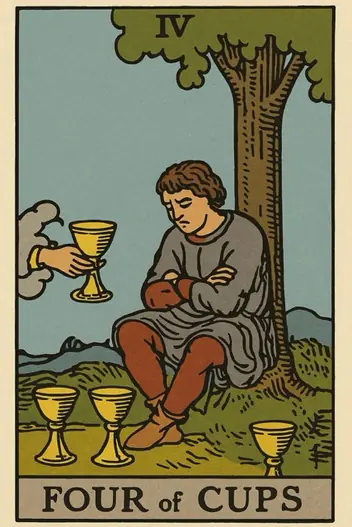
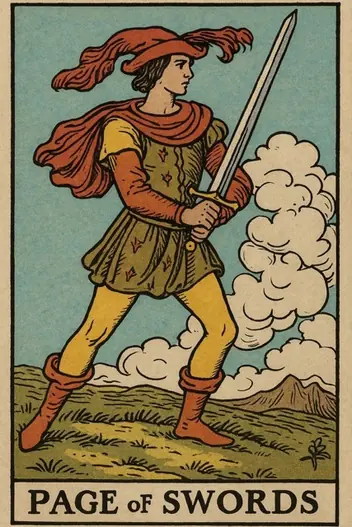
When the Four of Cups meets the Page of Swords, we witness a psychological collision between emotional stagnation and intellectual agitation. The Four of Cups represents a state of withdrawal, apathy, or dissatisfaction with what is currently being offered—a classic "grass is greener" mindset. In contrast, the Page of Swords embodies curiosity, mental restlessness, and a thirst for new information. Together, they create a tension where the seeker feels stuck in a rut yet simultaneously bombarded with ideas, critiques, or opportunities that seem to lead nowhere.
This combination often appears when someone is overthinking their dissatisfaction, turning a simple need for change into a complex mental loop. The key here is to recognize that the Page of Swords’ analytical energy can either break the Four of Cups' stagnation or deepen it into cynical rumination. The outcome depends entirely on whether the seeker uses their intellect to discover new possibilities or merely to justify their discontent.
Four of Cups and Page of Swords Card Meaning Explained
The core dynamic here is a psychological standoff between emotional withdrawal and intellectual pursuit. The Four of Cups signals a period of introversion and emotional numbness—the seeker may feel that nothing new is worth their attention. The Page of Swords, however, is a restless messenger who brings sharp questions, critical insights, and a desire for mental stimulation. When these energies merge, the seeker often finds themselves mentally analyzing why they feel so disconnected, but without taking action to change it.
This is a state of passive-aggressive introspection: you’re aware of your dissatisfaction, but you’re using your sharp mind to critique rather than to solve. The danger is turning your analytical skills into a weapon against yourself, justifying inaction with overly logical reasons for staying stuck. The opportunity, however, lies in redirecting that intellectual energy toward curiosity about what you haven’t yet considered. Ask yourself: Are you truly open to new perspectives, or are you just looking for reasons to reject them?
Practically, this combination demands a shift from “Why is this not working?” to “What am I not seeing?” The Page of Swords offers the mental tools to dissect the Four of Cups’ apathy, but only if you consciously choose to use them for exploration rather than critique. The real growth comes when you apply your critical thinking to your own blind spots, not to external circumstances.
Four of Cups and Page of Swords in Love and Relationships
If you are single:
This pairing suggests you may be overthinking potential partners or rejecting them based on superficial intellectual judgments. You’re likely to receive a message or invitation that feels uninteresting at first glance—pause before dismissing it.
If you are in a relationship:
You or your partner may be emotionally withdrawn while intellectually critical. The dynamic is one where one person feels unseen, while the other uses logic to avoid emotional vulnerability.
In relationships, the Four of Cups and Page of Swords often reveal a disconnect between emotional needs and intellectual expression. The withdrawn partner (Four of Cups) may feel unappreciated, while the analytical partner (Page of Swords) responds with questions, debates, or cold reasoning instead of empathy. This creates a cycle where one person’s silence is met with the other’s probing, leading to frustration on both sides.
The key relationship advice here is to stop using questions as a defense mechanism. Instead of asking “Why are you upset?” as a way to fix things, try asking “What do you need from me right now?” Boldly prioritize emotional presence over logical problem-solving. If you’re single, avoid writing off a potential connection just because it doesn’t fit your mental checklist—allow yourself to feel curious about what you don’t yet understand.
Your pair is already on the table. Ask your question and draw the clarifying card
or simply focus on it
Four of Cups and Page of Swords for Career and Money
Strategic Opportunities:
Use your analytical skills to audit your current dissatisfaction—list what’s truly missing, not just what’s annoying you. This is a prime time to research a new field or skill without committing yet.
Strategic Opportunities:
The Page of Swords energy supports networking for information, not immediate results. Attend a workshop, read industry reports, or interview a mentor to gather data before making a move.
Calculated Risks:
Avoid making a career change based solely on boredom—the Four of Cups can make everything look stale. Don’t quit impulsively; use the Page’s sharp mind to identify concrete alternatives first.
In the professional realm, this combination warns against letting intellectual dissatisfaction masquerade as strategic insight. You may feel your current role is beneath you (Four of Cups) while simultaneously critiquing every new idea that comes your way (Page of Swords). The danger is becoming the office cynic—someone who sees flaws but offers no solutions. Instead, channel this energy into constructive analysis: what specific changes would reignite your engagement? Bold financial warning: avoid speculative investments based on “interesting” ideas—the Page of Swords loves novelty, but the Four of Cups lacks the motivation to follow through.
Your career strategy should be to use the Page’s curiosity to explore, but commit only when the Four of Cups’ apathy lifts. Gather information, ask hard questions, and then set a timeline for decision-making to prevent endless analysis paralysis.
Get a personalized interpretation
Unlock the combined meaning of your cards in the context of your unique question — for free.
When Four of Cups and Page of Swords Signal Trouble
The shadow side of this combination is intellectual arrogance masking emotional avoidance. The seeker may use sharp questions and critical observations to keep others at a distance, rationalizing their withdrawal as “being discerning.” This is a cognitive bias known as confirmation bias: you’re only looking for evidence that supports your decision to disengage. The Four of Cups’ apathy becomes a self-fulfilling prophecy, as the Page of Swords’ criticisms reinforce why nothing is worth pursuing.
Another pitfall is passive-aggressive communication—you might say “I’m just asking questions” when you’re actually expressing resentment. This can damage relationships, as the other person feels interrogated rather than supported. Self-sabotage occurs when you use your intelligence to avoid emotional risk, convincing yourself that staying detached is safer than being vulnerable. Recognize when your “analysis” is actually a form of defensive pessimism.
Four of Cups and Page of Swords Reversed Meaning
When cards appear reversed, the dynamic becomes distorted, turning potential into a problem.
If the Four of Cups is reversed:
This indicates a reckless breakout from the comfort zone. Apathy gives way to chaotic activity. Instead of contemplating the situation (Page of Swords), the person acts impulsively, grabbing at any opportunity just to escape boredom. Warning: there is a high risk of making an unwise purchase or entering a toxic relationship on a wave of emotional hunger.
If the Page of Swords is reversed:
This is an internal resistance to the truth. The person hears criticism or sees the problem but refuses to accept it. This manifests as passive aggression, cynicism, or intellectual laziness. Advice: check whether you are using complex theories to justify a simple unwillingness to change.
If BOTH are reversed:
Complete imbalance. You are stuck in a state of toxic negativity with no way out. Apathy turns into depression, and a sharp mind turns into caustic wit and self-destruction. The logical way to correct this: a forced change of context. You need to physically distract yourself from thoughts and feelings — intense exercise, a change of scenery, or helping another person, in order to break the vicious cycle of internal monologue.
Four of Cups and Page of Swords: The Combined Message
How to constructively use the energy of the Four of Cups to balance the Page of Swords? The key lies in recognizing the value of both states. The Four of Cups is not an enemy, but an indicator of saturation. It says: "Stop, the current format no longer works." The Page of Swords is a diagnostic tool. Your task is not to let them conflict, but to unite them into a strategy for conscious emergence from stagnation.
Begin by legitimizing your apathy. Stop berating yourself for a lack of motivation. Say: "Yes, I am satiated. This means that old stimuli have lost their power. Now I need new information." Then, activate the Page of Swords not as a critic, but as an explorer. Ask yourself: "If I could change one thing in my life, without regard for others' opinions, what would it be?" The answer to this question is precisely the "arrow of insight" that the Page carries.
Strategic advice: use the "48-hour rule." Upon receiving a new idea or critical observation (Page), do not act on it or reject it. For 48 hours, allow the Four of Cups to "digest" this information. Record your reactions. After this period, once the emotional background has settled, make your decision. This will save you from impulsive mistakes and allow you to extract maximum benefit from this intellectual challenge.
Applying This to Your Situation
The core message of Four of Cups and Page of Swords is that your dissatisfaction is real, but your interpretation of it may be incomplete. You have the intellectual tools to understand your situation—now you must choose whether to use them for genuine exploration or to reinforce your own resistance. The path forward requires balancing critical thinking with emotional openness, asking what you might be missing rather than what you already know is wrong.
To unlock the full meaning of this combination for your specific life, you need more than general archetypes—you need context. That’s where the Fortune Cards app comes in. While this article provides the psychological framework, the true magic happens when Tarot is applied to your unique situation. Use the app on the web or download it to get a deep, personalized interpretation of this exact combination for your specific question right now. Don’t stay stuck in analysis—get the clarity you need to move forward.
Interpretation by the Fortune Cards editorial team, based on the Rider–Waite tradition and Jungian archetypes. About our methodology · Updated: 2026-09-17
Other Combinations with Four of Cups
Other Combinations with Page of Swords
Explore Individual Card Meanings
Table of Contents
- Four of Cups and Page of Swords Card Meaning Explained
- Four of Cups and Page of Swords in Love and Relationships
- Four of Cups and Page of Swords for Career and Money
- When Four of Cups and Page of Swords Signal Trouble
- Four of Cups and Page of Swords Reversed Meaning
- Four of Cups and Page of Swords: The Combined Message
- Applying This to Your Situation
Ready to find answers to your questions?
Start your first reading now and look at your situation with fresh clarity. The cards are ready to reveal deeper meaning.