Four of Pentacles + Eight of Pentacles: What This Tarot Pairing Means

- Arcana
- Four of Pentacles — Minor Arcana, Pentacles; Eight of Pentacles — Minor Arcana, Pentacles
- Elements
- Four of Pentacles — Earth; Eight of Pentacles — Earth
- Elemental interaction
- Same element — energies intensify each other
- Numerology
- 4 + 8 = 12 → 3
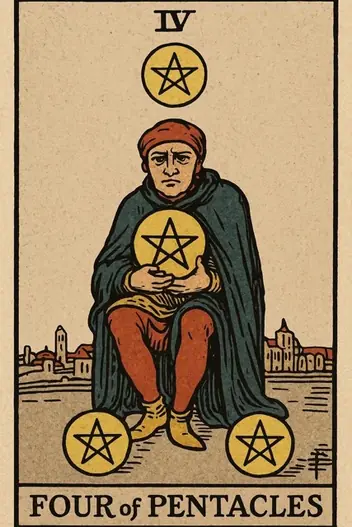
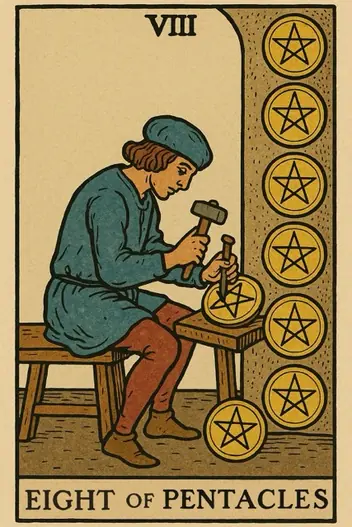
The intersection of the Four of Pentacles and the Eight of Pentacles is a study in disciplined resource management. The Four represents hoarding, security, and the fear of loss, while the Eight embodies diligence, craftsmanship, and repetitive skill-building. When these two archetypes collide, the seeker is often caught between the desire to protect what they have and the necessity to invest in their own growth.
This combination suggests a psychological state where control becomes a prerequisite for progress. You are not being asked to spend recklessly or open up emotionally without guardrails. Instead, the cards demand a pragmatic strategy: build your fortress, but fill it with tools, not just treasure. The key insight here is that security is not static—it is a product of continuous, focused effort. The seeker must learn to differentiate between protective boundaries that foster growth and defensive walls that stifle it.
Core Dynamics & Interpretation
The core dynamic of the Four of Pentacles and Eight of Pentacles is a trade-off between preservation and production. The Four warns against possessiveness—of money, time, energy, or affection—while the Eight insists that mastery requires sustained investment. Psychologically, this creates a tension between the Scarcity Mindset (fear of losing what you have) and the Growth Mindset (willingness to work for future abundance).
The most critical psychological insight is that this combination often manifests as obsessive perfectionism. The seeker may spend excessive hours refining a single skill or project, not out of passion, but out of a fear that anything less than perfect will lead to loss. This is a compensatory behavior—a defense mechanism against the anxiety of vulnerability. The cards advise: do not mistake meticulousness for meaningful progress. While dedication is admirable, the Four’s energy can turn the Eight’s labor into a Sisyphean task if the goal is merely to avoid criticism or failure.
Practically, this pair signals a period of intense specialization. You may be asked to double down on a niche skill, a specific savings plan, or a particular relationship dynamic. The risk is tunnel vision: focusing so narrowly that you miss opportunities for diversification or emotional connection. The reward, however, is deep expertise and financial stability—provided you keep a conscious eye on the horizon. The seeker must ask: Am I building a cage or a workshop?
Ask your question and flip the cards
or simply focus on it
Four of Pentacles and Eight of Pentacles in Love and Relationships
If you are single:
This combination suggests you are evaluating potential partners through a pragmatic, almost transactional lens. You may be overly focused on a person’s stability, career, or resources, neglecting emotional chemistry. Beware of treating relationships like a job application.
If you are in a relationship:
The pairing often points to a power imbalance around time and effort. One partner may be overly protective of their personal space or finances, while the other feels they are doing all the emotional "work." Negotiate contributions explicitly.
In relationships, the Four of Pentacles and Eight of Pentacles create a dynamic where love is treated as a limited resource. One partner may hoard affection, time, or shared assets, while the other feels compelled to constantly "earn" closeness through acts of service or caretaking. This can lead to a caregiver-rescuer dynamic that feels stable but is emotionally draining.
The key relationship advice is to separate boundaries from barriers. Healthy boundaries protect your individuality; barriers prevent intimacy. If you are the Four in this pairing, ask yourself: What am I afraid to lose if I give more? If you are the Eight, ask: Am I working to prove my worth, or to genuinely connect? The solution lies in explicit agreements: set clear expectations about time, money, and emotional support, then commit to them without resentment. Do not confuse self-protection with self-sabotage.
Get a personalized interpretation
Unlock the combined meaning of your cards in the context of your unique question — for free.
What Do Four of Pentacles and Eight of Pentacles Indicate for Your Career?
Strategic Opportunities:
Specialize in a high-demand niche. The Eight of Pentacles rewards deep expertise. Combine this with the Four’s caution to choose a field where you can control pricing or access.
Strategic Opportunities:
Create a "safety fund" for skill development. Use the Four’s saving instinct to allocate a specific budget for courses, certifications, or tools that increase your market value.
Calculated Risks:
Avoid over-saving at the expense of growth. If you are refusing to invest in marketing, networking, or equipment because of fear, you are turning a strength into a weakness.
Professionally, this combination is a powerful signal for career consolidation. It is an excellent time to master your current role rather than chase a promotion. Focus on process improvement—refining systems, reducing errors, and becoming the go-to expert in your department. For entrepreneurs, it suggests protecting cash flow while investing in production efficiency. A critical financial warning: do not confuse frugality with strategy. Hoarding cash without a plan for deployment is a form of procrastination.
Strategic tip:
Use the Four’s energy to audit your expenses and identify leaks. Then, use the Eight’s energy to build a second income stream through a skill you already possess. For example, a graphic designer might save money by cutting subscriptions while launching a side business designing templates. The goal is not to work harder, but to work more precisely.
Reversed Positions: What Changes?
When cards appear reversed, their energy is either blocked or distorted, creating new problems.
If the Four of Pentacles is reversed:
Blocked potential. This is the classic scenario of "a person who studies too much but does nothing." The fear of loss is replaced by recklessness or, conversely, complete apathy. You may spend money on courses without implementing the knowledge, or, on the contrary, chaotically switch fields of activity. Advice: Reduce the "input" of information. Focus on one skill and start applying it, even if you are afraid of making mistakes.
If the Eight of Pentacles is reversed:
Internal resistance and laziness. Mastery is not achieved, work causes disgust. This may be a consequence of burnout from previous perfectionism. The person sabotages any routine tasks, preferring "easy money" or procrastination. Advice: You don't need a plan, but a change of context. Change your job, tool, or approach. Routine is killing your motivation.
If BOTH are reversed:
Complete imbalance. "I don't want anything, I don't do anything, but I'm afraid of losing everything." This is a state of deep crisis, where fear paralyzes the will and skills are devalued. The logical way to correct it: Start with the smallest thing. Return to the base of the Eight — do one simple but complete task. This will restore the feeling of control (the Four). Don't try to solve everything at once.
The Shadow Side of Four of Pentacles and Eight of Pentacles
The shadow side of this pairing is stagnation disguised as discipline. The seeker may become pathologically risk-averse, refusing to delegate, collaborate, or take strategic leaps. This manifests as obsessive control: micromanaging projects, demanding perfection from others, or refusing to share credit. Cognitive biases at play include the sunk cost fallacy (continuing a failing project because you’ve already invested so much) and the endowment effect (overvaluing what you already possess, leading to missed opportunities).
Self-sabotage occurs when the seeker uses work as a shield against vulnerability. If you bury yourself in tasks to avoid intimacy, feedback, or change, you are not being diligent—you are being avoidant. The Eight’s repetitive labor becomes a compulsion rather than a craft. Similarly, the Four’s hoarding can turn into miserliness, where you deprive yourself of joy, rest, or generosity, falsely believing that sacrifice equals security. The pitfall is mistaking motion for progress.
What Is the Overall Message of Four of Pentacles and Eight of Pentacles?
Constructive use of this pair's energy requires you to become an "architect of your security," not merely its guard. Your task is to use the methodicalness and diligence of the Eight of Pentacles not for endless accumulation, but to create sustainable yet flexible systems. The Four of Pentacles should become not a wall, but a foundation upon which you build new levels.
The strategic advice lies in the principle of "controlled risk." Allocate 10-20% of your time and resources to experiments and projects that do not guarantee immediate returns. This will allow your Eight of Pentacles to realize its creative potential, and your Four of Pentacles to avoid becoming a prison. For example, if you are saving money, part of it should work for you (investments), and part should work for your development (courses, networking).
The key decision:
stop perceiving security as a static state. Security is a dynamic process of adaptation. Your competence (Eight of Pentacles) is your only true asset that cannot be taken away. The Four of Pentacles should guard not only what you have, but also your right to grow. Combine these energies: create a development plan that is protected by clear boundaries and a budget. Only then can you transform the fear of loss into a strategy of expansion.
Your Next Step: Personal Context Matters
The core message of the Four of Pentacles and Eight of Pentacles is that true security is built, not hoarded. You are being called to invest your time and resources into a specific skill or project with discipline and focus, but without becoming rigid or fearful. The path forward requires strategic patience: protect your foundation, but use it as a launchpad, not a prison.
Ready to see how this combination applies to your exact situation? The Fortune Cards app can provide a deep, personalized interpretation of this exact pairing for your specific question—whether it’s about love, career, or a pivotal decision. Stop guessing and start strategizing. Use the app on the web or download it now to unlock the hidden dynamics of your unique spread.
Interpretation by the Fortune Cards editorial team, based on the Rider–Waite tradition and Jungian archetypes. About our methodology · Updated: 2026-08-01
Other Combinations with Four of Pentacles
Other Combinations with Eight of Pentacles
Explore Individual Card Meanings
Table of Contents
- Core Dynamics & Interpretation
- Four of Pentacles and Eight of Pentacles in Love and Relationships
- What Do Four of Pentacles and Eight of Pentacles Indicate for Your Career?
- Reversed Positions: What Changes?
- The Shadow Side of Four of Pentacles and Eight of Pentacles
- What Is the Overall Message of Four of Pentacles and Eight of Pentacles?
- Your Next Step: Personal Context Matters
Ready to Discover Your Path?
Join thousands of seekers who have found clarity and guidance through our platform. Your cosmic journey awaits.