Four of Swords and Four of Pentacles Tarot as Feelings
- Arcana
- Four of Swords — Minor Arcana, Swords; Four of Pentacles — Minor Arcana, Pentacles
- Elements
- Four of Swords — Air; Four of Pentacles — Earth
- Elemental interaction
- Opposing elements — energies create tension
- Numerology
- 4 + 4 = 8
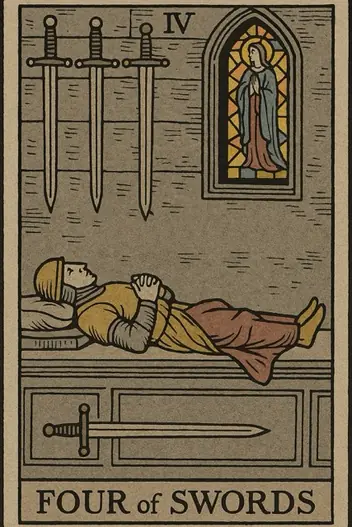
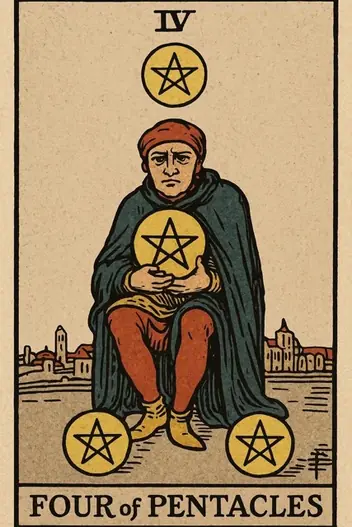
When the Four of Swords (mental retreat and recuperation) meets the Four of Pentacles (material hoarding and rigid control), we encounter a potent psychological state of defensive consolidation. This is not a card of growth or expansion; it is a strategic freeze-frame. The seeker is likely pulling back from the world to protect their energy, finances, or emotional stability, often after a period of significant stress or loss. The core tension here is between the need for genuine mental rest and the impulse to grip tightly to what remains, creating a fortress of scarcity that can feel safe but ultimately suffocating.
This combination reveals a powerful Jungian shadow dynamic: the identification of the self with its possessions or mental constructs. The Four of Swords asks for stillness to heal, while the Four of Pentacles warns against mistaking that stillness for a permanent state of hoarding. When these cards collide, the practical risk is turning a temporary retreat into a long-term prison of isolation and rigidity. The key insight is to recognize that true security comes not from holding everything in place, but from knowing what to release and when to re-engage.
What Do Four of Swords and Four of Pentacles Mean Together?
The psychological state created by this pairing is one of hyper-vigilant conservation. The Four of Swords provides the archetype of the wounded healer who must lie down to recover, while the Four of Pentacles adds the archetype of the miser who counts every coin in the dark. Together, they produce a mindset where rest is weaponized as a form of control. The seeker may feel they cannot afford to let down their guard, even in solitude, because every moment of peace feels borrowed against a future threat.
Real-world implications are stark: you are likely rationing your energy, time, and money as if you were in a siege. This can manifest as canceling social plans to save spoons, refusing to invest in new opportunities, or mentally replaying past failures to avoid future risks. The psychological defense mechanism at play is isolation of affect—separating your feelings from your actions to maintain a sterile sense of safety. While this can be useful in a crisis, it becomes maladaptive when it prevents you from processing the very emotions that need healing. The practical challenge is to distinguish between necessary convalescence and unnecessary contraction.
Your pair is already on the table. Ask your question and draw the clarifying card
or simply focus on it
Love and Relationships
If you are single:
This pair suggests you are over-evaluating a potential partner through a lens of scarcity. You may be so focused on what they could take from you (time, freedom, emotional energy) that you miss genuine connection. Set a time limit for observation before deciding.
If you are in a relationship:
You or your partner are likely withholding affection, resources, or vulnerability as a form of self-protection. The dynamic may feel like a cold war where both parties are waiting for the other to make the first move.
In relationships, this combination signals a crisis of trust and boundaries. The Four of Swords’ need for solitude can be misinterpreted as rejection, while the Four of Pentacles’ grip on resources (including emotional intimacy) creates a power imbalance. The key relationship advice is to negotiate explicit agreements about space and sharing. For example, agree that one partner can take a "mental health day" without the other feeling abandoned, or schedule a weekly check-in to discuss financial transparency. Bold action: schedule a low-stakes, shared activity that requires cooperation but not high emotional exposure—like cooking a meal together or organizing a shared space. This builds trust through practical collaboration rather than forced vulnerability.
Career and Finances
Strategic Opportunities:
Use this period to audit your systems. Review contracts, automate savings, or create a contingency plan. The Four of Swords’ clarity can help you spot inefficiencies.
Strategic Opportunities:
Negotiate from a position of quiet strength. Your current reserve gives you leverage; do not rush into deals. Use the time to research competitors or refine your pitch.
Calculated Risks:
Avoid hoarding cash at the expense of growth. The Four of Pentacles warns that holding too tightly to your current position or savings can cause you to miss a strategic pivot. Do not let fear of loss prevent necessary investment in yourself.
Professionally, this combination suggests a pause in career momentum that can be either a trap or a launchpad. The Four of Swords indicates you may need a sabbatical, reduced hours, or a shift to less demanding tasks to recover from burnout. However, the Four of Pentacles warns that this retreat should not become a permanent state of "waiting for the market to improve." Bold financial warning: do not confuse liquidity with security. Having cash in the bank is meaningless if you are too fearful to deploy it. Instead, create a "re-entry plan" with specific milestones (e.g., "after three months of rest, I will apply for one new opportunity per week"). This turns the retreat into a strategic pause rather than a dead end.
Deepen your understanding
Find out exactly what this reading means for your current life situation with our oracle.
Four of Swords and Four of Pentacles: Warning Signs
The shadow manifestation of this pairing is paralyzing miserliness—both emotional and material. When blocked, the seeker may exhibit cognitive biases like loss aversion (valuing what they have far more than what they could gain) and sunk cost fallacy (staying in a bad situation because they've already invested so much). This can lead to self-sabotage through over-control: you might refuse to spend money on a therapist because you're "saving," or reject a partner's affection because you're "protecting your peace." The irrational judgment here is believing that holding still is the same as moving forward. The shadow also includes a fear of vulnerability so intense that it masquerades as wisdom. You may tell yourself you are being "cautious" when you are actually being avoidant. The psychological cost is emotional atrophy—the very muscles of trust, generosity, and risk-taking weaken from disuse.
Reversed Positions: What Changes?
When the cards are reversed, the dynamic of the "besieged castle" breaks down, veering either into chaos or liberation.
If the Four of Swords is reversed:
Planned rest is disrupted. You recklessly emerge from hiding without having regained your strength. This leads to impulsive decisions in finances (spending your "safety net") or relationships (starting a quarrel unprepared). Warning: do not confuse fatigue with laziness — you need sleep, not action.
If the Four of Pentacles is reversed:
Inner resistance is broken, but at the cost of losing control. You either become wasteful (money, emotions) or, conversely, fall into extreme stinginess out of fear. Advice: find the "golden mean" by allowing yourself small expenditures for recovery.
If BOTH are reversed:
Complete imbalance. You are simultaneously exhausted and unable to hold onto what you have. This is the state of a "burned-out spendthrift." Logical way to correct it: artificially introduce a regime of strict economy and forced rest for two weeks. Only a rigid structure will return you to a resourceful state.
Synthesis: Strategic Conclusion
The constructive strategy lies in using the energy of the Four of Swords (analysis and planning) to redefine boundaries, rather than to erect them. Your task is not to build a wall forever, but to set up a fence for the duration of repairs. The Four of Pentacles should become not a symbol of greed, but a tool of selective focus.
A deep strategic piece of advice: conduct an "inventory of fears." Write down on a sheet of paper three things you are most afraid of losing. Then, opposite each one, write what you are willing to do to protect them (this is the Four of Pentacles). After that, draw up an action plan for the next month, where the first step is "24 hours of complete silence and rest" (this is the Four of Swords). Clarity will come only when you stop fearing loss and begin to manage risks. This combination teaches us that true strength lies not in a death grip, but in the ability to release control at the right time in order to preserve what matters most.
Where to Go From Here
The core message of Four of Swords and Four of Pentacles is this: rest is a tool, not a destination; holding is a strategy, not an identity. You are in a phase of consolidation that must be temporary. The true skill lies in knowing when to stop conserving and start engaging, when to open your hand instead of clenching your fist. This combination asks you to honor your need for safety without letting it become your cage.
Ready to see how this applies to your exact situation? The Fortune Cards app offers a deep, personalized interpretation of this exact combination for your specific question—whether it’s about a relationship, career move, or inner conflict. While this article provides the general archetype, the true magic happens when Tarot is applied to your unique life context. Use the app on the web or download it now to get a custom reading that cuts through the noise and gives you a clear, strategic next step.
Interpretation by the Fortune Cards editorial team, based on the Rider–Waite tradition and Jungian archetypes. About our methodology · Updated: 2026-08-26
Other Combinations with Four of Swords
Other Combinations with Four of Pentacles
Explore Individual Card Meanings
Ready to find answers to your questions?
Start your first reading now and look at your situation with fresh clarity. The cards are ready to reveal deeper meaning.