Four of Wands and Five of Wands Meaning in Tarot

- Arcana
- Four of Wands — Minor Arcana, Wands; Five of Wands — Minor Arcana, Wands
- Elements
- Four of Wands — Fire; Five of Wands — Fire
- Elemental interaction
- Same element — energies intensify each other
- Numerology
- 4 + 5 = 9
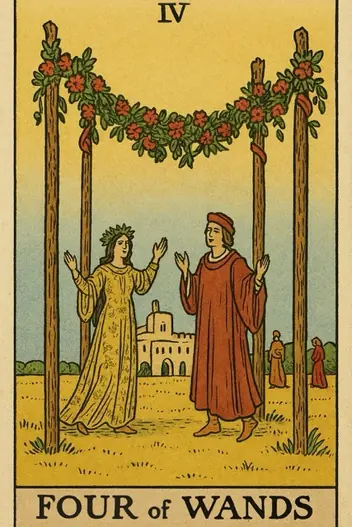
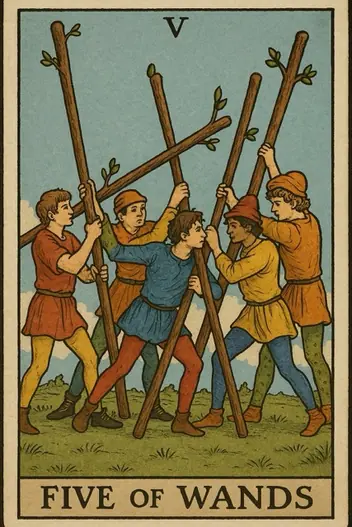
When the Four of Wands—a card of celebration, homecoming, and temporary peace—collides with the Five of Wands—a card of conflict, competition, and chaotic energy—you face a psychological paradox. You are standing at the threshold of a hard-won achievement, yet the ground beneath you feels unstable. This pairing forces you to confront a critical question: How do you protect your hard-earned stability when internal or external forces threaten to dismantle it?
Psychologically, this combination activates the tension between the archetype of the Guardian (who seeks to preserve harmony) and the archetype of the Warrior (who sees conflict as necessary for growth). You are not simply experiencing random discord; you are being asked to integrate both energies. The Four of Wands represents the finished structure—the team, the relationship, the career milestone. The Five of Wands represents the raw, unrefined friction that can either strengthen that structure or shatter it. Your task is to manage the friction without burning down the house.
Four of Wands and Five of Wands Card Meaning Explained
At its core, this combination signals a disruption of equilibrium. The Four of Wands promises a period of rest, social bonding, and mutual appreciation. Yet the Five of Wands arrives as an unwelcome guest, bringing arguments, rivalry, or a sudden loss of shared vision. The key insight here is that this conflict is often a symptom of unaddressed differences, not a failure of the foundation itself.
In practical terms, you might have just finished a major project, moved into a new home, or solidified a partnership, only to find that the very people you celebrated with now seem to be working against you. This is not a sign to abandon the structure. Instead, it is a signal that your group or relationship lacks a clear protocol for handling disagreement. The Five of Wands is chaotic because it has no rules—everyone is fighting for their own view without a referee. Your psychological challenge is to impose structure on the conflict, turning raw competition into productive negotiation.
The mindset required here is that of a diplomat who is also a realist. You must honor the achievement (Four of Wands) while acknowledging that the peace was, to some extent, a fragile truce. Do not mistake temporary harmony for permanent resolution. This pair demands that you actively maintain your boundaries and renegotiate terms before the conflict escalates into a full-blown crisis. It is a wake-up call to address the small disagreements you have been ignoring.
Your pair is already on the table. Ask your question and draw the clarifying card
or simply focus on it
Four of Wands and Five of Wands in Love and Relationships
If you are single:
This combination suggests you are drawn to someone who feels like a "homecoming" (stable, familiar, fun) but the relationship is already showing signs of competitive tension or power struggles. Do not ignore these early red flags. The Five of Wands here warns that unresolved differences will surface quickly. Use this friction as a data point: does the other person handle conflict with maturity, or do they escalate? Your next step is to test the relationship’s resilience, not just its comfort.
If you are in a relationship:
You and your partner may have recently celebrated a milestone (an anniversary, moving in together, a shared victory) only to find yourselves arguing over trivial matters. This is not a sign of a broken bond, but a sign that your communication style needs an upgrade. The Five of Wands indicates that you are both fighting to be "right" rather than fighting for the relationship’s health.
In a relationship context, the Four of Wands represents the shared foundation: trust, history, and mutual goals. The Five of Wands represents the individual egos pulling in different directions. The most common pitfall here is that one partner feels the need to "win" every argument, treating the relationship like a zero-sum game. This is a recipe for resentment. The pragmatic advice is to schedule a "conflict debrief" —a 15-minute weekly meeting where you both state one frustration and one appreciation. This transforms chaotic fighting into structured feedback.
Bold key relationship advice:
Do not avoid the conflict. The Five of Wands is actually a gift in disguise—it forces you to clarify your non-negotiables and to practice active listening. If you can navigate this tension without withdrawing or attacking, your relationship will emerge stronger and more authentic than before.
Get a personalized interpretation
Unlock the combined meaning of your cards in the context of your unique question — for free.
Four of Wands and Five of Wands in Career Readings
Strategic Opportunities:
This is an excellent time to renegotiate terms in a partnership or team project. The friction you feel is a sign that the current arrangement is unbalanced. Use the conflict as leverage to discuss roles, credit, and compensation.
Strategic Opportunities:
Consider pivoting from competition to collaboration. If you are in a competitive industry, look for ways to form an alliance with a rival. The Five of Wands energy can be channeled into a friendly rivalry that pushes both parties to perform better.
Calculated Risks:
Beware of over-committing to a group project that lacks clear leadership. The Five of Wands without structure leads to wasted time and resources. Do not invest more money or energy into a venture until roles and decision-making processes are clearly defined.
In a career reading, this combination often appears when you have just achieved a promotion, closed a deal, or launched a product, only to face internal team friction or a sudden market challenge. The warning here is clear: do not mistake past success for future security. The Four of Wands is a snapshot of a moment, not a permanent state. Financially, this pair advises against making large purchases or investments based on temporary euphoria. Instead, use this period to build a contingency fund or to diversify your income streams.
Bold financial warning:
The Five of Wands can signal a bidding war, a price undercutting situation, or a dispute over intellectual property. Protect your assets by getting everything in writing. If you are negotiating a salary or contract, be prepared for pushback. Hold your ground, but remain willing to compromise on non-essentials. The goal is to secure the foundation (Four of Wands) while managing the competitive noise (Five of Wands) without letting it derail your long-term plan.
When Four of Wands and Five of Wands Signal Trouble
The shadow manifestation of this pairing is defensive aggression or passive-aggressive withdrawal. When the Four of Wands energy is threatened, a common cognitive bias is the sunk cost fallacy: "I've invested so much in this relationship/project, I cannot afford to let it fail." This leads you to tolerate toxic conflict, hoping that the "good old days" will return. Conversely, the shadow of the Five of Wands is paranoid competition—seeing every colleague or partner as an enemy, turning a collaborative space into a battlefield.
Self-sabotage often looks like:
starting an argument right after a celebration, picking a fight with a supportive partner, or quitting a stable job because of one difficult conversation. The psychological trap is that you confuse the need for growth with the need for destruction. The Five of Wands is not asking you to burn the house down; it is asking you to remodel the living room. If you act impulsively, you will lose the very foundation you worked so hard to build.
Another pitfall is over-idealizing the past (the Four of Wands as a "perfect" moment) while demonizing the present (the Five of Wands as "all bad"). This binary thinking blocks your ability to see that the conflict is a natural part of any evolving system. The mature response is to hold both: appreciate what you have built, and accept that maintenance requires friction.
Four of Wands and Five of Wands Reversed: How to Read It
When cards are reversed, healthy dynamics are replaced by dysfunctional patterns. If the Four of Wands is reversed, it indicates blocked potential or recklessness. The stability you seek is unattainable due to external circumstances (a canceled wedding, a failed deal) or internal ones—you sabotage your own peace because you fear boredom. Advice: stop searching for the perfect home and start building a temporary shelter. Sometimes, the best is the enemy of the good.
If the Five of Wands is reversed, it signals internal resistance or weakness. Conflict is suppressed but not resolved. You avoid arguments, leading to passive aggression and a toxic atmosphere. Instead of fighting for your ideas, you withdraw into yourself. Warning: suppressed conflict destroys more deeply than open conflict. You need to find a safe way to express your disagreement, or the Four of Wands will collapse from within.
If BOTH cards are reversed, a complete imbalance of dynamics sets in. This is a state of "neither peace nor war." You can neither enjoy tranquility (the Four is inactive) nor engage in productive conflict (the Five is blocked). Apathy and a sense of meaninglessness arise. A logical way to correct this: forcibly create structure. You need to artificially introduce rituals (daily stand-up meetings, fixed time for hobbies) and artificially provoke discussions of problems. Only through action—even if artificial—will you break out of this stupor.
Four of Wands and Five of Wands: Tarot Advice
How can the energy of the Four of Wands be used constructively to balance the Five of Wands? The answer lies in the "Fortified Outpost" principle. Imagine the Four as your base, and the Five as scouts heading into battle. Your task is not to send all scouts into the attack, leaving the base undefended. Instead, you must use the energy of the Five for reconnaissance and establishing the boundaries of your territory.
This means that any conflict (Five) should end by strengthening your system (Four). You argue not for the sake of arguing, but to define the rules of the game more clearly. You compete not to destroy your opponent, but to prove the value of your shared "home." A deep strategic advice: turn your stability into a prize. If you have created something valuable (Four), make it the reward for the winner of the competition (Five). For example, in business—the best employee earns the right to a flexible schedule or the best office. In relationships—the partner who wins the argument chooses the movie for the evening. This way, you are not fighting against the system, but fighting for a place within it.
Ultimately, this combination teaches that true stability is not the absence of wind, but the skill to set the sails. The Five of Wands is the wind. Your task is not to close the windows, but to learn how to channel this wind into the sails of your Four. Only then can you move forward without losing your footing.
Where to Go From Here
The Four of Wands and Five of Wands combination is a powerful reminder that stability and conflict are not opposites; they are partners in growth. Your foundation is solid, but it needs active maintenance. The friction you feel is not a sign to abandon ship—it is a signal to refine your communication, set clearer boundaries, and renegotiate the terms of your agreements. This is a moment for strategic patience and emotional honesty. Do not let the chaos fool you into thinking the structure is weak; instead, use the chaos to identify the weak points and reinforce them.
While this article provides a general archetypal map, the true insight comes when you apply it to your unique life situation. To get a deep, personalized interpretation of this exact card combination for your specific question, use the Fortune Cards app. Available on the web or for download, it analyzes your context, your energy, and your question to deliver a reading that is tailored to you—not a generic prediction. Click here to start your personalized reading now.
Interpretation by the Fortune Cards editorial team, based on the Rider–Waite tradition and Jungian archetypes. About our methodology · Updated: 2026-08-26
Other Combinations with Four of Wands
Other Combinations with Five of Wands
Explore Individual Card Meanings
Table of Contents
- Four of Wands and Five of Wands Card Meaning Explained
- Four of Wands and Five of Wands in Love and Relationships
- Four of Wands and Five of Wands in Career Readings
- When Four of Wands and Five of Wands Signal Trouble
- Four of Wands and Five of Wands Reversed: How to Read It
- Four of Wands and Five of Wands: Tarot Advice
- Where to Go From Here
Ready to find answers to your questions?
Start your first reading now and look at your situation with fresh clarity. The cards are ready to reveal deeper meaning.