Four of Wands and Four of Swords Tarot as Feelings
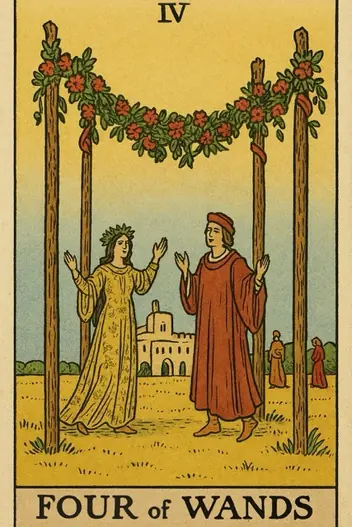

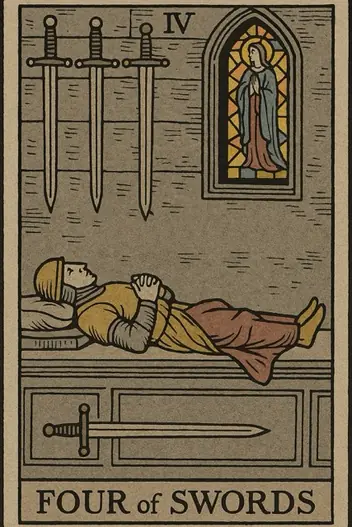
- Arcana
- Four of Wands — Minor Arcana, Wands; Four of Swords — Minor Arcana, Swords
- Elements
- Four of Wands — Fire; Four of Swords — Air
- Elemental interaction
- Friendly elements — energies support each other
- Numerology
- 4 + 4 = 8
The intersection of the Four of Wands and the Four of Swords creates a powerful psychological paradox: the need to stabilize and celebrate progress (Wands) collides with the equally urgent need to withdraw, rest, and mentally reset (Swords). In real life, this manifests as a moment where a major milestone—a completed project, a successful relationship phase, or a hard-won achievement—is immediately followed by an overwhelming sense of fatigue or a desire for solitude.
This combination often signals that the seeker has been running on adrenaline for too long. The Four of Wands represents the peak of social validation, homecoming, and temporary victory. The Four of Swords, however, acts as the psychological governor, forcing a slowdown to prevent burnout. The key insight here is that celebration without recovery leads to hollow success. The mind (Swords) demands a strategic retreat to solidify the gains made by the will (Wands).
Core Dynamics & Interpretation
When these two cards appear together, the primary psychological state is one of cognitive dissonance between external achievement and internal exhaustion. The Four of Wands energy pushes you to host the party, accept the applause, and solidify your community bonds. Yet the Four of Swords whispers that you are mentally depleted and need isolation to process what just happened. This is not a sign of failure; it is a sign of wise self-regulation.
The practical implication is that you must schedule a deliberate recovery period immediately after any significant milestone. The mind cannot sustainably operate at the high frequency of celebration and connection without a counterbalancing period of stillness. Think of this as the "cool-down" after a sprint. Without it, the risk of emotional burnout or decision fatigue increases dramatically. The archetype here is the Wise Caretaker—someone who knows that true sustainability requires honoring both the high of achievement and the low of necessary rest.
In terms of risk management, this pair warns against the "hangover" of over-commitment. If you ignore the Four of Swords' call for rest, the Four of Wands' stability will erode quickly. The most efficient path is to lean into the pause, not fight it. Use this time for journaling, light physical recovery, or simple, low-stimulation activities. The goal is to integrate the success before moving on to the next chapter.
Love and Relationships
If you are single:
This combination suggests that you may have recently emerged from a period of social success or dating activity. Do not force a new connection right now. Instead, use this time for self-reflection on what you truly want from a partner. The pause is not rejection; it is preparation for a more aligned match.
If you are in a relationship:
The dynamic here is about balancing shared joy with personal space. One partner may be craving quiet solitude while the other wants to celebrate or socialize. This is not a conflict of values but a mismatch in current energy levels.
The key relationship advice is to negotiate a "buffer zone" between social engagement and private time. For example, if you just hosted a family gathering (Four of Wands), schedule a quiet evening for just the two of you (Four of Swords) to decompress without pressure to perform. This prevents resentment and allows both partners to feel heard. For couples in conflict, this pair suggests that taking a 24-hour pause before a difficult conversation can lead to a more constructive outcome. The Four of Swords provides the clarity; the Four of Wands provides the safe foundation to return to.
Your pair is already on the table. Ask your question and draw the clarifying card
or simply focus on it
Career Meaning of Four of Wands and Four of Swords
Strategic Opportunities:
Use the downtime to audit your recent project for inefficiencies. The Four of Swords gives you the mental space to see what worked and what didn't, making your next move more precise.
Strategic Opportunities:
Leverage your recent success to negotiate better terms (e.g., a raise, a flexible schedule) but do so after a short break. Your confidence will be higher, and your arguments sharper.
Calculated Risks:
Avoid launching a new initiative or making a major purchase immediately. The combination warns that your judgment is clouded by either fatigue (Swords) or over-optimism (Wands). Wait at least one full business cycle before committing resources.
From a financial planning perspective, this is a "harvest and hibernate" phase. The Four of Wands indicates that your efforts have yielded a tangible reward—a bonus, a completed contract, a stable income stream. The Four of Swords advises you to protect that capital, rather than reinvesting it aggressively right now. The most pragmatic move is to build a cash reserve or pay down debt. In negotiations, do not accept counteroffers under time pressure. The best deals are made when you are mentally rested. If you are job searching, this pair suggests you may have received an offer (Wands) but need to take a few days to mentally evaluate it (Swords) before signing.
Your unique Tarot reading
See how these cards interact with your destiny. Start a free personal reading now.
Four of Wands and Four of Swords: Warning Signs
The shadow manifestation of this combination emerges when the seeker mistakes the need for rest for laziness or depression. The Four of Swords can become a trap of rumination if the mind is not consciously directed toward recovery. Instead of meditating or sleeping, the shadow self may engage in endless scrolling, worry loops, or avoidance of responsibilities. Simultaneously, the Four of Wands shadow can manifest as compulsive socializing or over-committing to maintain a facade of success, leading to burnout.
Another common cognitive bias here is the "all-or-nothing" fallacy: believing that you must either be fully "on" (celebrating, producing) or fully "off" (isolated, inactive). The truth is that a balanced integration of both states is more sustainable. Poor judgment occurs when the seeker pushes through the fatigue (ignoring the Swords) to chase the next high (Wands), leading to diminishing returns. Alternatively, the shadow of the Swords may cause the seeker to withdraw so deeply that they miss the genuine joy and support offered by the Four of Wands community. The risk is either over-exertion or under-connection.
Reversed Positions: What Changes?
When cards appear in a reversed position, the tension between archetypes intensifies, escalating into open conflict or dysfunction.
If the Four of Wands is reversed:
This indicates blocked potential or recklessness. You are either unable to solidify achieved success (a home is destroyed, a project fails due to negligence), or conversely, you are frantically trying to create an illusion of stability without a real foundation. Advice: acknowledge that the foundation is shaky and stop "painting the facade." Fix the roof first (solve the basic security problems).
If the Four of Swords is reversed:
A classic sign of inner resistance and mental insomnia. You cannot stop to rest. Thoughts prevent sleep, anxiety won't let you relax, even when you are physically safe. Warning: this state precedes nervous exhaustion. Urgently implement a regime of "digital detox" and physical release (sports, walks). Your mind demands an emergency pause.
If BOTH are reversed:
Complete imbalance of dynamics. This is chaos: you have simultaneously lost stability (the house is crumbling) and cannot find peace (you have no strength to restore it). The logical way to correct it: act on the principle of "put your own oxygen mask on first." Temporarily abandon attempts to control the external world (Wands) and focus on basic mental hygiene (sleep, food, minimal information). Only after restoring your inner foundation can you begin to clear the rubble outside.
Four of Wands and Four of Swords Combined Message
How can the energy of the Four of Wands be used constructively to balance or activate the Four of Swords? The answer lies in the concept of "conscious ritual." The Four of Swords is not an enemy of stability, but its necessary guardian. Your task is not to choose between celebration and solitude, but to learn to embed periods of recovery into the very structure of your success.
Strategic advice: create a "safety schedule." The Four of Wands gives you a home and community. Use the Four of Swords to define clear temporal boundaries where this home becomes inviolable. For example, "every Wednesday evening — no work calls or guests, only personal time." Or "the first week after a major project — a mandatory mini-vacation without discussing plans." This transforms chaotic anxiety (shadow Swords) into structured protection (conscious Swords).
Remember: true stability is not a static fortress, but a flexible ecosystem that knows how to recover from stress. The Four of Wands symbolizes roots, and the Four of Swords represents the ability of those roots to survive a drought. By integrating these energies, you cease to be a slave to your success and become its wise steward. You are not just building a home — you are creating a system that allows you to live in that home, not merely guard it.
Where to Go From Here
The Four of Wands and Four of Swords together deliver a clear, pragmatic message: you have earned the right to rest, but you must actively choose to take it. This is not a time for guilt or productivity anxiety. It is a time for intentional recovery to ensure your next chapter is built on a solid foundation. The core takeaway is that sustainable success requires honoring both the celebration of achievement and the necessity of mental stillness.
While this article provides the general archetype, the true magic happens when Tarot is applied to your unique situation. The meaning of this combination shifts dramatically depending on whether you are single, in conflict, or planning a career move. To get a deep, personalized interpretation of this exact combination for your specific question right now, use the Fortune Cards app. Available on the web or as a download, it analyzes your query with precision, helping you turn these archetypal insights into actionable, context-aware decisions.
Interpretation by the Fortune Cards editorial team, based on the Rider–Waite tradition and Jungian archetypes. About our methodology · Updated: 2026-08-26
Other Combinations with Four of Wands
Other Combinations with Four of Swords
Explore Individual Card Meanings
Ready to find answers to your questions?
Start your first reading now and look at your situation with fresh clarity. The cards are ready to reveal deeper meaning.