The Hanged Man and Knight of Pentacles Together in Tarot
- Arcana
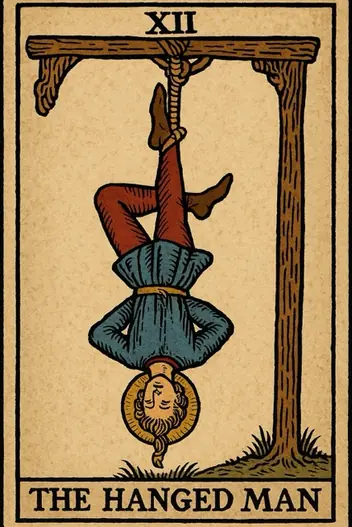
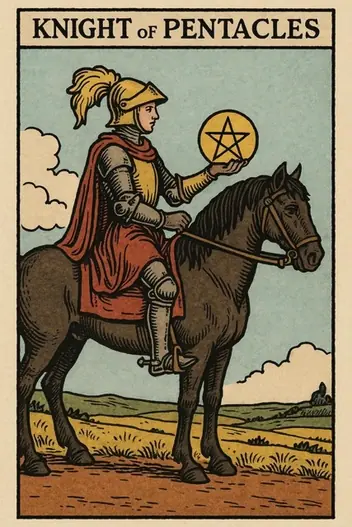
- The Hanged Man — Major Arcana; Knight of Pentacles — Minor Arcana, Pentacles
- Elements
- The Hanged Man — Water; Knight of Pentacles — Earth
- Elemental interaction
- Friendly elements — energies support each other
- Numerology
- 12 + 12 = 24 → 6
This combination represents a fascinating psychological tension: the suspension of action meets the slow, steady march of duty. When these two archetypes collide, the seeker is caught between a need for surrender and a compulsion to grind forward. The Hanged Man asks you to pause and see the world from a new angle, while the Knight of Pentacles demands you stay the course with disciplined effort. The result is a cognitive dissonance that can either paralyze you or forge a new, more mindful approach to productivity. In real life, this often manifests as a period where you feel stuck in a routine but know that pushing harder isn't the answer—yet stopping entirely feels irresponsible.
The psychological cost here is real: you may experience decision fatigue from trying to reconcile these opposing drives. The Knight’s fear of failure clashes with the Hanged Man’s acceptance of uncertainty. However, this tension is not a bug; it’s a feature. It forces you to redefine what “progress” actually means—shifting from external metrics of output to internal metrics of insight and alignment. The key is to recognize that this is not a call to do nothing, but a call to do differently.
What Do The Hanged Man and Knight of Pentacles Mean Together?
The core dynamic of The Hanged Man and Knight Of Pentacles is a paradox of movement: you are moving forward, but only after a necessary suspension of old habits. The Knight represents the ego’s drive for stability, routine, and tangible results—a methodical, almost stubborn, approach to life. The Hanged Man, however, represents the unconscious’s demand for a shift in perspective—a willingness to sacrifice the old self-image to gain wisdom. When these energies merge, the seeker is asked to hold two contradictory truths: that you must act with discipline, yet also surrender control over the outcome.
This creates a unique psychological state—a kind of “active patience.” You are not waiting passively; you are preparing the ground for a future shift. The Knight’s slow pace becomes a virtue, allowing you to observe patterns without rushing to judgment. The Hanged Man’s suspension becomes a strategic pause rather than a crisis. In practice, this means continuing your daily responsibilities (the Knight’s domain) while actively questioning your assumptions about what you’re doing and why (the Hanged Man’s domain). The most important insight here is that this combination rewards consistency, not urgency. It suggests that the best way to navigate a period of uncertainty is to keep showing up—but with a radically open mind.
Your pair is already on the table. Ask your question and draw the clarifying card
or simply focus on it
Love and Relationships
If you are single:
This combination suggests you should stop chasing and instead evaluate potential partners with a long-term, practical lens. The Knight’s patience is your ally: take time to observe consistency and reliability before committing emotionally. The Hanged Man warns against idealizing someone based on a single moment of connection.
If you are in a relationship:
You may be feeling a stagnation in the relationship’s growth, but this is a signal to redefine what growth looks like—not more excitement, but deeper trust and shared responsibility. The Knight’s loyalty meets the Hanged Man’s need for sacrifice; ask yourself what you are willing to let go of to improve the partnership.
In relationships, this card pair often points to a power struggle between routine and renewal. One partner may feel the relationship is “stuck in a rut” (the Hanged Man’s frustration), while the other insists on maintaining the status quo (the Knight’s resistance to change). The key psychological insight is that both are right. The solution is not to abandon the routine, but to infuse it with intentional pauses for reflection. Bold the following advice: Schedule a weekly, no-distraction conversation where you both share one thing you’re willing to sacrifice for the other’s well-being. This turns the Hanged Man’s sacrifice into a concrete, Knight-like action. Avoid blaming each other for the lack of progress; instead, acknowledge that the tension itself is a sign of commitment—you both care enough to feel the conflict.
Uncover hidden insights
Let our advanced Tarot system interpret these archetypes specifically for your personal path.
Career and Finances
Strategic Opportunities:
Double down on your current project, but only after auditing your methods. Use the Hanged Man’s perspective to identify inefficiencies in your workflow. The Knight’s consistency will pay off if you refine your process first.
Strategic Opportunities:
Seek mentorship or a second opinion. The Hanged Man’s suspension is ideal for learning from someone who has walked this path. The Knight’s discipline ensures you will implement what you learn.
Calculated Risks:
Do not make any major financial moves for at least 30 days. The Hanged Man warns against impulsive decisions, while the Knight’s slow pace protects you from market volatility. Bold this warning: The greatest financial risk now is mistaking activity for progress.
Professionally, this combination signals a period of slow, steady growth—not a breakthrough. The Knight of Pentacles is the archetype of the reliable worker, while The Hanged Man is the strategic thinker. Together, they demand that you stop trying to “hack” your way to success and instead embrace a methodical approach to problem-solving. Bold this strategic tip: Create a “pause protocol” in your workflow—every 2 hours, take 5 minutes to step back and ask, “Is this task aligned with my long-term goal?” This prevents burnout from the Knight’s grind and turns the Hanged Man’s suspension into a practical tool. Financially, this is a conservative, risk-averse energy. Avoid new investments, especially those promising quick returns. Instead, focus on paying down debt or building an emergency fund. The Hanged Man’s sacrifice here means letting go of the fantasy of a financial windfall and accepting the reality of incremental savings.
The Hanged Man and Knight of Pentacles: Warning Signs
When this energy is blocked, the seeker may fall into analysis paralysis—overthinking every decision to the point of inaction, while the Knight’s stubbornness turns into rigid resistance to change. This is the shadow of the Hanged Man: a martyr complex where you sacrifice your own needs for the sake of appearing committed. You might stay in a dead-end job or a draining relationship because the Knight’s loyalty has become codependency. The cognitive bias at play is sunk cost fallacy—you continue investing time and energy because you’ve already invested so much, ignoring the Hanged Man’s call to release what no longer serves you.
Another pitfall is passive-aggressive behavior: you outwardly comply with routines (the Knight) but inwardly resent them (the Hanged Man). This leads to resentment and burnout because you are not honestly expressing your need for a perspective shift. Bold this warning: If you feel a growing sense of “going through the motions,” you are likely in the shadow of this combination. The solution is to schedule a real pause—a day or even a week away from your routine—to consciously evaluate whether your current path aligns with your values. The Knight’s discipline can be your ally here: use it to commit to a period of reflection as if it were a work project. Without this, you risk self-sabotage by quitting suddenly or making a reckless change out of frustration.
Reversed Positions: What Changes?
When cards appear reversed, the constructive pause transforms into a destructive stupor or reckless haste.
If The Hanged Man is reversed (upside down):
Voluntary waiting turns into meaningless resistance. You stubbornly refuse to stop, even though every signal points to the need for a pause. This is a path to burnout and financial loss. Advice: Take a pause now, before it becomes forced by illness or crisis.
If the Knight of Pentacles is reversed (upside down):
Methodicalness disappears, giving way to chaotic activity or laziness. You either grab at everything at once or fall into apathy, losing focus. Advice: Return to basic rituals — a daily plan, clear deadlines, minimalism in tasks.
If BOTH are reversed:
Complete imbalance — you are simultaneously stuck and rushing about. This is a state of "Brownian motion" without progress. Advice: The only way out is external discipline. Hire a coach, ask a friend to hold you accountable, or set up strict time management for a month.
Synthesis: Strategic Conclusion
Constructive use of this combination requires paradoxical thinking. The energy of The Hanged Man should be directed not at slowing down the Knight, but at calibrating his goals. Imagine you are a sniper. The Hanged Man is the time spent holding your breath and taking aim. The Knight of Pentacles is the smooth squeeze of the trigger. Without the first, the shot will be inaccurate. Without the second, you will never fire.
Your strategy for the near future: active waiting. This means you are not simply sitting idle. You are:
- Gathering intelligence — analyzing competitors, your partner's behavior, market trends.
- Fortifying your rear — putting your finances, documents, and resources in order.
- Testing hypotheses with minimal effort — conducting surveys, making prototypes, but not launching full-scale projects.
A deep strategic counsel: set an "activation" date 3-6 months from now. This will transform the pause from an indefinite one into a limited one, alleviating anxiety and giving the Knight of Pentacles a clear planning horizon. Until that date, you are an observer and analyst. After it, you are the executor.
Your Next Step: Personal Context Matters
The core message of The Hanged Man and Knight Of Pentacles is that true progress often looks like standing still. This combination asks you to trust the slow, methodical path while remaining open to a fundamental shift in how you see your situation. It is not a call to stop, but a call to move with intention, not urgency. By honoring both the Knight’s discipline and the Hanged Man’s willingness to surrender, you can transform a period of stagnation into a strategic foundation for lasting change.
While this article provides a deep, archetypal analysis, the real power of Tarot lies in its application to your specific life. The same cards can mean very different things depending on your unique question, relationship dynamics, and career context. To get a personalized, actionable interpretation of The Hanged Man and Knight Of Pentacles for your exact situation right now, use the Fortune Cards app. You can access it on the web or download it to receive a deep, tailored reading that accounts for your unique circumstances—turning these ancient archetypes into a practical roadmap for your next step.
Interpretation by the Fortune Cards editorial team, based on the Rider–Waite tradition and Jungian archetypes. About our methodology · Updated: 2026-08-26
Other Combinations with The Hanged Man
Other Combinations with Knight of Pentacles
Explore Individual Card Meanings
Ready to find answers to your questions?
Start your first reading now and look at your situation with fresh clarity. The cards are ready to reveal deeper meaning.