Love Tarot: Justice and The Hanged Man
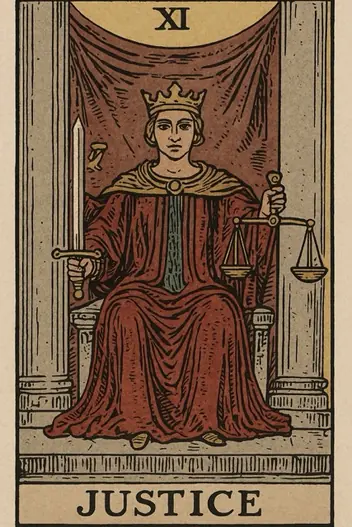
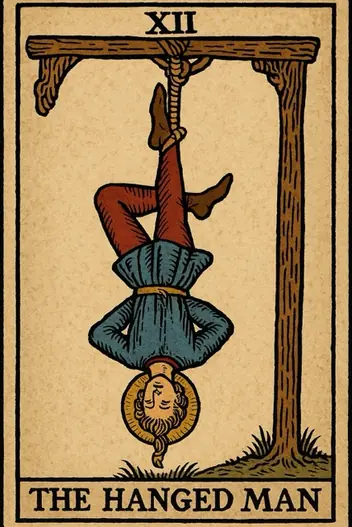
- Arcana
- Justice — Major Arcana; The Hanged Man — Major Arcana
- Elements
- Justice — Air; The Hanged Man — Water
- Elemental interaction
- Neutral elements — energies coexist without conflict
- Numerology
- 11 + 12 = 23 → 5
When the archetype of Justice—rooted in logic, accountability, and cause-and-effect—collides with The Hanged Man—a symbol of suspension, sacrifice, and reversed perspective—the result is a profound psychological paradox. You are asked to hold two contradictory truths at once: that actions have consequences, yet that some outcomes require you to stop fighting and simply wait.
This combination often appears when you have made a difficult decision, but the results are not yet visible. You may feel trapped between the need to enforce a boundary (Justice) and the need to surrender control (The Hanged Man). In Jungian terms, this is an integration of the thinking function with the introverted feeling function—a call to align your ethical framework with a deeper, often uncomfortable, patience. The tension between these cards is not a flaw; it is the engine of real transformation.
Justice and The Hanged Man Combination Meaning
The central psychological dynamic here is the tension between judgment and surrender. Justice represents the conscious mind’s need for fairness, balance, and rational evaluation. The Hanged Man represents the unconscious process of letting go, of seeing from a different vantage point, and of accepting that some outcomes cannot be forced. When these cards appear together, they signal a period where action and non-action must coexist strategically.
In practice, this means you are likely facing a situation where you have already done the right thing—you have assessed the facts, made a decision, or spoken your truth. Yet the result is not immediate. The Hanged Man warns that forcing a resolution now will disrupt the natural ethical balance that Justice is trying to create. You must trust that the system (legal, relational, or personal) is working, even when it appears stalled. The key insight is that waiting is not passive; it is an active form of discernment. You are not stuck—you are in a necessary liminal space where new information will emerge.
The practical implication is clear: do not rush to judgment about the judgment itself. If you feel you have been treated unfairly, the Hanged Man suggests that a change in perspective—not a change in action—is what is needed. If you are waiting for a verdict or outcome, Justice assures you that the truth will surface, but The Hanged Man reminds you that truth often requires a sacrifice of your timeline. This combination is a masterclass in emotional regulation under uncertainty.
Love and Relationships
If you are single:
This pair suggests you must stop chasing closure from a past relationship or a potential partner who is inconsistent. Instead, pause and observe the pattern of fairness in how they treat you. The right connection will not require you to suspend your self-respect.
If you are in a relationship:
You may be in a phase where one partner feels they have sacrificed more (The Hanged Man) while the other insists on equal accountability (Justice). The solution is not to keep score, but to redefine what “fair” means in your shared context.
In relationships, Justice and The Hanged Man often point to a power imbalance that needs to be acknowledged, not resolved overnight. The partner embodying Justice may feel they are upholding standards, while the partner embodying The Hanged Man may feel unfairly punished. The key relationship advice here is to separate the act of accountability from the act of punishment. If you are the one waiting for an apology or change from your partner, The Hanged Man warns that demanding it immediately will backfire. Instead, use this time to clarify your own boundaries (Justice) while allowing space for your partner to arrive at their own understanding (The Hanged Man). This is not about winning; it is about allowing the relationship to evolve through mutual respect for each other’s timing.
Your pair is already on the table. Ask your question and draw the clarifying card
or simply focus on it
Career Meaning of Justice and The Hanged Man
Strategic Opportunities:
Use this period to audit your professional ethics—review contracts, reassess partnerships, and ensure your work aligns with your values. The pause is perfect for legal or compliance checks.
Strategic Opportunities:
Consider taking a temporary step back from a leadership role or high-stakes project. This suspension can reveal hidden inefficiencies or untapped resources that you missed while pushing forward.
Calculated Risks:
Avoid making major financial commitments or signing long-term agreements until the current situation resolves. The Hanged Man warns that what looks like a sacrifice now may be a necessary cost to avoid a larger loss.
Professionally, this combination demands a strategic pause in decision-making. If you are in a legal dispute, a negotiation, or a career transition, Justice assures you that the facts will support you—but The Hanged Man warns that rushing the timeline will undermine your position. The most financially prudent move is to gather more data and resist the urge to “fix” the situation through force. If you feel undervalued at work, this is not the moment to demand a raise or threaten to leave. Instead, document your contributions (Justice) and observe how the organization responds to your quiet competence (The Hanged Man). This combination often precedes a breakthrough where your worth is recognized without you having to argue for it.
Get a personalized interpretation
Unlock the combined meaning of your cards in the context of your unique question — for free.
Reversed Positions: What Changes?
When cards appear in a reversed position, the constructive dynamic collapses, exposing destructive patterns.
If Justice is reversed:
This points to blocked potential due to a denial of responsibility. You are either blaming everyone around you or refusing to see objective facts. Combined with the upright Hanged Man, this creates a dangerous illusion of "undeserved suffering." Advice: stop looking for someone to blame. Acknowledge that your current pause is the result of your own decisions, even if they seem unfair. Without this, you will never emerge from the crisis.
If the Hanged Man is reversed:
This is a signal of inner resistance and recklessness. You are refusing to take the necessary pause, trying to force your way through the wall. Combined with upright Justice, this suggests that your sense of righteousness is blinding you. You are ready to destroy everything for a victory that isn't worth the effort. Warning: your stubbornness will lead to irreversible losses. Slow down.
If BOTH are reversed:
This is a complete imbalance of the dynamic. A chaotic situation where there is neither objective assessment nor the capacity for acceptance. The person oscillates between aggression and apathy. The logical way to correct this: return to basics. Temporarily turn off your emotions and compile a dry list of facts (what happened, what you can control). This is the only way to "reset" the system.
Justice and The Hanged Man: Warning Signs
When the energy of Justice and The Hanged Man is blocked or misapplied, the shadow manifests as passive-aggressive resentment or rigid martyrdom. You may convince yourself that you are being “patient” when you are actually avoiding a necessary confrontation. The cognitive bias here is moral licensing: you believe that because you have sacrificed or waited, you are entitled to a specific outcome. This leads to bitterness when the universe does not deliver on your timeline.
Alternatively, you may fall into analysis paralysis—endlessly weighing pros and cons (Justice) without ever taking the suspended perspective (The Hanged Man) that would reveal a simple solution. The shadow side of this pair is the belief that fairness means you must suffer. If you find yourself repeatedly in situations where you feel used or overlooked, check whether you are using “waiting” as an excuse to avoid setting firm boundaries. True Justice does not require martyrdom; it requires clarity. And true surrender does not mean passivity; it means active trust.
What Is the Overall Message of Justice and The Hanged Man?
How can one constructively use the energy of Justice to balance the Hanged Man? The answer lies in creating a ritual of "conscious choice." You cannot avoid the pause, but you can transform it from passive suffering into active observation. Justice provides the framework: "I know why I am here." The Hanged Man provides the method: "I look at this from another perspective." Your task is to connect these two processes.
A deep strategic counsel: embrace the concept of the "price of admission." Any meaningful change requires sacrifice. Justice tells you what the price is. The Hanged Man says you must pay it. Do not try to bargain or cheat the system. If you feel stuck, ask yourself: "What illusion or habit must I relinquish for the situation to move from deadlock?" The answer to this question is your next step. This is not magic; it is pure psychology of cause and effect. You are not waiting for the Universe to change; you are changing yourself to align with new conditions.
Where to Go From Here
The core message of Justice and The Hanged Man is this: you have done the right thing; now let time do its work. Your task is not to force a resolution, but to hold the tension between accountability and surrender. The facts will surface, the balance will be restored, but only if you stop trying to control the outcome.
This article provides the general archetype, but the true power of Tarot lies in how these cards apply to your unique situation. Do you need to wait, or do you need to act? Is your sacrifice noble or self-defeating? The Fortune Cards app gives you a deep, personalized interpretation of this exact combination for your specific question right now. Use it on the web or download it to get the clarity you need—no fluff, just the psychological and strategic insight that aligns with your life.
Interpretation by the Fortune Cards editorial team, based on the Rider–Waite tradition and Jungian archetypes. About our methodology · Updated: 2026-08-26
Other Combinations with Justice
Other Combinations with The Hanged Man
Explore Individual Card Meanings
Table of Contents
Ready to find answers to your questions?
Start your first reading now and look at your situation with fresh clarity. The cards are ready to reveal deeper meaning.