King of Cups and Two of Swords Tarot Combination
- Arcana
- King of Cups — Minor Arcana, Cups; Two of Swords — Minor Arcana, Swords
- Elements
- King of Cups — Water; Two of Swords — Air
- Elemental interaction
- Neutral elements — energies coexist without conflict
- Numerology
- 14 + 2 = 16 → 7
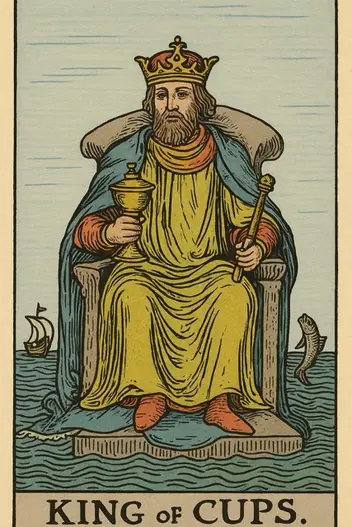
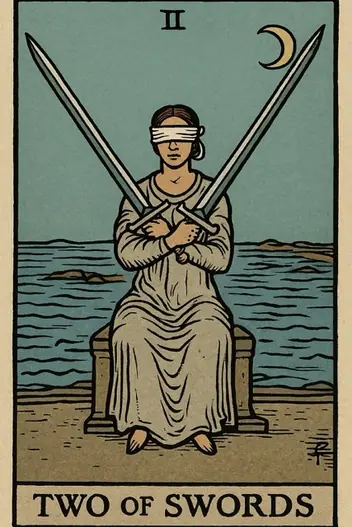
This pairing represents a critical tension between deep emotional intelligence and strategic indecision. The King of Cups embodies mature, controlled emotional mastery—the ability to navigate feelings without being overwhelmed. The Two of Swords introduces a state of deliberate blindness, where the seeker refuses to see a truth that would force a difficult choice. Together, they describe a person who feels deeply but is actively avoiding the emotional confrontation needed to move forward.
The psychological intersection here is fascinating: you possess the emotional tools to handle conflict, yet you are choosing to keep your eyes closed. This is not a lack of capability, but a strategic avoidance of responsibility. The King’s calm exterior masks an internal stalemate, where the mind and heart are locked in a cold war. The question becomes: will you use your emotional maturity to finally cut the blindfold, or will you remain paralyzed by the fear of what you might see?
King of Cups and Two of Swords Card Meaning Explained
The core dynamic is a paradox of control. The King of Cups represents the highest form of emotional regulation—he can feel anger, sadness, or passion without acting on impulse. The Two of Swords, however, suggests that this control has become a defense mechanism. You are not just calm; you are willfully detached from a situation that requires a verdict. This creates a psychological state of managed denial: you know something is wrong, but you have constructed a rational argument to avoid addressing it.
In practical terms, this combination often appears when a person is sitting on a decision that affects their emotional life. They have the insight to understand the stakes, but they refuse to look at the evidence. This is not ignorance—it is a cognitive choice to remain in a holding pattern. The risk here is that prolonged avoidance erodes the very emotional authority the King represents. If you do not use your power to decide, you will lose the trust of those who rely on your judgment.
The real-world implication is clear: you must acknowledge that emotional intelligence without action is a form of cowardice. The King of Cups does not sit on the throne by avoiding problems; he governs by facing them with composure. The Two of Swords demands that you lower your guard and look at the truth, even if it hurts. Your task is to bridge the gap between feeling and acting, using your emotional resources to make a choice rather than to avoid one.
Your pair is already on the table. Ask your question and draw the clarifying card
or simply focus on it
King of Cups and Two of Swords for Career and Money
Strategic Opportunities:
Use your emotional intelligence to read the room in negotiations. You can sense what others are feeling, which gives you leverage if you act on that insight rather than just observing.
Strategic Opportunities:
Consider a role that requires conflict resolution or crisis management. Your ability to stay calm under pressure is a rare asset—the Two of Swords warns you not to waste it by avoiding necessary confrontations.
Calculated Risks:
Do not accept a "wait and see" approach. The Two of Swords is a warning that indecision is a decision. If you are delaying a financial choice or a career move, you are losing momentum and credibility.
In professional life, this combination signals a leadership dilemma. You have the emotional bandwidth to manage a team, handle a difficult client, or navigate a merger. But the Two of Swords suggests you are withholding a crucial decision because you are afraid of the fallout. Perhaps you know a project is failing, or a colleague is underperforming, but you are hoping the problem will resolve itself. It will not.
Important financial warning in bold: Do not invest or make a major financial commitment while this energy is present. The Two of Swords indicates a blind spot—you may be ignoring data or advice that contradicts your preferred outcome. The King of Cups gives you the composure to wait, but the Two of Swords warns that waiting without information is gambling. Instead, gather all facts, seek an outside perspective, and then make the decision. Your emotional control is your strength, but only if it leads to action, not paralysis.
Get a personalized interpretation
Unlock the combined meaning of your cards in the context of your unique question — for free.
King of Cups and Two of Swords Love Outcome
If you are single:
This pair suggests you are evaluating a potential partner from a safe distance, but you are ignoring red flags or your own true feelings. You may be overly rationalizing why you should or shouldn't pursue someone, when the real issue is a fear of emotional vulnerability.
If you are in a relationship:
You and your partner may be stuck in a silent standoff where both of you are emotionally present but refuse to discuss the core issue. There is a power imbalance where one person is controlling the emotional temperature, and the other is too afraid to break the silence.
The relationship dynamic here is a test of emotional honesty. The King of Cups offers the capacity for deep empathy, but the Two of Swords indicates that this empathy is being used to maintain a façade of peace rather than to resolve conflict. You may be protecting your partner from your true feelings—or protecting yourself from their reaction. This is a recipe for emotional stagnation.
Key relationship advice in bold:
You must stop protecting the status quo and start having the difficult conversation. The King’s emotional maturity is wasted if it only serves to keep the boat steady while the hull is leaking. If you are single, ask yourself: are you avoiding this person because you actually don't want them, or because you are afraid of wanting them too much? If you are in a relationship, schedule a time to talk without distractions—the blindfold must come off, even if the truth is uncomfortable.
King of Cups and Two of Swords Reversed Meaning
If the King of Cups is reversed, emotional intelligence turns into its shadow: manipulation and emotional blackmail. The person uses their knowledge of others' feelings for control, not support. Paired with the Two of Swords, this creates a dangerous dynamic where the victim is deliberately kept in a state of ignorance. You urgently need to check if you are using your empathy as a weapon.
If the Two of Swords is reversed, internal resistance gives way to an impulsive, ill-considered decision. You tear off the blindfold in panic and make a choice you will regret. The King of Cups in this position should act as an anchor: slow down the process and restore awareness. Key advice: do not make decisions in a state of emotional breakdown.
If both cards are reversed, a complete imbalance arises: emotional incompetence meets chaotic choice. This is a scenario where a person neither understands their own feelings nor acts with regard to consequences. The only logical way to correct this is external consultation (therapist, mentor, coach). You cannot handle this on your own.
Negative Meaning of King of Cups and Two of Swords
The shadow manifestation of this combination is emotional manipulation disguised as diplomacy. The King of Cups can become a passive-aggressive tyrant who uses his calm demeanor to control others without taking responsibility. The Two of Swords amplifies this by enabling gaslighting—you may convince yourself (and others) that the problem doesn't exist, when in reality you are avoiding accountability.
The cognitive bias at play is the ostrich effect: the tendency to avoid negative information. You are burying your head in the sand, but unlike the fable, you are fully aware of the danger. This leads to self-sabotage where your emotional maturity becomes a tool for denial rather than resolution. You might tell yourself you are "being patient" or "staying objective," when in truth you are terrified of the emotional cost of a decision.
Another pitfall is burnout from emotional labor. The King of Cups is constantly managing feelings—his own and others’. When combined with the Two of Swords’ stalemate, you may be exhausting yourself by maintaining a false equilibrium. You are the only one holding up the walls of this emotional fortress, and they are starting to crack. The shadow warns that if you do not release the pressure, you will either explode or collapse. Acknowledge the cost of your silence.
King of Cups and Two of Swords: The Combined Message
Constructive use of this energy requires a conscious step: transforming empathy from a defense into a tool for breakthrough. The King of Cups must cease being the "keeper of peace" and become the "guide through the storm." His task is not to calm the waves, but to help the ship navigate through them intact.
Strategically, you need to do three things. First, acknowledge that avoidance is also a decision, and often the worst possible one. Second, use emotional intelligence to gather data, not to filter it. Ask yourself: "What do I not want to see? Why am I afraid of this choice?" Third, set a deadline for making a decision. Without an external constraint, the Two of Swords can keep you in limbo for years.
A deep strategic counsel: apply the "worst-case scenario" method. The King of Cups, with his capacity for empathy, can envision what all participants will feel after each possible decision. The Two of Swords must remove its blindfold and look at these scenarios. Often, it turns out that the most terrifying outcome is not a choice, but its absence. Your strength lies not in avoiding pain, but in choosing which pain you are willing to accept for the sake of growth.
Where to Go From Here
The core message of the King of Cups and Two of Swords is that emotional mastery without decisive action is hollow. You have the capacity to handle the truth, but you must first be willing to see it. This combination is a call to stop protecting your comfort zone and start using your emotional intelligence to make a choice—even if it is a difficult one. The blindfold will not fall on its own; you must cut it.
To truly understand what this means for your unique situation, you need a reading that considers your personal context, history, and specific question. General interpretations are a map, but your life is the terrain. Take the next step by using the Fortune Cards app—available on the web or for download. Get a deep, personalized interpretation of this exact combination for your specific question right now. Turn insight into action.
Interpretation by the Fortune Cards editorial team, based on the Rider–Waite tradition and Jungian archetypes. About our methodology · Updated: 2026-08-26
Other Combinations with King of Cups
Other Combinations with Two of Swords
Explore Individual Card Meanings
Table of Contents
- King of Cups and Two of Swords Card Meaning Explained
- King of Cups and Two of Swords for Career and Money
- King of Cups and Two of Swords Love Outcome
- King of Cups and Two of Swords Reversed Meaning
- Negative Meaning of King of Cups and Two of Swords
- King of Cups and Two of Swords: The Combined Message
- Where to Go From Here
Ready to find answers to your questions?
Start your first reading now and look at your situation with fresh clarity. The cards are ready to reveal deeper meaning.