Knight of Cups and Five of Swords Meaning in Tarot

- Arcana
- Knight of Cups — Minor Arcana, Cups; Five of Swords — Minor Arcana, Swords
- Elements
- Knight of Cups — Water; Five of Swords — Air
- Elemental interaction
- Neutral elements — energies coexist without conflict
- Numerology
- 12 + 5 = 17 → 8
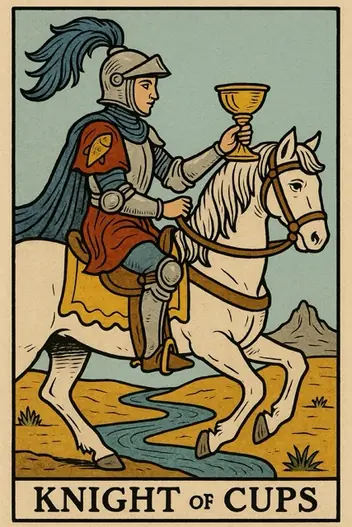
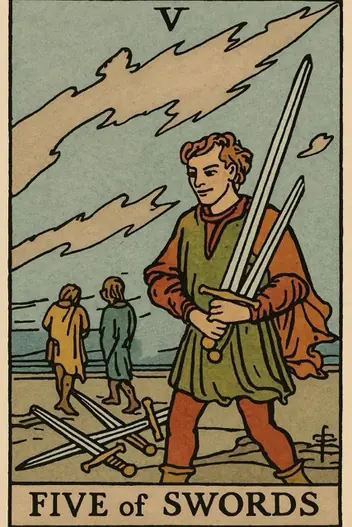
The Knight of Cups embodies the romantic idealist—driven by emotion, creative vision, and a deep desire to connect. The Five of Swords represents cold conflict, hollow victory, and the aftermath of a battle where no one truly wins. When these two cards appear together, we witness a collision between heartfelt aspiration and pragmatic defeat. The dreamer enters the fray, only to discover that winning the argument may cost them the relationship.
Psychologically, this combination signals a critical moment of cognitive dissonance: the Knight’s emotional integrity clashes with the Five’s cynical reality. You may feel torn between fighting for what you believe in and recognizing that some fights are self-destructive. The key insight here is that your emotional investment does not guarantee a favorable outcome. The cards ask you to evaluate whether your passion is fueling a noble quest or merely feeding an ego-driven conflict.
Knight of Cups and Five of Swords Together: Meaning
This pairing creates a psychological state of strategic vulnerability. The Knight of Cups brings a willingness to take emotional risks, often rushing into situations with a romanticized vision. The Five of Swords then forces a harsh reality check: someone will lose, and it might be you—or worse, you might “win” at the cost of your integrity. The core dynamic is a battle between heart-driven action and cold calculation.
In real-world terms, this manifests as a scenario where you feel compelled to defend your ideals, but the tactics required to win are morally uncomfortable. You might be tempted to manipulate, withdraw emotionally, or engage in passive-aggressive behavior to “win” a point. The psychological trap is believing that victory in a conflict will validate your emotional investment. Instead, the cards suggest that the most strategic move is often to disengage—preserving your energy for battles that align with your deeper values.
The archetypal tension here is between the Lover (Knight of Cups) and the Warrior (Five of Swords) . Neither is inherently wrong, but without integration, they create a cycle of emotional burnout. The wise path is to recognize when your idealism is being weaponized against you, and to set boundaries that protect your emotional capital rather than squandering it on pyrrhic victories.
Knight of Cups and Five of Swords: Career and Money
Strategic Opportunities:
Use your emotional intelligence to de-escalate office politics; position yourself as the mediator who values resolution over victory.
Strategic Opportunities:
Channel the Knight’s creativity into a project that requires diplomacy, such as negotiating a partnership or pitching a vision to skeptical stakeholders.
Calculated Risks:
Avoid engaging in public disputes or email chains where winning a point could damage your professional reputation.
In the workplace, this combination signals a high-stakes interpersonal conflict that could derail your career if mishandled. The Knight of Cups wants to build bridges and inspire others; the Five of Swords warns that some colleagues are not interested in collaboration—they want to win at your expense. Important financial warning in bold: Do not sign contracts or make major financial commitments while this energy is active. The emotional charge of the Knight can lead to impulsive decisions, while the Five’s competitive edge may cause you to overlook hidden costs or unfavorable terms.
Strategic tip:
Treat this as a negotiation simulation. Before any meeting, write down your ideal outcome, your walk-away point, and the emotional triggers you must avoid. The goal is not to defeat the other party, but to protect your resources and reputation while maintaining your integrity. If you feel the urge to “prove” something, step back and ask: “Is this battle worth my energy, or is it a distraction from my long-term goals?”
Your pair is already on the table. Ask your question and draw the clarifying card
or simply focus on it
Knight of Cups and Five of Swords Love Outcome
If you are single:
This combination warns against pursuing someone who is emotionally unavailable or caught in a power struggle with an ex. Your romantic idealism may blind you to red flags of manipulation or unresolved conflict.
If you are in a relationship:
You are likely in a cycle of arguments where one partner “wins” but the relationship loses. The Knight’s desire for connection is being undermined by the Five’s need to be right.
The relationship dynamics here reveal a toxic pattern of emotional escalation. One partner may be playing the role of the wounded romantic, while the other adopts a defensive, combative stance. The core issue is not the content of the argument, but the underlying need for validation. The Knight of Cups wants to be seen as caring and noble; the Five of Swords wants to be seen as strong and correct. Neither is listening.
Key relationship advice in bold:
Stop trying to prove your love through conflict. Instead, create space for genuine vulnerability. If you feel the urge to “win” an argument, ask yourself: “Will being right bring me closer to my partner, or drive us further apart?” In many cases, the most loving act is to lay down your sword and simply say, ‘I hear you.’ This combination often signals a need to reset the emotional baseline—perhaps through a structured conversation where each partner speaks without interruption for five minutes.
The Shadow Side of Knight of Cups and Five of Swords
The shadow of this combination manifests as emotional manipulation disguised as vulnerability. You may find yourself playing the victim to gain sympathy, then using that sympathy to win arguments. This is a classic cognitive bias called ‘moral licensing’ —believing that because your intentions are pure, your actions are justified. In reality, you are using your emotional capital as a weapon.
Another pitfall is self-sabotage through over-idealization. The Knight of Cups may convince you that a toxic relationship or career situation is “meant to be” because it feels passionate. The Five of Swords then delivers the painful lesson: passion without boundaries is just chaos. You may stay in a losing battle long after it’s clear you should walk away, simply because you’ve invested too much emotionally to admit defeat.
The most dangerous cognitive bias here is the sunk cost fallacy—the belief that because you’ve already given so much, you must continue fighting. This combination demands that you objectively assess whether your current path is leading to growth or just more pain. If you feel a knot in your stomach when you think about this situation, that is your psyche’s warning signal. Listen to it.
Deepen your understanding
Find out exactly what this reading means for your current life situation with our oracle.
Knight of Cups and Five of Swords Reversed: How to Read It
Reversed Knight of Cups:
Emotional potential is blocked. You cannot express your feelings, or your romantic impulse turns into recklessness and jealousy. Combined with the upright Five of Swords, this creates an explosive mixture: passive aggression, resentment, and a desire to punish your partner. Advice: Don't try to "negotiate" — first, restore emotional contact with yourself.
Reversed Five of Swords:
Aggression retreats into the shadows. This can be internal resistance or guilt over your own harshness. You lost the "war" before it even began, surrendering without a fight. Paired with the upright Knight of Cups, this looks like "rescuing": you allow yourself to be used, thinking it is noble. Warning: This is a path to burnout.
Both Reversed:
Complete imbalance. The Knight of Cups loses touch with reality (illusions, false hopes), while the Five of Swords loses the will to win (apathy, depression). Logical way to correct: Focus on basic needs (food, sleep, safety). No strategies or romance until baseline energy is restored.
Overall Meaning of Knight of Cups and Five of Swords
How can the energy of the Knight of Cups be used constructively to balance the Five of Swords? The key lies in a conscious shift of context. The Knight of Cups is your "emotional radar" and capacity for empathy. The Five of Swords is your "will" and ability to defend. Instead of suppressing one in favor of the other, learn to use them as two distinct tools.
Here is the strategy: before entering a "battle" (an important conversation, negotiation, or competitive struggle), use the Knight of Cups for diagnosis. Understand the true motives of the other party. What drives them? Fear? Greed? A desire for recognition? Once you have obtained this information, activate the Five of Swords for execution. At this stage, there is no room for sentimentality. You act clearly, coolly, and according to plan.
Your strength lies not in being "good" or "evil." Your strength lies in flexibility. The ability to be tough when necessary and empathetic when appropriate is a sign of high psychological maturity. Remember: your goal is not to destroy your opponent, but to preserve your resources and achieve your objectives with minimal losses. The Knight of Cups provides you with vision; the Five of Swords provides the tool for its realization. Do not let one subjugate the other.
Where to Go From Here
The Knight of Cups and Five of Swords together deliver a clear message: your emotional investment does not guarantee a favorable outcome. The wisest move is often to disengage from conflicts that drain your spirit, even if you are “right.” Protect your emotional energy as you would a financial asset—spend it only on battles that align with your deepest values. This combination challenges you to distinguish between genuine passion and ego-driven obsession.
While this article provides the general archetype, the true magic happens when Tarot is applied to your unique situation. Your specific question, relationship history, and career context will shift the meaning in subtle but crucial ways. Use the Fortune Cards app to get a deep, personalized interpretation of this exact combination for your specific question right now. Available on the web or as a download, it will guide you through the psychological nuances that a generic reading cannot capture. Your next step is to take this insight and apply it with precision—starting today.
Interpretation by the Fortune Cards editorial team, based on the Rider–Waite tradition and Jungian archetypes. About our methodology · Updated: 2026-08-26
Other Combinations with Knight of Cups
Other Combinations with Five of Swords
Explore Individual Card Meanings
Table of Contents
- Knight of Cups and Five of Swords Together: Meaning
- Knight of Cups and Five of Swords: Career and Money
- Knight of Cups and Five of Swords Love Outcome
- The Shadow Side of Knight of Cups and Five of Swords
- Knight of Cups and Five of Swords Reversed: How to Read It
- Overall Meaning of Knight of Cups and Five of Swords
- Where to Go From Here
Ready to find answers to your questions?
Start your first reading now and look at your situation with fresh clarity. The cards are ready to reveal deeper meaning.