Knight of Cups and Four of Pentacles Together in Tarot

- Arcana
- Knight of Cups — Minor Arcana, Cups; Four of Pentacles — Minor Arcana, Pentacles
- Elements
- Knight of Cups — Water; Four of Pentacles — Earth
- Elemental interaction
- Friendly elements — energies support each other
- Numerology
- 12 + 4 = 16 → 7
This pair represents a classic psychological tension between the desire to give emotionally (Knight of Cups) and the need to protect one's resources, time, or self-esteem (Four of Pentacles). In Jungian terms, we see the Anima (emotional openness) clashing with the Shadow of scarcity—the fear that giving too much will leave you empty.
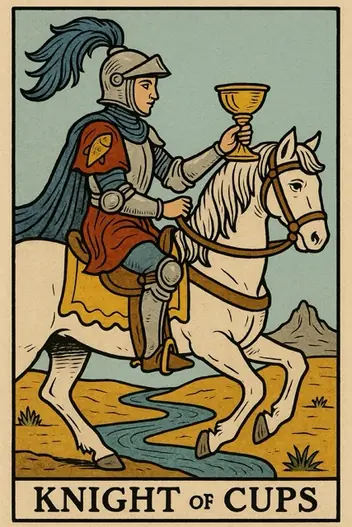
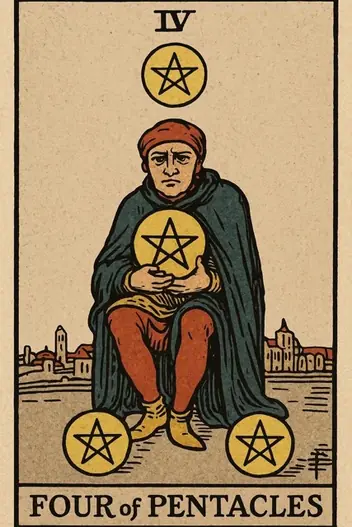
When these cards appear together, the seeker is often caught in a double-bind: they feel a genuine impulse to connect, pursue a passion, or express affection, but simultaneously lock down their assets, time, or emotional availability. This is not laziness; it is a strategic defense mechanism born from past disappointments. The Knight wants to ride forward with a heart full of idealism, while the Four of Pentacles whispers, "Hold back. Guard what you have. Don't let anyone take advantage."
What Do Knight of Cups and Four of Pentacles Mean Together?
The core dynamic here is emotional idealism meeting material conservatism. The Knight of Cups is the archetype of the Puer Aeternus—the eternal youth who chases beauty, romance, and inspiration. The Four of Pentacles is the Senex—the old, cautious guardian who hoards stability. In a healthy integration, this combination produces a calculated romantic or a strategic visionary: someone who pursues their passions but with a clear budget of time, money, and emotional energy.
In practice, this often manifests as delayed action. The seeker has a creative idea or romantic impulse but hesitates to invest resources. They may be waiting for the "perfect moment" or the "guaranteed return." The psychological risk is paralysis through analysis. The Knight's fire is dampened by the Four's grip. The real-world implication: the seeker must ask, "Am I protecting myself from genuine risk, or am I protecting myself from the vulnerability of caring?" The most productive mindset is to treat emotional investment as a calculated experiment, not an all-or-nothing gamble.
Your pair is already on the table. Ask your question and draw the clarifying card
or simply focus on it
Career Meaning of Knight of Cups and Four of Pentacles
Strategic Opportunities:
This is an excellent time to pursue a passion project (Knight of Cups) but only with a strict budget and timeline (Four of Pentacles). Propose a pilot program, not a full launch.
Strategic Opportunities:
Use your emotional intelligence to negotiate better terms. The Knight's charm can soften the Four's resistance in salary talks or client contracts.
Calculated Risks:
Avoid over-committing to a venture just because it feels inspiring. The Knight's enthusiasm can blind you to hidden costs or long-term liabilities.
In a career context, this pair represents the art of balancing inspiration with discipline. You may have a creative idea (Knight of Cups) but are worried about the financial outlay or time commitment (Four of Pentacles). The practical approach is to prototype first. Invest a small amount of money or time to test your idea before going all-in. A major financial warning: do not let the Knight's idealism lead you to ignore red flags in a business partnership or investment. Conversely, do not let the Four's fear cause you to miss a genuine opportunity. The sweet spot is to allocate a "risk budget" —a specific amount of money or time you are willing to lose—and then proceed with the Knight's enthusiasm within that frame.
Knight of Cups and Four of Pentacles in Love Tarot
If you are single:
This pair suggests you are evaluating a potential partner with excessive caution—perhaps using practical checklists (job, status, reliability) to avoid emotional risk. You may be drawn to someone who seems "safe" but lacks the spark you truly crave.
If you are in a relationship:
You or your partner may be withholding affection or resources (time, money, intimacy) as a form of control. There is a fear that giving more will deplete you, leading to a static, transactional dynamic.
In relationships, this combination often points to a power struggle over emotional currency. One partner wants to express love freely (Knight of Cups), while the other sets strict boundaries (Four of Pentacles). The key insight is to identify what is being hoarded: is it money, time, emotional vulnerability, or commitment? The Knight's idealism can feel suffocating to the Four's need for security, while the Four's rigidity can feel rejecting to the Knight's need for connection. Healthy resolution requires a compromise where both partners agree on a "budget" for emotional investment—e.g., "We will spend one weekend per month on spontaneous adventures, but the rest is planned." This honors both the Knight's desire for romance and the Four's need for predictability.
Uncover hidden insights
Let our advanced Tarot system interpret these archetypes specifically for your personal path.
What If Knight of Cups or Four of Pentacles Appears Reversed?
When the cards are reversed, their shadow side comes to the forefront, exacerbating the conflict.
If the Knight of Cups is reversed:
The emotional message becomes toxic. This is no longer a sincere offer, but manipulation, jealousy, or passive aggression. The person may use feelings as a weapon to break through the Four's defenses. Advice: Do not fall for emotional provocations. If you feel you are being manipulated through guilt or pity, immediately disengage from contact and steer communication into strictly businesslike channels.
If the Four of Pentacles is reversed:
This is not protection, but an extreme degree of instability and wastefulness. The person loses control over resources: either spending everything on emotional pleasures (to please the Knight), or conversely, falling into complete apathy and ceasing to manage finances. Advice: Immediately conduct an audit of all assets and liabilities. Implement a strict budget for 30 days to regain a sense of solid ground beneath your feet.
If BOTH are reversed:
Complete imbalance. Emotional manipulation (reversed Knight) collides with financial chaos (reversed Four). This is a scenario of toxic relationships or a failed startup where everyone blames each other. The logical way to correct this: a complete halt. Cease any investments (of money and feelings) for 2 weeks. Introduce a "zero trust" rule for all emotional statements and verify every financial step. Only cold analysis can lead you out of this storm.
Knight of Cups and Four of Pentacles: Warning Signs
When this energy is blocked, the seeker may exhibit cognitive biases such as loss aversion—overvaluing what they have and undervaluing what they could gain. The Knight's shadow is emotional manipulation: using charm to get what you want without giving anything real. The Four's shadow is miserliness: hoarding love, time, or money to the point of emotional starvation. Together, they can create a self-fulfilling prophecy of disappointment: the Knight's unrealistic expectations crash against the Four's rigid walls, leading to resentment. The seeker may sabotage a relationship or project by being simultaneously too demanding (wanting a perfect fairy tale) and too withholding (refusing to invest). The core self-sabotage pattern is pretending you want connection while actively building walls.
Synthesis: Strategic Conclusion
Constructive use of this pair requires conscious synthesis, not choosing one side. Your strategic task is to use the emotional intelligence of the Knight of Cups to make the defense of the Four of Pentacles more flexible and effective. You cannot simply discard control—that is the path to chaos. You cannot suppress feelings—that is the path to depression.
The practical algorithm of action is as follows. First, legitimize the fear of the Four. Tell yourself: "Yes, I am afraid of losing this money/these relationships. This is a normal protective reaction." Second, give voice to the Knight: "What exactly do I want to obtain? What feeling or experience am I trying to acquire?" Third, strike a deal between these parts. For example: "I (the Knight) want to give an expensive gift to my partner. I (the Four) am afraid this will undermine the budget. Solution: we give not a thing, but a shared experience (theater tickets), which costs half as much but provides ten times more emotion."
This synthesis turns conflict into an engine for growth. You learn to invest resources (time, money, feelings) not impulsively, but strategically, gaining maximum return. You cease being a slave to your fears or your emotions, becoming the architect of your own life. Clarity comes when you understand that your task is not to choose between heart and wallet, but to teach them to work toward a single goal.
Your Next Step: Personal Context Matters
The Knight of Cups and Four of Pentacles together urge you to reconcile your heart's desires with your need for security. The question is not whether to give or to hold back, but how to give wisely and hold with purpose. This is a call to conscious investment—in love, in work, and in yourself. You don't have to choose between being a hopeless romantic and a cynical realist; you can be a strategic idealist.
This article gives you the general archetype, but the true power of Tarot lies in its application to your unique situation. To get a deep, personalized interpretation of this exact combination for your specific question, use the Fortune Cards app on the web or download it now. Ask it about your relationship, your career move, or your financial decision—and receive guidance tailored to your life.
Interpretation by the Fortune Cards editorial team, based on the Rider–Waite tradition and Jungian archetypes. About our methodology · Updated: 2026-08-26
Other Combinations with Knight of Cups
Other Combinations with Four of Pentacles
Explore Individual Card Meanings
Table of Contents
- What Do Knight of Cups and Four of Pentacles Mean Together?
- Career Meaning of Knight of Cups and Four of Pentacles
- Knight of Cups and Four of Pentacles in Love Tarot
- What If Knight of Cups or Four of Pentacles Appears Reversed?
- Knight of Cups and Four of Pentacles: Warning Signs
- Synthesis: Strategic Conclusion
- Your Next Step: Personal Context Matters
Ready to find answers to your questions?
Start your first reading now and look at your situation with fresh clarity. The cards are ready to reveal deeper meaning.